In my last post, I explained two ways to teach this song. Here’s a video of my students sharing this dance with you. You can find the lyrics in my blog post “Hop Along Easter Bunny.” If you like this music, check out my CD Kathy Kampa’s Special Days and Holidays, available on iTunes and CD Baby.
“Happy New Year 2014 Card46” image courtesy of gubgib / FreeDigitalPhotos.net
It’s already January 3rd, yet here in Japan, New Year’s celebrations continue. O-shogatsu (New Year’s) begins on the night of Dec. 31st and continues for three days. Tonight we’ll be enjoying o-sechi ryori, traditional New Year’s foods, with our Japanese friends. Starting on Monday, I’ll be back in the classroom with my students. Here are two songs I’ve written to teach my students about New Year’s celebrations. The first song was written with my son Christian when he was in elementary school. He and Chuck are singing it for you!
Happy New Year
Words and music by Christian Vilina and Kathleen Kampa
My students love to keep a “steady beat” by patting their legs, then clapping their hands. Think “pat-clap-pat-clap.” Do this for the first three lines.
We like to do something special on the last line.
On Happy New Year! my students like to wave their hands above their heads. More advanced students like to turn around quickly!
On Hip hip hooray! students roll their hands and jump once in place.
To hear the studio version of this song, go to iTunes, and click on Track #3.
________________________________________________
And now for our second New Year’s song! . . .
In the Chinese or lunar calendar, this is the Year of the Horse. Here in Japan, we already began celebrating the Year of the Horse on January 1st.
In this song, students learn the name of the animal, how to spell the animal name, and how to say “2014.”
Medley of songs based on French song “Marlbrough s’en va-t-en guerre” (For He’s a Jolly Good Fellow) and BINGO
It’s the year of the horse,
It’s the year of the horse,
It’s the year of the horse,
It’s 2014.
H–o–r-s-e, h–o–r-s-e, h–o–r-s-e,
It’s the year of the horse!
1. Display the image of the horse. There are twelve animals in the lunar calendar. What do your students know about horses? Can they make a pose like a horse? Can they gallop like a horse? What other movements do horses do?
If you have a small space, have students create a pose when they sing the word “horse.” If you have a larger space, students may enjoy galloping in a circle while singing “It’s the year of the horse.”
2. Write the number 2014 on the board. My students like to make these numbers with their fingers. Try this:
Hold up two fingers for “two,” then move two fingers in a circle to say “thousand.” For fourteen, students hold up one finger on their left hand, and four fingers on their right.
When you sing the song, students stop in place and do the finger movements on “It’s 2014!” Students can even wave their hands in the air!
3. Now your students are ready to spell. Write the word horse on the board. Use lower case letters. Say the letters with your students.
Then clap the rhythm while saying the letters.
You can encourage your students to make different sounds for this rhythm by patting their legs, stamping their feet, or snapping their fingers. You can even add simple instruments.
4. Finish the song with a horse pose on “It’s the year of the horse!”
We hope you enjoy these New Year songs with your students!
(Image courtesy of digitalart / FreeDigitalPhotos.net)
Do your students like to pretend to be different Halloween characters? Then “Marching Monsters” is a great new addition to your Halloween song repertoire! It encourages creativity and imagination, plus gives students great language practice with “alliteration.”
“Alliteration” happens when two or more words begin with the same sound. The phrase “marching monsters” has two words that begin with the sound /m/. Other phrases in the song include “skipping skeletons,” “waltzing witches,” and “jumping jack-o-lanterns.” Children love to sing these fun phrases while doing the actions throughout the song. They also learn the song quickly because of the repeated phrases.
Here is a simple recording of the song. A FUN professional version is available on iTunes here (just click on Track #11).
Here are the lyrics, plus notes on how to teach it!
Marching Monsters
Words and music by Kathleen Kampa and Charles Vilina
Students can move around a circle or freely around the classroom.
1. On Marching Monsters, students march around, pretending to be monsters. On Turn around and stop, students turn around and make a pose. They hold until the music begins again.
2. On Skipping Skeletons, students skip around, moving their arms like a skeleton. For very young learners, children can gallop, or they can slide sideways.
3. On Waltzing Witches, students dance in one place. If you’re in a circle, face the center. Students sway from side to side moving their arms.
4. On Jumping Jack-o-lanterns, students jump in one place, making the shape of a jack-o-lantern.
Enjoy this wonderful song and dance activity with your students!
Once again, you can find the professional version of this song on
My nieces like to dress up as black cats for Halloween.
I love Halloween! It’s a time of year when students can enjoy expressing their ideas. They’re encouraged to use their imaginations and can pretend to be many different characters.
How can your students use their imaginations?
First, you can encourage students to create movements like Halloween characters. For example, students can make a pose while sitting. Then, they can do movements around a circle. Finally, you can let them move freely around an open space. For shy students, demonstrate some simple ideas. Soon they’ll be creating their own ideas.
Students can also use their imaginations with costumes or props. With a scarf, a student can turn into a prince or princess, ride a witch’s broomstick, or become a spooky ghost. Pieces of fabric can be used over and over again and made into various costumes. Show students photos of children dressed up to go trick-or-treating. Although many companies sell fancy costumes, I have fond memories of creating costumes from things we had around the house.
Here’s a Halloween song I wrote entitled “I’m A Witch.” It prompts students to imagine that they’re different Halloween characters. To teach this song, sit with students in front of you.
(Use the transitional song: Come and sit in front of me . . .)
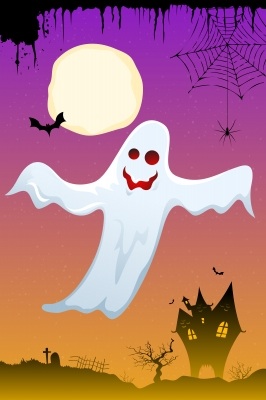
Show students images of each of the characters in the song — a witch on a broomstick, a ghost floating in the air, a bat flying in the air, an owl sitting in a tree, and a black cat creeping. Using visuals is important — especially for students learning English. This is an important first step in learning the vocabulary in the song.
Here’s a simple version of the song. (A more professional version is available below.) You can listen to the song while showing students these pictures.
Spoken: Let’s be witches and fly on our broomsticks.
Hee! Hee! Hee! I’m a witch!
Hee! Hee! Hee! I’m a witch!
Hee! Hee! Hee! I’m a witch!
Happy Halloween!
Spoken: Let’s be ghosts and float gently through the air.
Boo! Boo! I’m a ghost! (3X) Happy Halloween!
Spoken: Let’s be bats and fly through the night sky.
Eeek! Eeek! I’m a bat! (3X) Happy Halloween!
Spoken: Let’s be owls and turn our heads from side to side.
Whoo! Whooo! I’m an owl! (3X) Happy Halloween!
Spoken: Let’s be black cats. Put on your whiskers and sneak around.
Meow! Meow! I’m a black cat! (3X) Happy Halloween!
Now students can stand in a circle, move around the circle, or move freely around the classroom. Hold up pictures of each character. Before playing the music, I like to practice movements for each of the characters. You may want to share your own ideas. Just remember that if you demonstrate the movement first, your students are more likely to copy your ideas.
Here are some suggestions:
Witch: Students pretend to fly on broomsticks by holding their hands in front of their bodies and galloping.
Ghost: Students move their arms smoothly up and down, while walking in curvy pathways around the room.
Bat: Students pull their elbows in to create small wings. They move quickly around the room. My students also like to pretend they’re sleeping bats by folding their arms in and creating an upside-down pose.
Owl: Students stand in one place with their arms down. They turn their heads from side to side.
Black Cat: Students pretend to have whiskers, paws, and a tail. They sneak around with tiptoeing movements. I remind them to be “kind cats.”
Whenever students are moving in your classroom, check to make sure that everything is safe. Push chair legs in, and move things out of the way.
Now play the music! My students love moving freely about the room while they hear the cues. I remind them to stop after each character, and listen for the new cues. I hope that your students have as much fun as mine do with this song!
The professional version of “I’m a Witch” is available on iTunes and CDBaby. Just click on the title below:
Left image courtesy of digitalart / FreeDigitalPhotos.net. Right image courtesy of nuchylee / FreeDigitalPhotos.net.
Are your students getting ready for Halloween? Mine are! This song was inspired by the book “Where’s the Halloween Treat?” by Harriet Ziefert and Richard Brown (Putnam Juvenile). As you read the book to students, you can see children dressed in different costumes going trick-or-treating.
If you don’t have this wonderful book, you can hang pictures of Halloween friends around the classroom. In this song, we chose a ghost, a witch, a monster, a skeleton, and a black cat.
1) Have students sit in front of you. Ask students, What do you see? as they look around the classroom. They may be able to name some of the Halloween vocabulary words.
2) Point to one word, such as ghost. Say, I see a ghost.
Continue with the other Halloween friends in the same way.
3) Now teach the phrase Trick or Treat. You might explain the tradition of children going from house to house and getting treats from neighbors. When children ring the doorbell, they always say, Trick or Treat! We do this because It’s Halloween!
4) Students can sit as they sing the following song. Here’s a simple version of it. This is an original melody that’s easy to sing.
This song has also been recorded professionally and is available on iTunes on


 MagicTimeKids