Having Fun with Fortune Tellers!

When I was a little girl, we made “Fortune Tellers” to play with our friends.  We used our homemade fortune tellers to write messages about things that might happen when we grew up.

Your students will love this game.  It’s easy for students to put into their pockets and play wherever they go.  You can practice any vocabulary or grammar by adapting the game in this way.

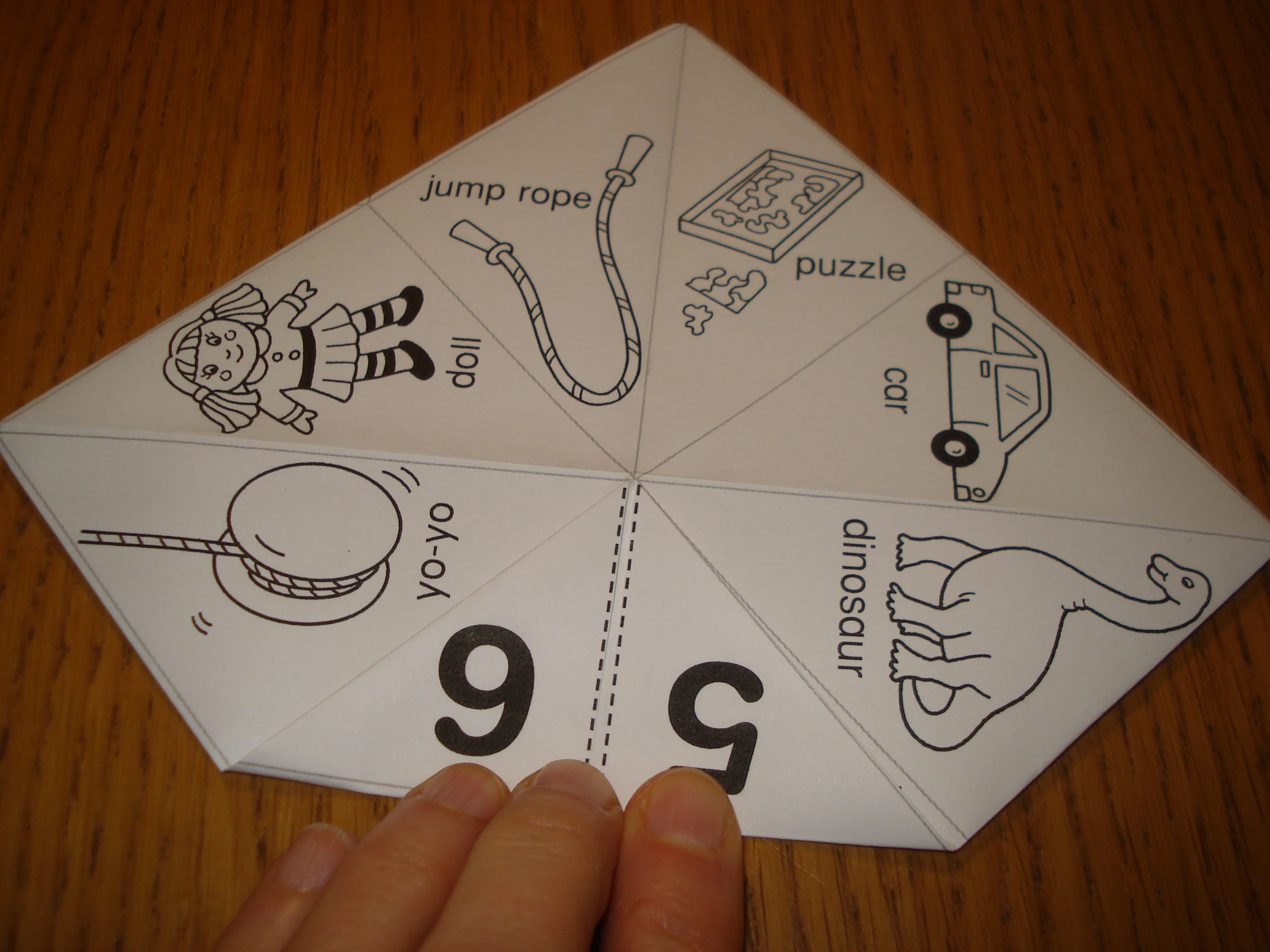
Here’s an example of a fortune teller from Magic Time 2, Unit 5, Teacher’s Book reproducible by Oxford University Press.  Once you understand how this fortune teller works, your students can create their own.  This unit focuses on toys with the phrase “I have a _________.”   They can expand it to “You have a ________.”

Download a free Fortune Teller template taken from Magic Time Teacher’s Book 2.

3.   Copy one sheet per student.  Students cut out on the dotted lines to create a square.

a.  To begin, have students fold the paper in half.

Open and fold in half the other way.  This makes folding easier. (See below.)

DSC00096

b.  Turn paper over.  Find the middle point.  Fold the corners to this middle point.  Crease well.

DSC00101

c.   Turn the paper over again.  Fold the new corners to the middle.

DSC00100

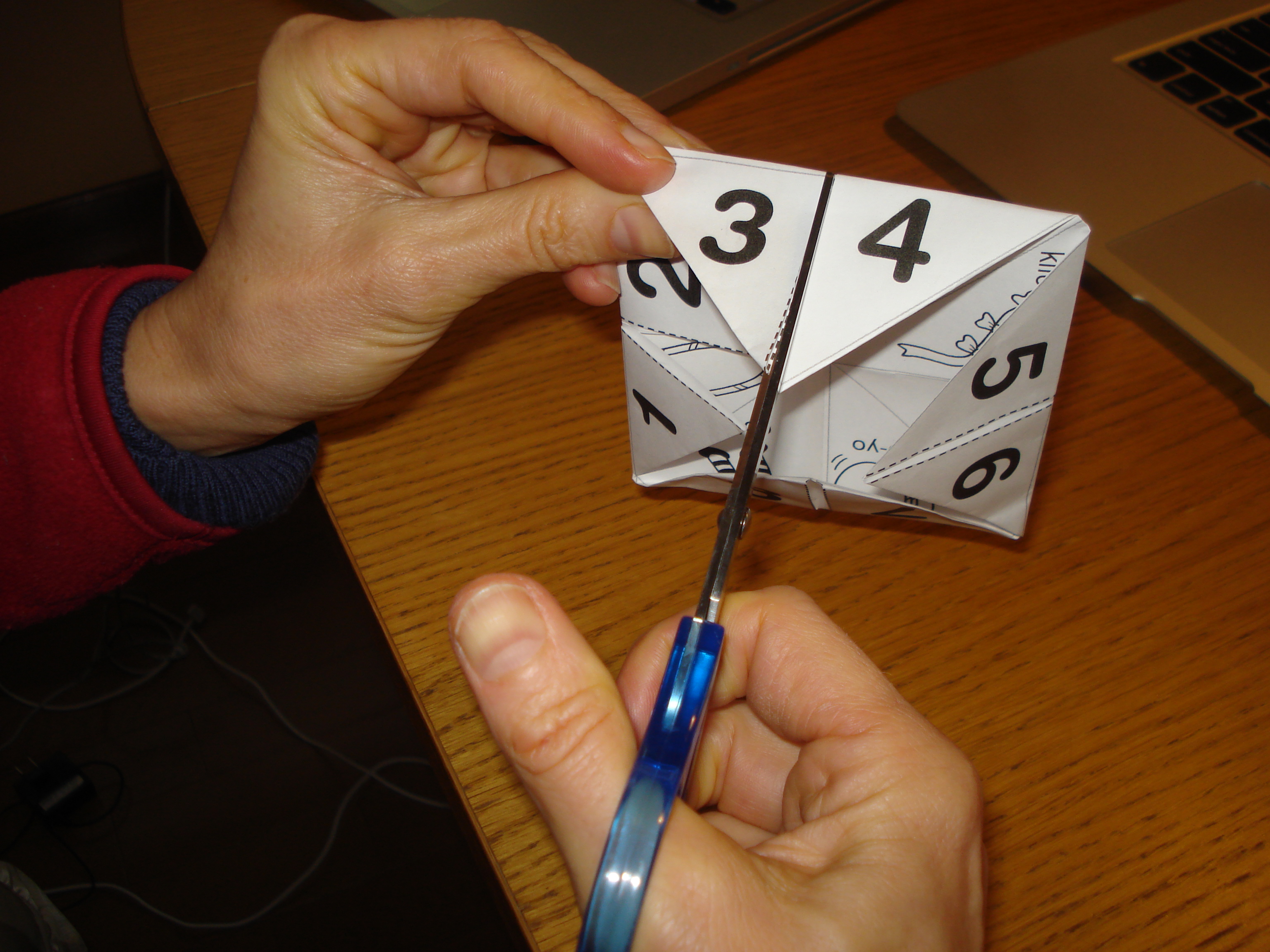
d.  Find the numbers.  Cut up from the point up to the fold between each of the numbers (1 and 2, 3 and 4, 5 and 6, 7 and 8).

DSC00102

e.  Now fold it in half so that you can put your thumbs and pointer fingers into the four openings at the bottom.

DSC00108

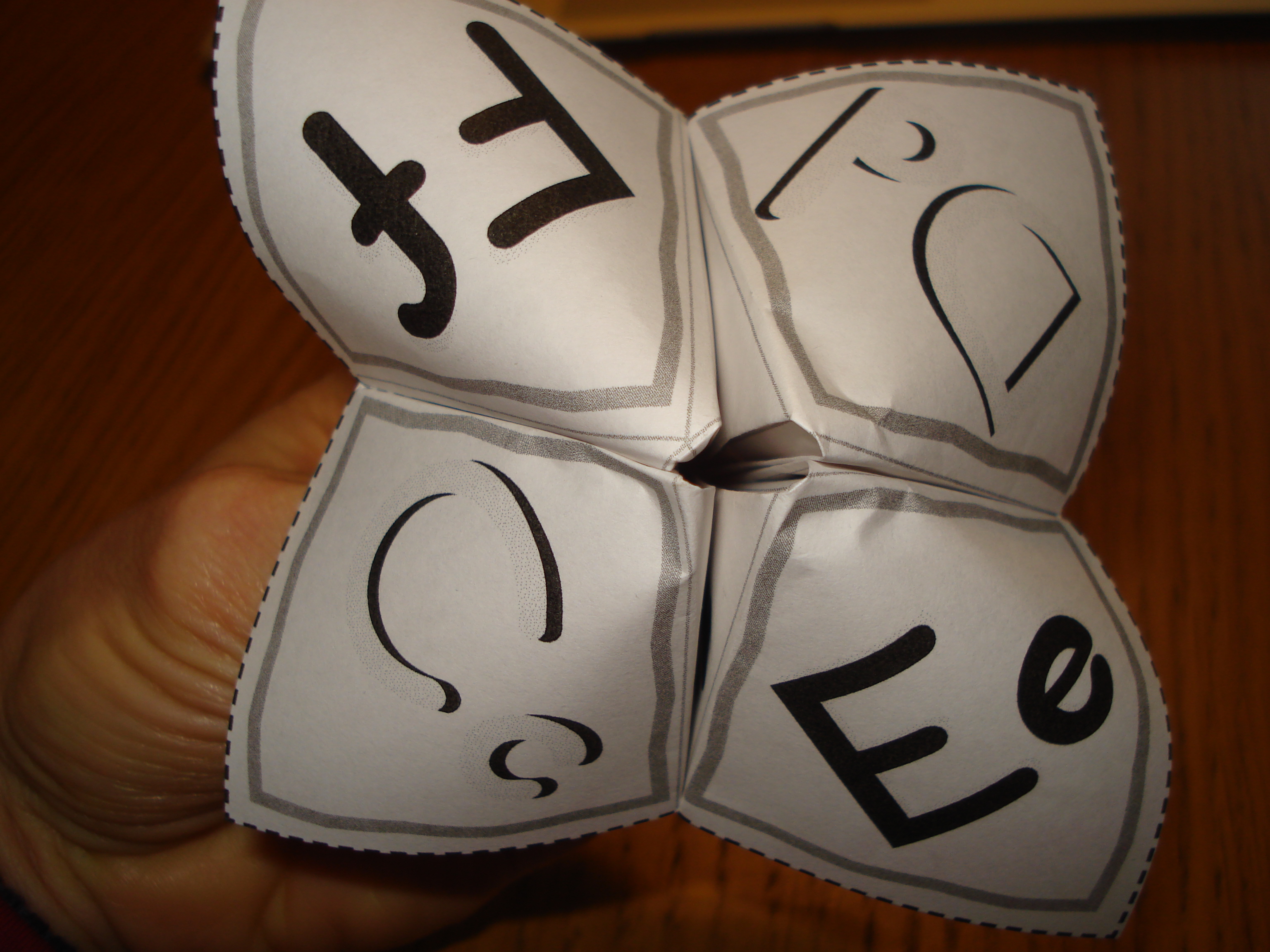
f.  Bring the points together.  Then open and close the fortune teller.

DSC00104

To play the game:

A:  Asks, “Which letter?”

B:  Says (for example), “C.”

A:  Moves the fortune teller three times, and says, “A-B-C.”

A:  Shows the inside of the fortune teller, and asks, “Which number?”

DSC00106

B:  Says (for example), “4.”

A:  Moves the fortune teller four times, counting to 4.

A:  Shows the inside of the fortune teller again, and asks, “Which number?”

B:  Says (for example), “7.”

DSC00111

A:  Says, “You have a yo-yo!”

With a little creativity, you can add more language to these dialogues.  With this fortune teller, students can imagine that they’re celebrating a birthday.

A:  “Happy Birthday. This toy is for you!  It’s a yo-yo!”

B:  “Thanks a lot!”

Or they can pretend to be Santa, saying “Ho, ho, ho! Merry Christmas.  Here’s a yo-yo for you!”

To make your own fortune teller, do your folding first.  Then open it up and add numbers, pictures, words, etc.  Instead of counting or saying the ABC’s, more advanced students can spell out words.

Keep me posted . . . I’d love to see how your creativity builds upon this idea in your classroom.

Happy Teaching!

Kathy

Celebrate Halloween as Marching Monsters . . . Boo!

Happy Halloween by digitalart

(Image courtesy of digitalart / FreeDigitalPhotos.net)

Do your students like to pretend to be different Halloween characters? Then “Marching Monsters” is a great new addition to your Halloween song repertoire! It encourages creativity and imagination, plus gives students great language practice with “alliteration.”

“Alliteration” happens when two or more words begin with the same sound. The phrase “marching monsters” has two words that begin with the sound /m/. Other phrases in the song include “skipping skeletons,” “waltzing witches,” and “jumping jack-o-lanterns.” Children love to sing these fun phrases while doing the actions throughout the song. They also learn the song quickly because of the repeated phrases.

Here is a simple recording of the song. A FUN professional version is available on iTunes here (just click on Track #11).

Here are the lyrics, plus notes on how to teach it!

Marching Monsters

Words and music by Kathleen Kampa and Charles Vilina

copyright © 2013 by Kathleen Kampa

1. Marching monsters!  Happy Halloween!  Boo!

Marching monsters!  Happy Halloween!  Boo!

Marching monsters,

Turn around and stop! (hold)

Marching monsters!  Happy Halloween!  Boo!

2. Skipping skeletons!  Happy Halloween!  Boo! . . .

3. Waltzing witches!  Happy Halloween!  Boo! . . . .

4. Jumping jack-o-lanterns!  Happy Halloween!  Boo! . . . .

Students can move around a circle or freely around the classroom.

1. On Marching Monsters, students march around, pretending to be monsters. On Turn around and stop, students turn around and make a pose. They hold until the music begins again.

2. On Skipping Skeletons, students skip around, moving their arms like a skeleton. For very young learners, children can gallop, or they can slide sideways.

3. On Waltzing Witches, students dance in one place. If you’re in a circle, face the center. Students sway from side to side moving their arms.

4. On Jumping Jack-o-lanterns, students jump in one place, making the shape of a jack-o-lantern.

Enjoy this wonderful song and dance activity with your students!

Once again, you can find the professional version of this song on

Kathy Kampa’s Special Days and Holidays, available on iTunes.

Happy Teaching!

Kathy and Chuck

Let’s Pretend for Halloween–Time for Witches, Black Cats, and More!

Shannon

Brooke and Shannon

My nieces like to dress up as black cats for Halloween.

I love Halloween! It’s a time of year when students can enjoy expressing their ideas. They’re encouraged to use their imaginations and can pretend to be many different characters.

How can your students use their imaginations?

First, you can encourage students to create movements like Halloween characters. For example, students can make a pose while sitting. Then, they can do movements around a circle. Finally, you can let them move freely around an open space. For shy students, demonstrate some simple ideas. Soon they’ll be creating their own ideas.

Students can also use their imaginations with costumes or props. With a scarf, a student can turn into a prince or princess, ride a witch’s broomstick, or become a spooky ghost. Pieces of fabric can be used over and over again and made into various costumes. Show students photos of children dressed up to go trick-or-treating. Although many companies sell fancy costumes, I have fond memories of creating costumes from things we had around the house.

Here’s a Halloween song I wrote entitled “I’m A Witch.” It prompts students to imagine that they’re different Halloween characters. To teach this song, sit with students in front of you.

(Use the transitional song:  Come and sit in front of me . . .)

Show students images of each of the characters in the song — a witch on a broomstick, a ghost floating in the air, a bat flying in the air, an owl sitting in a tree, and a black cat creeping. Using visuals is important — especially for students learning English. This is an important first step in learning the vocabulary in the song.

Here’s a simple version of the song. (A more professional version is available below.) You can listen to the song while showing students these pictures.

Here are the lyrics if you want to sing along.

I’m A Witch

Words by Kathleen Kampa and Charles Vilina

copyright © 2013 by Kathleen Kampa

Music: Skip to my Lou

(Available on iTunes on Kathy Kampa’s Special Days and Holidays — see Track #10)

Spoken: Let’s be witches and fly on our broomsticks.

Hee! Hee! Hee! I’m a witch!

Hee! Hee! Hee! I’m a witch!

Hee! Hee! Hee! I’m a witch!

Happy Halloween!

Spoken: Let’s be ghosts and float gently through the air.

Boo! Boo! I’m a ghost! (3X) Happy Halloween!

Spoken: Let’s be bats and fly through the night sky.

Eeek! Eeek! I’m a bat! (3X) Happy Halloween!

Spoken: Let’s be owls and turn our heads from side to side.

Whoo! Whooo! I’m an owl! (3X) Happy Halloween!

Spoken: Let’s be black cats. Put on your whiskers and sneak around.

Meow! Meow! I’m a black cat! (3X) Happy Halloween!

Now students can stand in a circle, move around the circle, or move freely around the classroom. Hold up pictures of each character. Before playing the music, I like to practice movements for each of the characters. You may want to share your own ideas. Just remember that if you demonstrate the movement first, your students are more likely to copy your ideas.

Here are some suggestions:

Witch: Students pretend to fly on broomsticks by holding their hands in front of their bodies and galloping.

Ghost: Students move their arms smoothly up and down, while walking in curvy pathways around the room.

Bat: Students pull their elbows in to create small wings. They move quickly around the room. My students also like to pretend they’re sleeping bats by folding their arms in and creating an upside-down pose.

Owl: Students stand in one place with their arms down. They turn their heads from side to side.

Black Cat: Students pretend to have whiskers, paws, and a tail. They sneak around with tiptoeing movements. I remind them to be “kind cats.”

Whenever students are moving in your classroom, check to make sure that everything is safe. Push chair legs in, and move things out of the way.

Now play the music! My students love moving freely about the room while they hear the cues. I remind them to stop after each character, and listen for the new cues. I hope that your students have as much fun as mine do with this song!

The professional version of “I’m a Witch” is available on iTunes and CDBaby. Just click on the title below:

 Kathy Kampa’s Special Days and Holidays (Click on Track #10)

Happy Halloween and Happy Teaching!

Kathy and Chuck

Enjoy Trick or Treating in your Classroom with “Trick or Treat”

%22Halloween Ghost%22 by digitalart

%22Halloween Word%22 by nuchylee

Left image courtesy of digitalart / FreeDigitalPhotos.net. Right image courtesy of nuchylee / FreeDigitalPhotos.net.

Are your students getting ready for Halloween? Mine are!  This song was inspired by the book “Where’s the Halloween Treat?” by Harriet Ziefert and Richard Brown (Putnam Juvenile).  As you read the book to students, you can see children dressed in different costumes going trick-or-treating.

If you don’t have this wonderful book, you can hang pictures of Halloween friends around the classroom.  In this song, we chose a ghost, a witch, a monster, a skeleton, and a black cat.

1) Have students sit in front of you. Ask students, What do you see?  as they look around the classroom.  They may be able to name some of the Halloween vocabulary words.

2) Point to one word, such as ghost.  Say, I see a ghost.

Continue with the other Halloween friends in the same way.

3) Now teach the phrase Trick or Treat.  You might explain the tradition of children going from house to house and getting treats from neighbors.  When children ring the doorbell, they always say, Trick or Treat!  We do this because It’s Halloween!

 4)  Students can sit as they sing the following song. Here’s a simple version of it. This is an original melody that’s easy to sing.

This song has also been recorded professionally and is available on iTunes on

Kathy Kampa’s Special Days and Holidays.  (click on the title, then on Track #8)

 -Pat your legs on the chorus, Trick or treat . . . .

-When you hear It’s Halloween put your arms up like you’re saying Hooray!

-When you hear each of the characters (such as I see a ghost), point to each one in the classroom, or in your book.

-When you hear Oooooh, wave your arms in a spooky way.

Here are the lyrics:

Trick or Treat

Words and music by Kathleen Kampa and Charles Vilina

copyright © 2013 by Kathleen Kampa

 Chorus:

Trick or treat! ch-ch-ch  Trick or treat! ch-ch-ch

It’s Halloween!  Say “Trick or treat!”  ch-ch-ch

Trick or treat! ch-ch-ch  Trick or treat! ch-ch-ch

It’s Halloween!  Say “Trick or treat!”   ch-ch-ch

 Verse:

I see a ghost!

I see a ghost!

Ooooooooooooooh!

Sing again with Halloween characters: witch, monster, skeleton, black cat

5)  Now your students are ready to stand up and move to the song!

Make a circle.  Practice a movement standing in one spot for each Halloween friend.

Here are some suggestions; however, using your own imagination is even better!  Your students will certainly have some interesting ideas!

For the ghost, you might move your arms like you’re floating.

For the witch, you might pretend to make some witch’s brew or cast a spell.

For the monster, you might make scary arms and stomp in place.

For the skeleton, you can move your elbows up and down.

For the black cat, you can creep in place.

On the chorus, Trick or Treat . . . march around the circle.

On It’s Halloween, put your arms up in the air as you continue marching.

On each of the verses (such as I see a ghost), stop in one place and turn into that character.

On Oooh, do spooky arm movements.  You might even want to turn around.

Then begin marching again around the circle.

6) Later, have your students draw their favorite Halloween friends and post them around the classroom.

My students really love this song because it’s a lot of fun.  As a teacher, though, I like to make sure my lessons cover valuable concepts.

This teaches young learners:

a.  simple phrases, especially for EFL / EAL students –

It’s Halloween!  Trick or Treat!  I see a ____.

b.  how to control their movements, by moving around the circle and stopping in one place

c.  movements, such as marching, that go from one place to another

d.  how to express their own ideas and inspire their creativity

e.  patterns (chorus / verse pattern)

We hope that your students enjoy singing and dancing throughout the month of October.  Happy teaching!

Kathy

“The Apple in the Tree” : Storytelling that builds phonics and listening skills!

%22Elefante%22 by Idea go

“Elefante” courtesy of Idea go / FreeDigitalPhotos.net

As teachers of young learners, we know that phonics is an important part of our curriculum.  How can we teach phonics in a way that gets children excited to learn?

 The following activity is one of our favorites!  Here’s how it’s done:

1.  Begin by showing your students the following words illustrated with colorful pictures. These six vocabulary words are part of our Magic Time series (Magic Time One, Spring ABC’s).  If you teach Magic Time, use the picture cards for that lesson. If not, make your own picture cards, placing the upper and lower case letters above the picture that begins with that sound. Attach them to your whiteboard or blackboard. You can also use items such as stuffed animals, puppets, plastic fruit, etc.  The Internet also has pictures available.

Aa   apple

Bb   bear

Cc   cat

Dd   dog

Ee   elephant

Ff    fish

2.  For each picture card, teach the letter name (optional), the letter sound, and the word that begins with it.  For example:  “A / a / apple,” and so on.  Continue until students are familiar with the six words and the sounds they begin with.  Students can also make apple shapes, or explore the movements these animals make.

3.  Draw a simple apple tree on the board, with one big apple high up on a branch of the tree.

4.  Next, read the following story to your students.  As the six words above are introduced in the story, point to their pictures on the board.  You may want to tell the story more than once as you say the words slowly and clearly.

The Apple in the Tree

by Kathy Kampa and Chuck Vilina

copyright © 2013 by Kathleen Kampa and Charles Vilina

Once upon a time, there was a very hungry elephant.  She was looking for something to eat.  Suddenly, she saw an apple tree with a big red apple on it.  She reached for the apple with her trunk.  Oh, no!  It was too high up in the tree.

Along came a bear.  “Climb up on my back,” said the elephant, “and you can get the apple.”  So the bear climbed up on the elephant’s back, and reached for the apple.  Oh, no!  It was too high up in the tree.

Along came a dog.  “Climb up on my back,” said the bear, “and you can get the apple.”  So the dog climbed up on the bear’s back, and reached for the apple.  Oh, no!  It was too high up in the tree.

Along came a cat.  “Climb up on my back,” said the dog, “and you can get the apple.”  So the cat climbed up on the dog’s back, and reached for the apple.  Oh, no!  It was too high up in the tree.

The elephant, the bear, the dog, and the cat looked at the apple.  It was such a big, red apple!  Oh, how they wanted to eat that apple!

Suddenly, a little fish jumped out of the water — up, up, up!  It grabbed the apple in its mouth, and went back under the water. “Thank you,” said the fish.  “I just LOVE apples!”

__________________________________________

Children love this story.  And NOW they’ll have an opportunity to MOVE to it.  Do you notice the underlined words in the story?  They are the six target words, used this many times:

apple:              14 times

bear:                  5 times

cat:                    3 times

dog:                   5 times

elephant:           4 times

fish:                   2 times

This brings us to the next step in the activity:

5.  Prepare one small picture card for each child, using the six target words above.  You can even let children draw their favorite picture (from the above group) on a piece of paper and use that.  However, the cards should be evenly mixed if possible.  For example, if you have six students, each one should get a different letter picture card.  If you have more than six students, add more cards, so that more than one student will have the same word card.

6.  Have your students place their chairs in a circle, facing out.  If space is a problem, the chairs can be put in two rows with their backs to each other.  Students sit quietly in their chairs.  At this time, give each student a picture card (unless they drew their own, in which case they should be holding them).

7.  Explain to students that you are going to tell the story again.  When a student hears the word on their picture card, they GET UP QUICKLY and run around the circle of chairs, then sit back down in their own chair.  They must do this EVERY TIME they hear their word.

8.  NOW – tell the story SLOWLY.  Watch as your children jump up out of their seats and run around the circle.  As you can see from the words above, the “apple” holders have to run around the circle 14 times!  The “fish” holders only run around 2 times.

Of course, to make it more fair, mix up the cards after the story, hand them out again, and tell the story again!  This gives each child more chances to run around the circle.

This activity has many Multiple Intelligence strategies rolled into one:  It’s Word Smart (using written and spoken words), Picture Smart (using pictures), Body Smart (moving quickly in a circle), People Smart (listening and responding together), Self Smart (drawing their own picture cards), and Nature Smart (showing the relationship between the animals according to size).

Most importantly, it builds strong listening skills as it reinforces letter sounds.

You can follow up this activity with an art project:  students can draw a funny picture with all the animals standing on top of each other, with the fish jumping up to grab the apple!

You can also write similar stories using other letters from the alphabet.  Be creative!  In fact, your students may help you write the story!

Let us know how your students enjoy this activity!  Happy Teaching!

Kathy and Chuck