
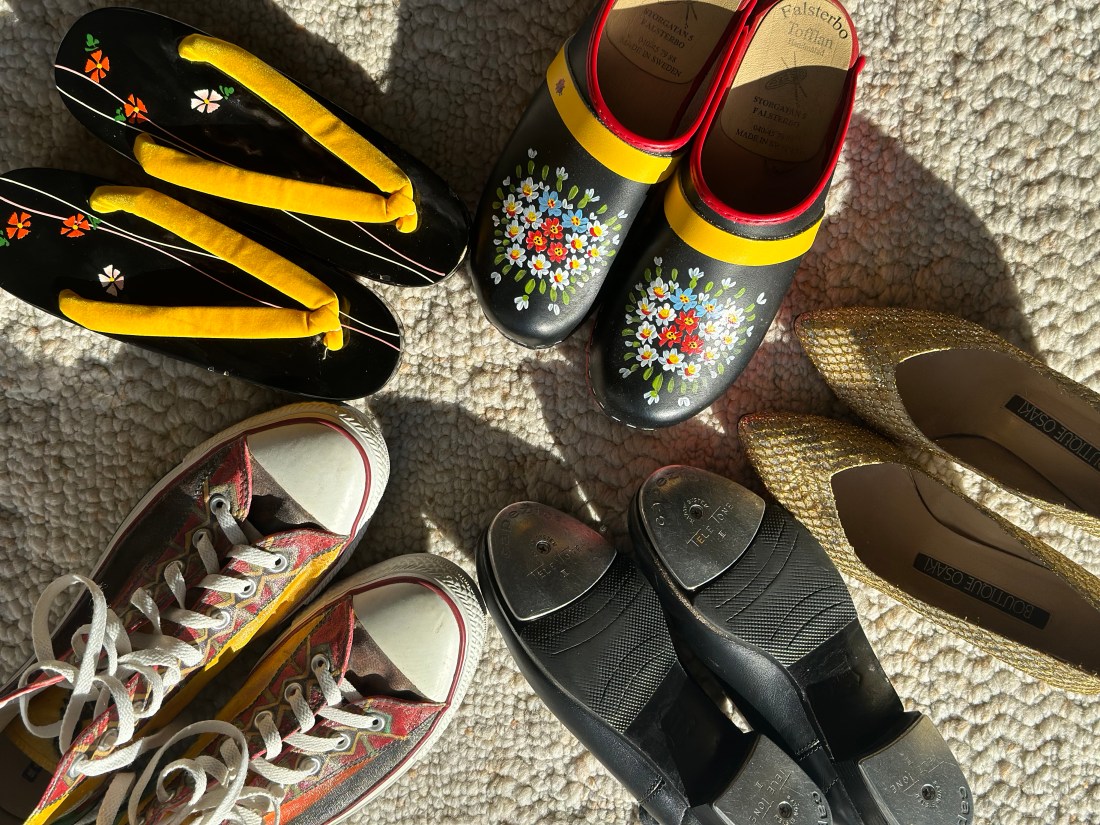
What kinds of shoes do you have in your closet? Well, I have some unique shoes. Take a look!

When I brought these shoes to young learners’ classes, they wondered where they came from and searched for the country on our big rug map. I shared stories of the places I had traveled to.
In the Shoemaker’s Dance by the Shenanigans, it’s fun for children to imagine many kinds of shoes. What kind of shoes would you like to wear? I begin by suggesting something like popcorn shoes. I show picture cards, such as the images below from Magic Time (OUP), or realia of the items.
These are the questions I ask:
What do we know about popcorn?
What do you think popcorn shoes would look like?
How would you move in them?
For example, popcorn has round edges. It surprises us when it pops. It’s light and bouncy. So, popcorn shoes might have soft, smooth edges. When you put them on, you might jump or hop.
How about rainbow shoes? What do we know about rainbows? We know that rainbows are colorful–red, orange, yellow, green, blue, indigo, and violet. Rainbow shoes will be filled with color. When you put them on, you might leap or find pots of leprechaun gold.
How about dinosaur shoes? What do we know about dinosaurs? Most dinosaurs are really big and powerful. When you put dinosaur shoes on, you might powerfully stomp your feet.
Butterfly shoes? They might have delicate wings. When you put them on, you can fly (well, we have to pretend!)
Spaghetti shoes? They might have lots of wiggly lines. When you put them on, you start to wiggle all over.
Puzzle shoes? They might have straight and curvy lines. When you put them on, your feet jump apart and together.
Birthday cake shoes? We may have to mix up the batter and add sprinkles. When you put them on, you might want to skip or dance. It’s your special day!
Unicorn shoes–a favorite of almost every class! They might have lots of beautiful colors. When you put them on, you gallop and soar in the sky.
Well, anything is possible.
Pokemon shoes, race car shoes, pizza shoes, donut shoes, princess shoes, leprechaun shoes, star shoes, rocket shoes . . . .
I like to “play” with a lot of different ideas first. We explore Then children may want to choose one idea and draw their designs. They have a clearer image of what the shoes might look like and how they might move in them. Here are a few of my students’ shoe ideas from a recent program at Children’s Day Montessori.

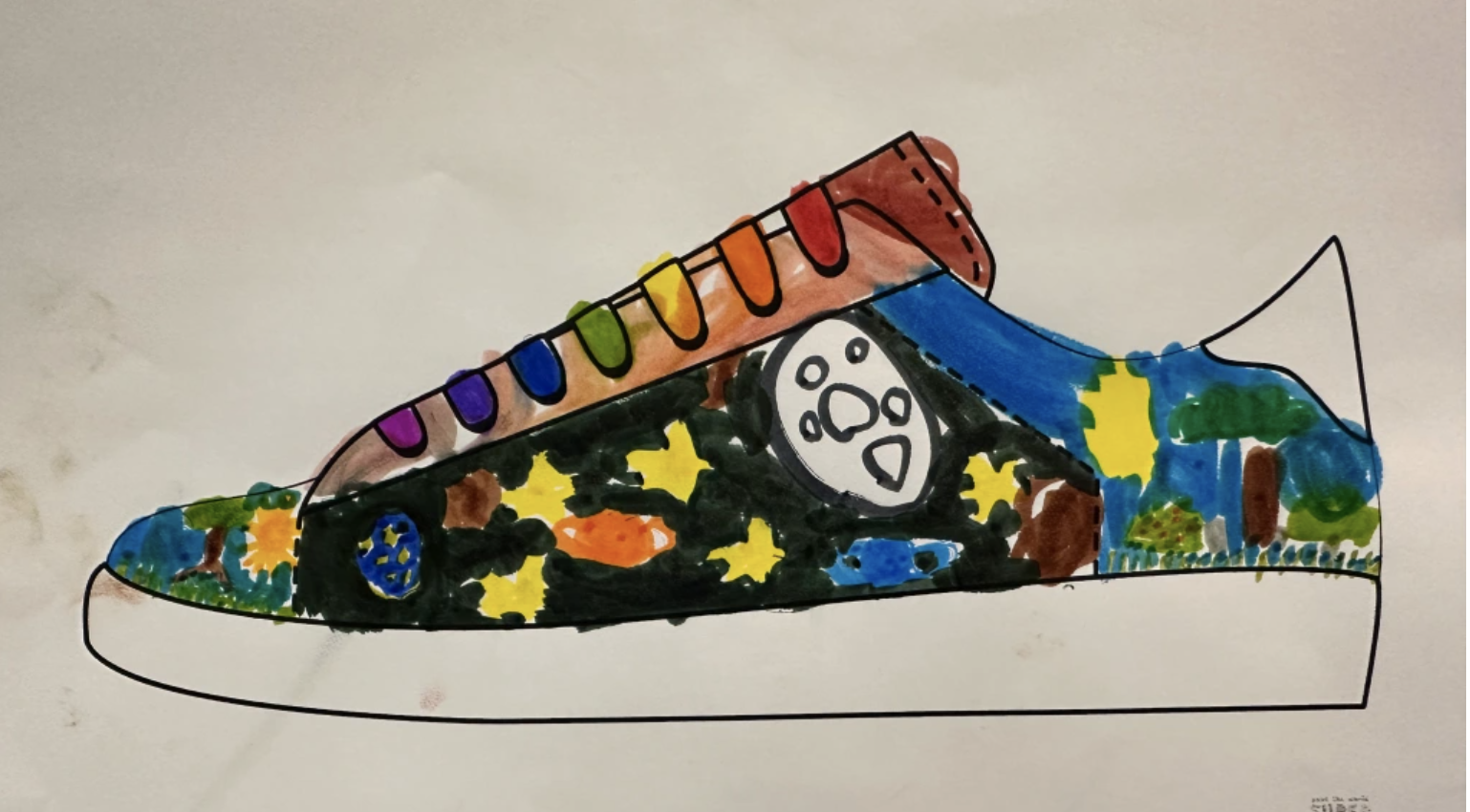
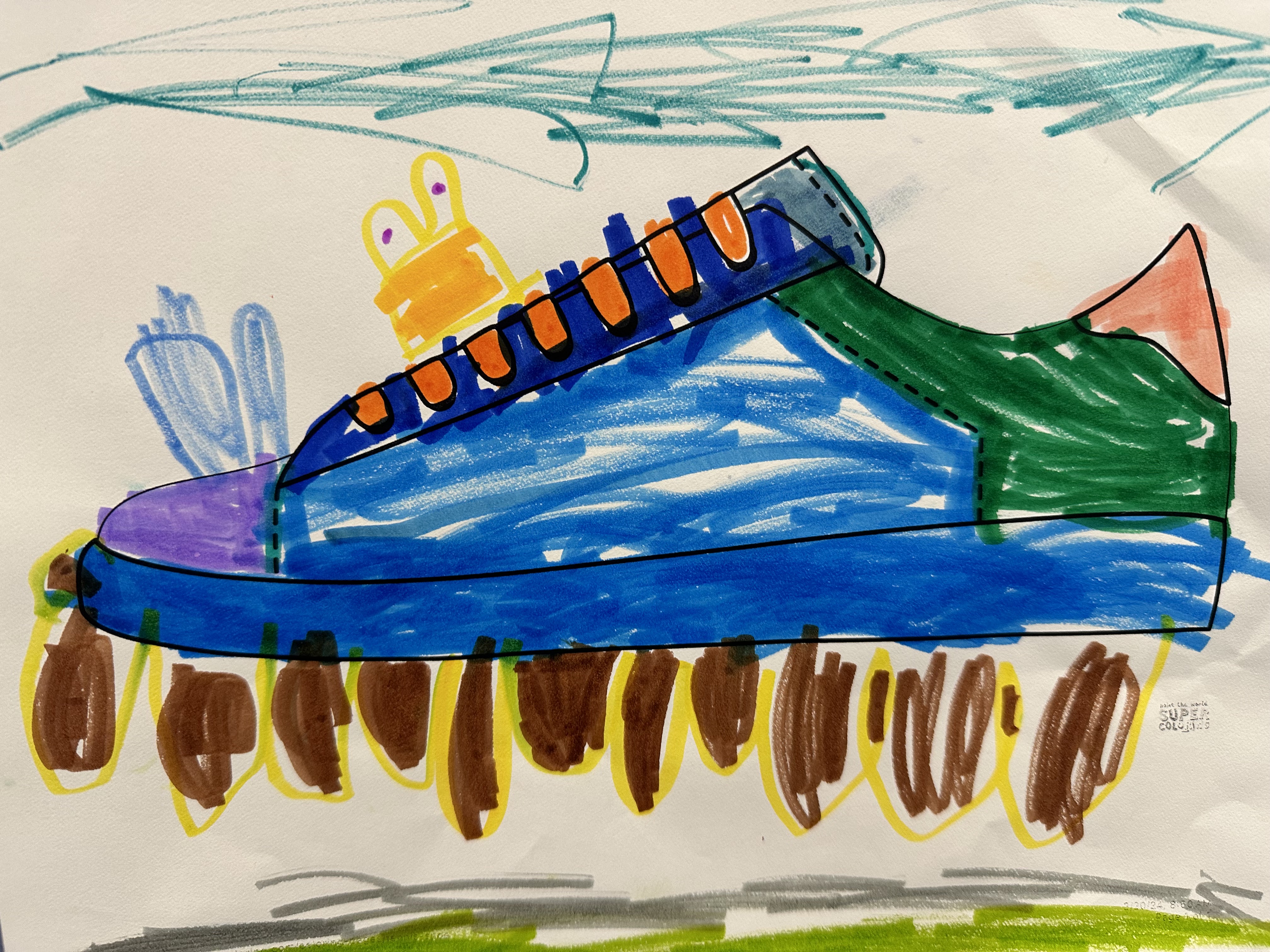
Here’s the folk dance! Folk dances are so important to young learners’ education. Here’s what I’ve noticed.
-Children learn to work together in a group.
-They move their bodies in time to the music.
-They follow the musical form or the pattern. This one is ABC.
-They visualize the movement patterns in their heads. In this one children move around a circle or away from and back to their own space.
-They hear repeated language in the song. They describe their own ideas, too.
-The more children repeat the pattern, the more confident they grow.
-They’re happy!
This dance is by the Shenanigans on their album, Dances of Terra del Zur, Vol. 1. or Dance Music for Children, Level 1.
In Part A, children pretend to make shoes. They might pretend to paint, sew, pound, or make a shape. When we first do this, we all make the same idea, such as Dinosaur shoes.

In Part B, children do a little clapping or pounding pattern. I say, (ti-ti ta)
This happens eight times. If I’m making the dinosaur shoes, I might make a LOUD sound. If I’m making butterfly shoes, I might make a quiet sound.
In Part C, children pretend to dance around the space in their pretend shoes. I like to have the children move around a circle. Once they’re comfortable in their space, they can move freely and come back to their spot.
The three shoes I’ve chosen are:
Popcorn Shoes
Rainbow Shoes
Dinosaur Shoes
At the end, the children pretend to clean up.

Here’s a video of the Shoemaker’s dance.
If you’re looking for more songs for children to “move and groove to,” check out this Spotify playlist.

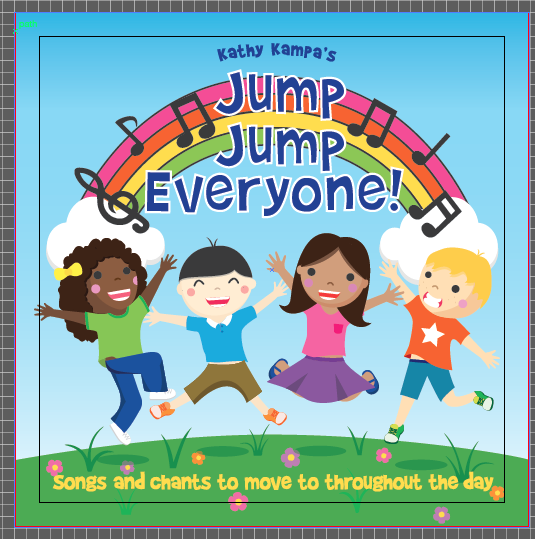
Songwriter and educator Kathy Kampa seeks to nurture children’s imaginations and spark creativity through fun and engaging activities. Kathy believes that music and movement should be a part of every young child’s education. Kathy’s songs for kids (Kathy Kampa’s Special Days and Holidays and Jump Jump Everyone) are available on iTunes.
Kathy has taught children in a Montessori/PYP school in Tokyo, Japan as well as in the United States. She uses a globally-minded and inquiry-based approach to teaching through which students develop 21st-century skills. She also supports the development of English language skills by creating songs, chants, and TPR/movement activities targeted to young learners’ needs. Kathy is an author and teacher-trainer with Oxford University Press.
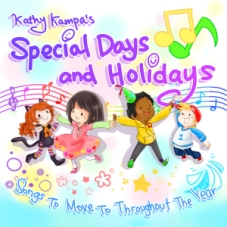
Kathy Kampa’s Special Days and Holidays CD are filled with songs to celebrate special days in a child’s life–birthdays, a loose tooth, and lots of holidays. In addition, there are 23 engaging songs for kids on Kathy Kampa’s Jump Jump Everyone. It’s filled with movement songs, classroom management songs, and CLIL/content songs. These activities support English language development while developing global skills. Your young learners will love them!
These two CDs each include a handy attached booklet with lyrics and are available for teachers in Japan at ETJ Book Service. The songs are available for download through iTunes or on streaming services, such as Spotify or Amazon Music.
If you’re interested in learning more about creativity, check out this blog called “The Creativity Post.

 MagicTimeKids