Skeleton Dance is definitely one of my students’ favorite songs! It teaches various body parts and directional movements. You can start your school day with it, use it during break time, dance it on a rainy day, move during a health unit, or dance it on Halloween. I have taught Skeleton Dance to students in kindergarten through upper elementary, and everyone enjoys it. I’ve also shared this song with teachers in America, Japan, Korea, Mexico, Taiwan, Thailand, Vietnam, and Indonesia.
You can watch some of my students here in Japan doing the Skeleton Dance, and read the lyrics below:
Here’s how you do the Skeleton Dance:
In this song, students will move four different body parts: shoulders, elbows, knees, and feet.
First, students move their shoulders to the beat.
1. Move your shoulders . . .
A. Skeleton, skeleton, skeleton dance, Move your shoulders, do the skeleton dance. Skeleton, skeleton, skeleton dance, Move your shoulders, do the skeleton dance.
Next, students move their whole bodies to the front, to the back, and to the side. I usually start by moving only my arms, but my students love to jump in each direction.
B. To the front, to the back, to the side, side, side, To the front, to the back, to the side, side, side,
Next, students move their shoulders up, down, and around. Each time they repeat the song, they will move a different body part in these directions.
C. Put your shoulders up. Put your shoulders down. Move them up and down and all around. Put your shoulders up. Put your shoulders down. Move them up and down and all around.
Finally, students move their shoulders in their own way.
This dance is repeated with the following body parts.
Before I play the music, my students and I figure out how we’ll move up, down, and around using each of these body parts.
2. Move your elbows . . .
3. Move your knees . . .
4. Move your feet . . .
You can download this song from iTunes (Track #15) or CD Baby.
I hope that your students enjoy this as much as mine do.
While our summer was filled with many opportunities to enjoy the nature of Minnesota, it was also a busy time of successfully completing my MA degree. Now we have time to share many more ideas with you!
On our second day back at school, my Grade One students found a giant grasshopper outside of our classroom. It was as big as a praying mantis. We took it into our classroom. What an exciting way to begin our new school year!
Giant grasshopper
Children are fascinated with living creatures–especially insects and other mini-beasts. While some children may be a bit timid about holding certain insects, most seem to enjoy them.
Here are a couple of activities that you can easily do in your classroom.
1.Simple, Invented Songs
It’s easy to nurture creativity in young learners through music. Try “playing” with words.
Here’s a simple pattern to create a song or chant.
Students choose three insects for their song, usually one shorter word, and two longer words.
When young children sing, they often use so and mi in their invented songs. You can use so and mi for this song, too.
My students think it’s funny to sing the negative form of this. I don’t like ______. I hate bugs!
Another activity to help students play with words is to repeat the first consonant of a word, such as /b/ /b/ /b/ /b/ Bees! Bees!
2. Stories
I love using stories with my students–especially predictable ones. A predictable story uses repetition, similar to the way a song might have a chorus. It might have repeated words, phrases, sentences, and other patterns. New characters, new events, and other surprises keep the children guessing about what’s going to happen next.
Story: The Very Busy Spider by Eric Carle
This story shows how a spider gradually spins a web. In my edition of this book, students can also feel the change in the web as it gets bigger. You can read the book to your students in a traditional manner, but you can use the pictures in the book like flash cards to help you tell the story.
A. Pre-read by looking at the pictures of the animals in the book. You can chant this pattern, or sing it to the melody of “The Farmer in the Dell.”
The horse says “Neigh!” The horse says “Neigh!” Let’s play together. “Neigh! Neigh! Neigh!”
Many animals visit the spider, but the spider continues to spin the web.
Repeat with the other animals from the story (cow, sheep, goat, pig, dog, duck, rooster).
The cow says “Moo!” The cow says “Moo!” Let’s play together. “Moo! Moo! Moo!”
The phrase for the rooster is longer than the rest.
“Cock-a-doodle-doo!” “Cock-a-doodle-doo!” Let’s play together. “Cock-a-doodle-doo!”
B. Now add the following chant pattern.
(But the spider said . . . ) Sorry. I’m busy. I’m spinning a web. Busy, busy, busy. I’m spinning a web.
Add gestures to help children remember the language. Change your voice to express the sounds of the animals.
C. Now I “read” the story by showing the children the pictures of the animals and singing the animal songs. I show students the web in the book. With a small class, students can feel the texture of the web on the page. On subsequent readings, you can draw the web on a whiteboard as the story progresses by drawing a couple of lines at a time. If your students can sit in a circle, you can even create a yarn web by passing a ball of yarn from one student to one across on the other side.
D. At the very end, an owl comes and the spider is sleeping.
Whisper . . . .
The spider was busy, but she’s sleeping now. Sh! Sh! Be quiet! She’s sleeping now.
*Another fun predictable story with insects and animals is Lily and the Moon by Mari Nakamura and Patricia Daly Oe.
3. Find It!
You can look for insects outside with your students. You can also find them in books! In Magic Time One, Unit One, Annie and Ted are outside playing. In addition to finding the target vocabulary, students can look for animals and insects on these pages too. They can find a dragonfly, grasshopper, rabbit, turtle, frog, squirrel, bird, butterfly, and caterpillar. We love to add little surprises for the students to discover.
Enjoy this season of insects and mini-beasts! Happy teaching!
Can you nurture creativity while building English language skills? Yes, you can!
An important part of creative thinking is to generate many possible solutions. This is easy to do with young learners. Here is a simple activity and chant that you can use to help develop creative and imaginative thinking with your young learners.
Introducing Vocabulary
1. Show students (or draw) a picture of a circle. Say, What is this? Can you make this shape with your fingers?
2. Point out the various ways that your students are making circles. For example:
Yuri is making a tiny circle using her thumb and pointer finger. Can you do that?
Daniel is using all of his fingers to make a circle. Let’s try that, too! We can make circles in many ways.
3. Say, Can you make your circle bigger? Can you make a circle with a friend?
4. Repeat the three steps above using other shapes. I usually show shapes in the following order because some are a little easier to make than others.
circle
triangle
heart
rectangle (two long sides, and two short sides)
square (four equal sides)
star (five points)
Remember, it’s important to take time making these shapes with your students before putting them into the chant.
My fingers, fingers, fingers, fingers, fingers dance!
My fingers, fingers, fingers, fingers, fingers dance!
Make a circle. Take a picture. Click!
Make a circle. Take a picture. Click!
Now, let me break it down so that you know the movement for each part.
1. My fingers, fingers, fingers, fingers, fingers dance!
My fingers, fingers, fingers, fingers, fingers dance!
(For this part, students have fun wiggling or “dancing” their fingers.)
2. Make a circle.
(Students make the shape with their fingers.)
3. Take a picture. Click!
(Students look through the shape at a classmate, and pretend to take a photo.)
(Repeat steps 2 and 3.)
(Students then substitute the other shapes in this chant.)
You can use any shape picture cards to teach the vocabulary. I used the picture cards from Magic Time 1, Unit Two, for my video. Feel free to add your own shape ideas, such as diamonds, ovals, etc.
Here’s a video I’ve prepared to show you how the chant is done. Just click here. You can also find a studio version of this chant on iTunes by clicking here.
This chant is also on my new album Jump Jump Everyone, available on iTunes. Physical CDs are also available.
(Note: This is our second blog post on transitional songs. Our first blog post, entitled “Transitional Songs Part One,” was posted on September 23, 2013. Please scroll down this page to our earlier blog posts to find it, or simply click here. Thanks!)
In any children’s class, many activities are needed to keep students happy and motivated throughout the lesson. Transitional songs are a perfect way to signal to children that one activity is ending and another is beginning. A good transitional song also has other benefits:
It supports the natural rhythm and intonation of the phrase or sentence you are using.
The melody is quickly learned and recognized by students, so they move into action as soon as they hear it.
In most cases, children can be encouraged to sing along, building group cohesion as well as productive language skills.
Transitional songs soon become part of a classroom routine, giving students a sense of structure and making them feel secure during the lesson.
Today, for Part Two, we present a variety of transitional songs that help to make activities smooth and enjoyable for students.
1. Open Your Books
This song is a great way to motivate students to open their student books to the correct page.
Open your books. Please open your books. (gesture)
(Spoken) Turn to page _________.
(Write this page number on the board, or show the number with your fingers. Hold the book open to show the page to students, then check to be sure all students are ready.)
Open your books.
2. Let’s Make a Line
This transitional song quickly motivates children to form a line in the classroom, either for an activity or when they are preparing to leave the classroom.
This is a great chant to use when students need to find a partner. Demonstrate this chant with one student first. Decide how students will show that they are partners. They can stand back-to-back, touch palms, sit facing each other knee-to-knee, etc.
Practice finding partners before you actually do your activity.
(Note: The following transitional songs can be found on our blog post entitled “Transitional Songs, Part One.” Please scroll down to our earlier blog posts to find these songs and the recordings for them, or simply click here.)
Today we’d like to talk about the “many ways to learn” that are available to us through the theory of Multiple Intelligences (what we will refer to as MI).
This theory was proposed by Dr. Howard Gardner of Harvard University in 1983. Dr. Gardner proposed that there was not just ONE intelligence that we could measure in people, but MANY.
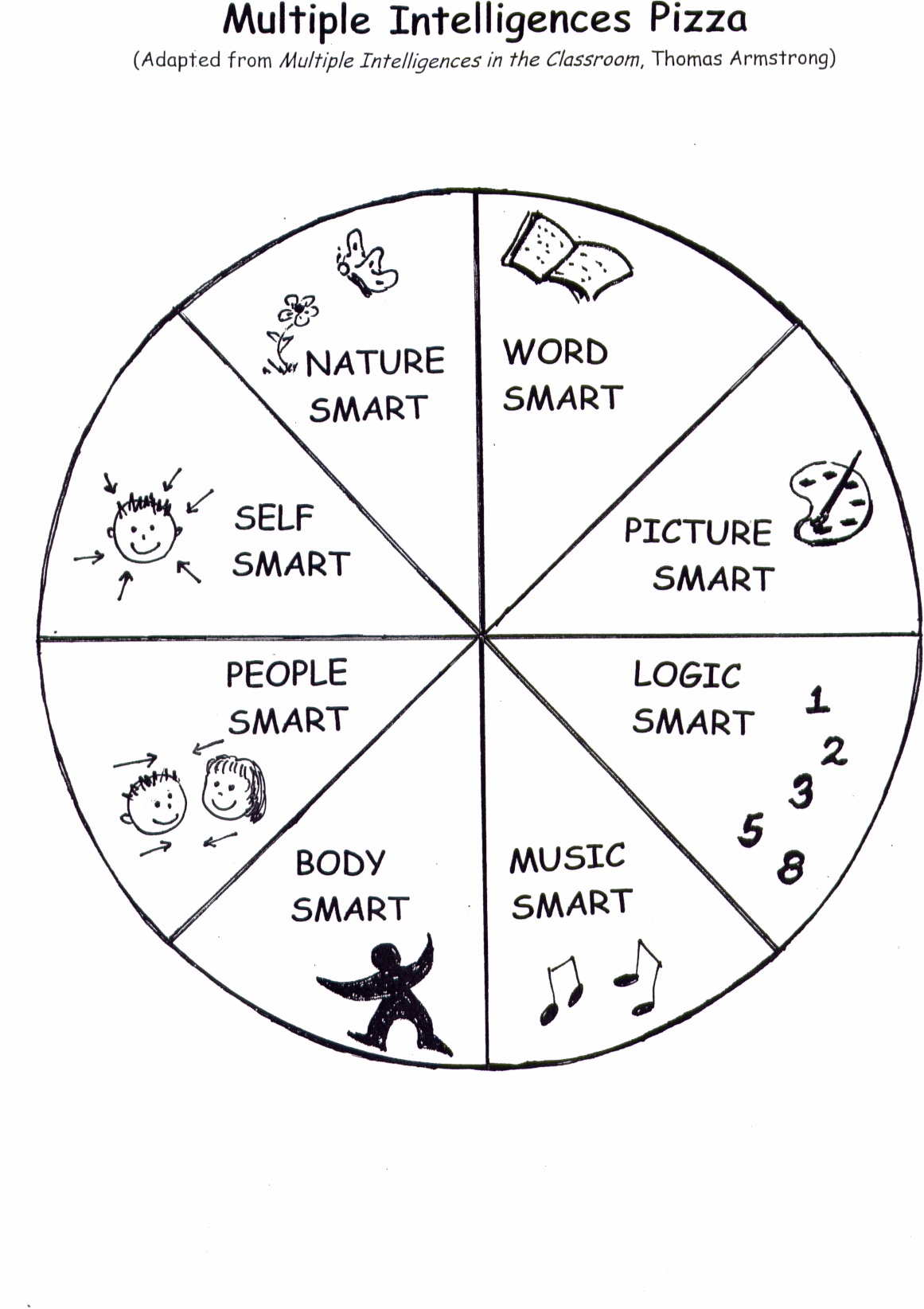
Later, Dr. Thomas Armstrong took this theory and made it even more practical for teachers of children by creating the following MI Pizza! (We’ve adapted it from the original.) He referred to each intelligence as a way of being “smart.”
Each student learns in different ways. Some learn best through words, as in the Word Smart category above. Other students learn best through visual support such as pictures and photos. Some learn well through music, while others learn best by moving.
Of course, it is difficult for us to know how each of our students learn best. Therefore, the best way to approach MI in the classroom is to provide as many ways to learn as possible in each of our lessons. Here are some guidelines to consider as you plan tomorrow’s lesson, based on the MI Pizza shown above:
1. Word Smart: Are you providing strong Word support? Write words on the board, even if students are pre-readers. When you speak the words, say them slowly, quickly, or with different voices and emotions. Play with words! Use poems, tongue twisters, onomatopoeia (words formed from actual sounds, such as “bark,” “clap,” “giggle,” “splash,” “whisper,” and many others), and alliteration (such as “skipping skeletons,” “blue bouncing balls,” or “Walter is washing windows.”)
2. Picture Smart: Are you providing a lot of visual support for the language you are teaching? Most children are strong visual learners, so illustrations and photos are important for comprehension and retention of language. In addition, when you write letters or words, draw close borders around them so that students become aware of their shapes. Picture books and art activities are also an important part of every lesson.
3. Logic Smart: Patterns are important for learning. Find ways to present language in patterns to tap into a child’s sense of logic. Many chants and songs use patterns. So do “pattern predictable” books that repeat words, phrases, and language in fun ways. Give students opportunities to solve word problems or puzzles that use logic.
4. Nature Smart: This type of intelligence is also logical, finding similarities and differences in the world around us. Look for opportunities to “classify” and “categorize” vocabulary. For example, have students put food words into groups such as fruits and vegetables. You can also put some words in chronological, or “time” order, such as a butterfly’s life cycle: egg, caterpillar, chrysalis, and butterfly. Thinking logically helps students learn better.
5. Music Smart: There is more and more research being done about the power of music to help learning. Young learners are natural singers, so bring music into every lesson. Songs and chants help students to learn and remember target vocabulary and phrases. The steady beat in music helps students develop fluency and proper intonation. Use musical sounds such as “snap,” “clap,” “pat,” and “stamp,” as you chant with children. In addition, use transitional songs to help children move quickly from one activity to another (see our blog post below about transitional songs).
6. Body Smart: Closely tied in with music is “movement.” Children love to move, and in fact they learn better by moving. For example, making letter shapes with their fingers, their arms, their whole body, and together with friends can help students remember those letters better. Moving to commands (Total Physical Response) helps students learn a variety of action verbs. Add movement to the songs and chants you use in the classroom. Any opportunity to move will bring greater learning and motivation into your classroom.
7. People Smart: Children are social beings. A language classroom should be a place where children interact using English in a variety of ways. Songs, chants, and activities can be done first with the entire class, then with small groups, then with partners. Non-competitive games, folk dances, and role plays all help students to learn and achieve goals together.
8. Self Smart: Finally, give your students a chance to personalize their learning through creative activities such as individual art projects that use the target language. Give individual students opportunities to think of their own ways to make letter shapes or move to action verbs. By personalizing what they have learned, students make English a lasting part of their lives.
These eight “ways of learning” can and should be combined as often as possible in your lessons. Very often, the best and most successful activities bring all of these “ways of learning” together in one event. In future blog posts, we’ll give you some examples of these activities and how you can use them effectively. Until then, keep a copy of the MI Pizza in your lesson planner, reminding you to bring many ways to learn into each and every lesson.
Chuck and I are going to be leading a webinar this week for teachers of very young learners. It’s really exciting for us to do this and share ideas with teachers. If you’d like to join us, just follow the link to sign up.
Dates: 25th and 28th September 2013
Times: 12:00 – 13:00 and 07:00 – 08:00 (BST)
Speakers: Kathleen Kampa and Charles Vilina
This webinar draws on content from the Magic Time course.
What are Multiple Intelligences?
How can I use Multiple Intelligence strategies with my young learners?
How can I bring my lessons to life with big pictures, picture cards, songs, chants, and movement?
How does a good kindergarten course differentiate learning so that all my students are successful?
Join Magic Time authors, Kathleen Kampa and Charles Vilina to learn practical answers to these questions and find out more about giving every child in your class the chance to learn English – and enjoy it!
Teachers have regular opportunities to observe classroom behavior. Bad behavior can be disruptive, of course. However, when we focus on our students’ successes and describe the great things they are doing, we can create a positive classroom culture that minimizes bad behavior. Chuck and I call this strategy CCBA — Catch Children Being Amazing!
Here’s what to do when you catch a child being amazing:
1. Refer to the student by name.
2. Name the task that the student is doing.
3. Describe the behavior that you want other students to notice and imitate.
For example:
I see that Natalia and Carlos have opened their books and are already writing their stories.
I see Mariko making a big ‘M’ using her whole body. At first she made a small ‘m’ with her fingers, but now she thought of another idea.
I can hear Jiwoo singing all of the words to our song. She is pointing to the picture cards, too.
Students work harder when they know that their hard work doesn’t go unnoticed. Celebrate your class successes with this chant. Songs and chants help build a positive classroom atmosphere. This celebration chant really builds team spirit!



 MagicTimeKids