Transitional Songs, Part Two

Dot

(Note: This is our second blog post on transitional songs. Our first blog post, entitled “Transitional Songs Part One,” was posted on September 23, 2013. Please scroll down this page to our earlier blog posts to find it, or simply click here. Thanks!)

In any children’s class, many activities are needed to keep students happy and motivated throughout the lesson. Transitional songs are a perfect way to signal to children that one activity is ending and another is beginning. A good transitional song also has other benefits:

  1. It supports the natural rhythm and intonation of the phrase or sentence you are using.
  2. The melody is quickly learned and recognized by students, so they move into action as soon as they hear it.
  3. In most cases, children can be encouraged to sing along, building group cohesion as well as productive language skills.
  4. Transitional songs soon become part of a classroom routine, giving students a sense of structure and making them feel secure during the lesson.

Today, for Part Two, we present a variety of transitional songs that help to make activities smooth and enjoyable for students.

1. Open Your Books

This song is a great way to motivate students to open their student books to the correct page.

Open Your Books  (copyright © 2012 by Kathleen Kampa and Charles Vilina)

Open your books. Please open your books. (gesture)

(Spoken) Turn to page _________.

(Write this page number on the board, or show the number with your fingers. Hold the book open to show the page to students, then check to be sure all students are ready.) 

Open your books.

 2. Let’s Make a Line

This transitional song quickly motivates children to form a line in the classroom, either for an activity or when they are preparing to leave the classroom.

Let’s Make a Line  (copyright © 2012 by Kathleen Kampa and Charles Vilina)

(melody:  Skip To My Lou)

Let’s make a line long and straight,

Let’s make a line long and straight,

Let’s make a line long and straight,

Let’s make a line long and straight.

 3. Find a Friend

This is a great chant to use when students need to find a partner. Demonstrate this chant with one student first. Decide how students will show that they are partners. They can stand back-to-back, touch palms, sit facing each other knee-to-knee, etc.

Practice finding partners before you actually do your activity.

Find a Friend  (copyright © 2012 by Kathleen Kampa and Charles Vilina)

Find a friend, find a friend,

before I can count to ten.

1-2-3-4-5-6-7-8-9—— 10!    Hooray!

 4. Goodbye Children

This is a fun way to say goodbye to your students at the end of the lesson!

Goodbye (copyright © 2012 by Kathleen Kampa and Charles Vilina)

(melody: Good Night Ladies)

Good-bye children!  Good-bye children!

Good-bye children!  It’s time for you to go.

Clap your hands and walk along, walk along, walk along,

Clap your hands and walk along, I’ll see you very soon.

Good-bye children!  Good-bye children!

Good-bye children!  It’s time for you to go.

5. We Did It!

We Did It! (copyright © 2012 by Kathleen Kampa and Charles Vilina)

We did it!  We did it!  We did it today!

We did it!  We did it!  Hip hip hooray!

We did it!  We did it!  We did it today!

We did it!  We did it!  Hip hip hooray!

 (Note: The following transitional songs can be found on our blog post entitled “Transitional Songs, Part One.” Please scroll down to our earlier blog posts to find these songs and the recordings for them, or simply click here.)
Let’s Make a Circle
Come and Sit In Front of Me
Cards Please

(All songs and chants in this blog are copyright © 2012 by Kathleen Kampa)

Happy teaching, everyone!!

Kathy and Chuck

Having Fun with Fortune Tellers!

When I was a little girl, we made “Fortune Tellers” to play with our friends.  We used our homemade fortune tellers to write messages about things that might happen when we grew up.

Your students will love this game.  It’s easy for students to put into their pockets and play wherever they go.  You can practice any vocabulary or grammar by adapting the game in this way.

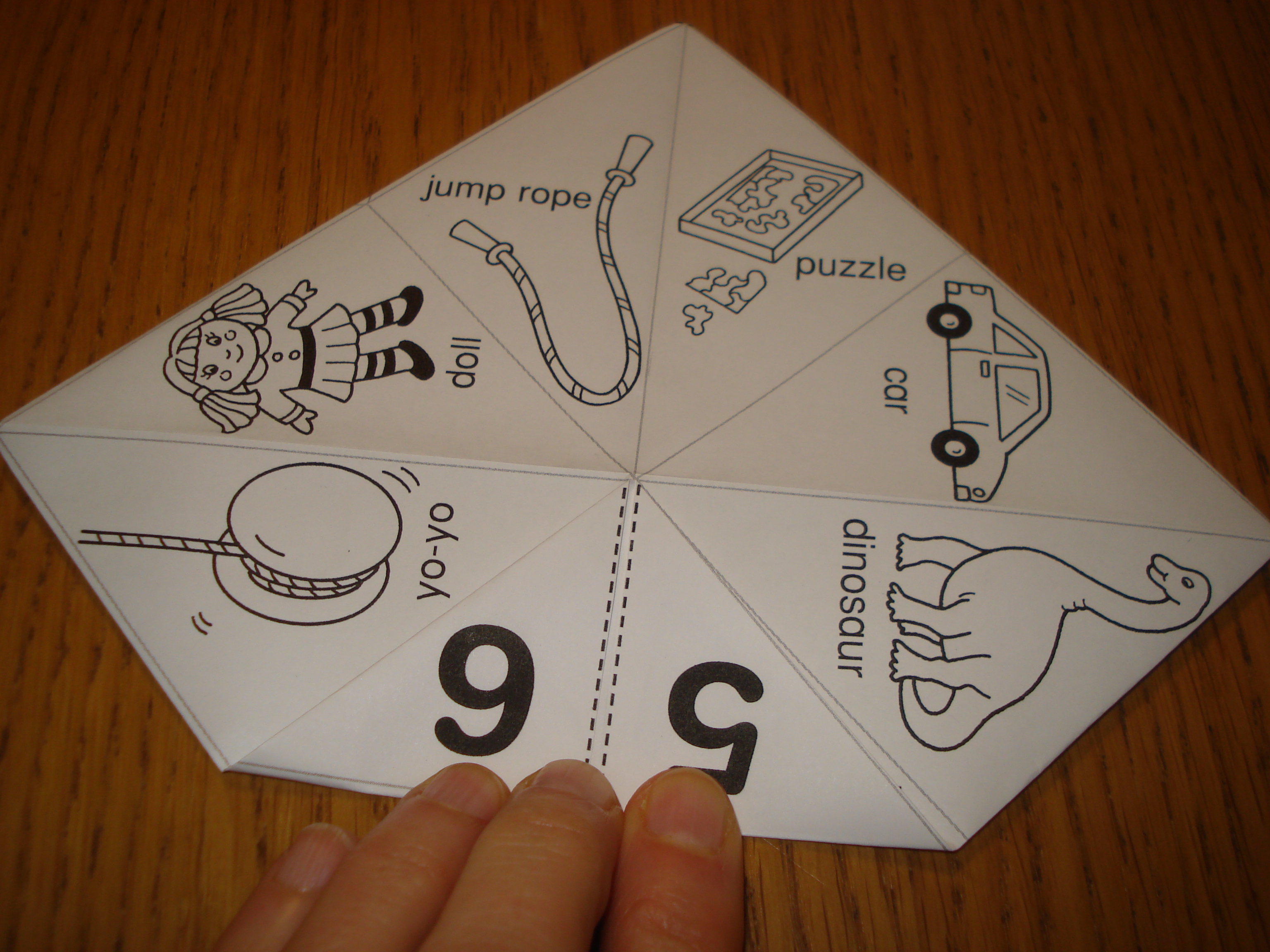
Here’s an example of a fortune teller from Magic Time 2, Unit 5, Teacher’s Book reproducible by Oxford University Press.  Once you understand how this fortune teller works, your students can create their own.  This unit focuses on toys with the phrase “I have a _________.”   They can expand it to “You have a ________.”

Download a free Fortune Teller template taken from Magic Time Teacher’s Book 2.

3.   Copy one sheet per student.  Students cut out on the dotted lines to create a square.

a.  To begin, have students fold the paper in half.

Open and fold in half the other way.  This makes folding easier. (See below.)

DSC00096

b.  Turn paper over.  Find the middle point.  Fold the corners to this middle point.  Crease well.

DSC00101

c.   Turn the paper over again.  Fold the new corners to the middle.

DSC00100

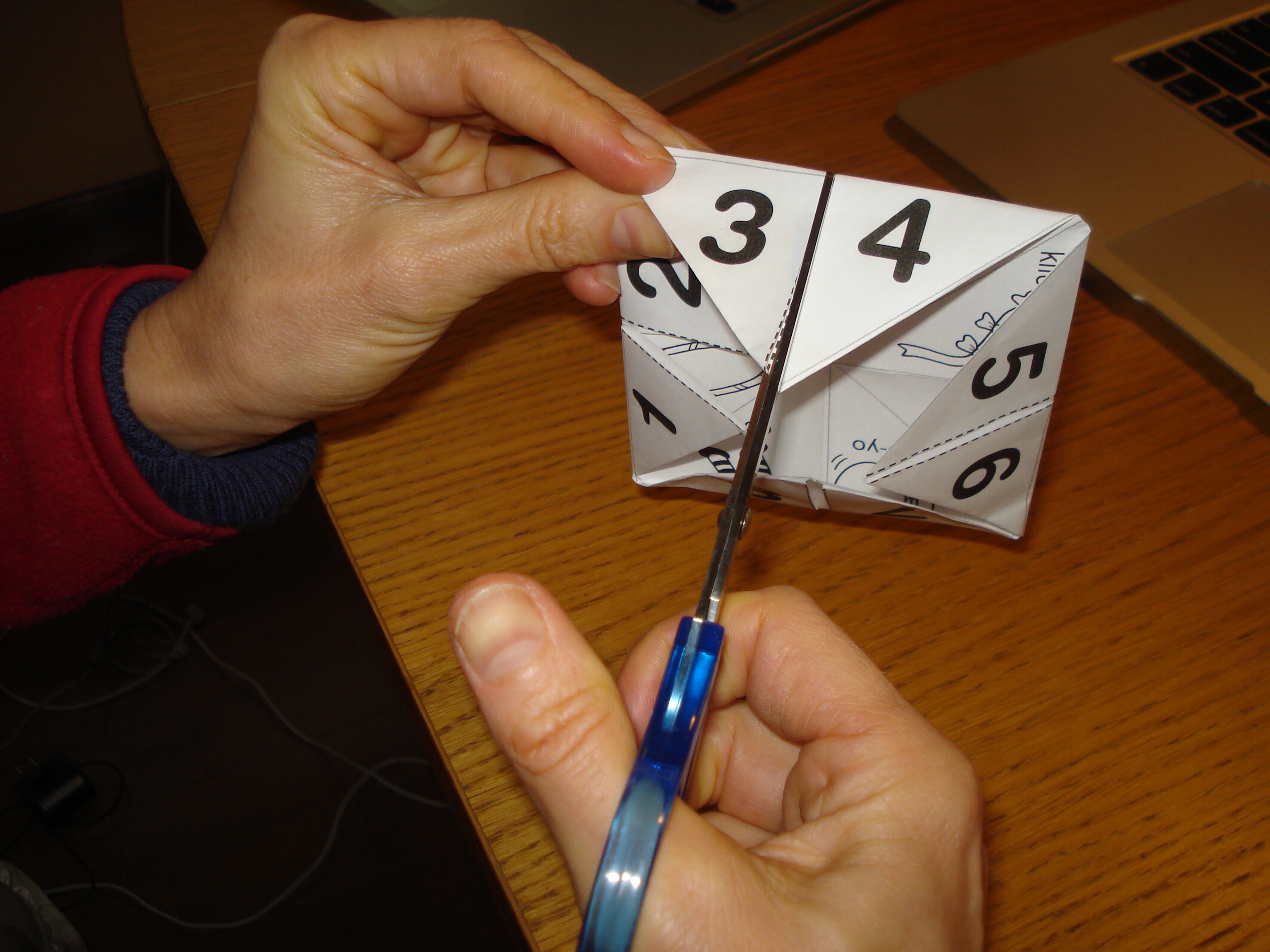
d.  Find the numbers.  Cut up from the point up to the fold between each of the numbers (1 and 2, 3 and 4, 5 and 6, 7 and 8).

DSC00102

e.  Now fold it in half so that you can put your thumbs and pointer fingers into the four openings at the bottom.

DSC00108

f.  Bring the points together.  Then open and close the fortune teller.

DSC00104

To play the game:

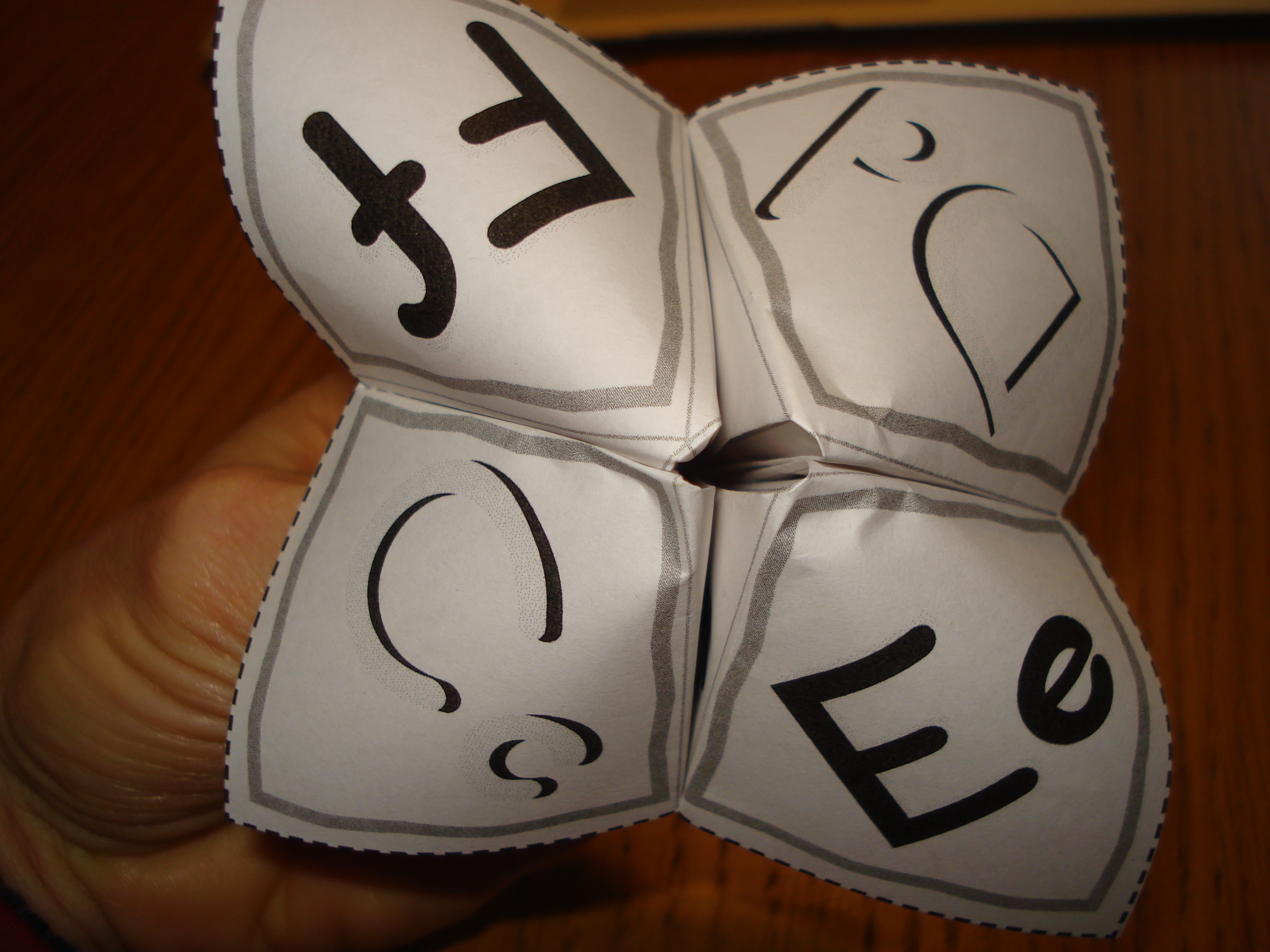
A:  Asks, “Which letter?”

B:  Says (for example), “C.”

A:  Moves the fortune teller three times, and says, “A-B-C.”

A:  Shows the inside of the fortune teller, and asks, “Which number?”

DSC00106

B:  Says (for example), “4.”

A:  Moves the fortune teller four times, counting to 4.

A:  Shows the inside of the fortune teller again, and asks, “Which number?”

B:  Says (for example), “7.”

DSC00111

A:  Says, “You have a yo-yo!”

With a little creativity, you can add more language to these dialogues.  With this fortune teller, students can imagine that they’re celebrating a birthday.

A:  “Happy Birthday. This toy is for you!  It’s a yo-yo!”

B:  “Thanks a lot!”

Or they can pretend to be Santa, saying “Ho, ho, ho! Merry Christmas.  Here’s a yo-yo for you!”

To make your own fortune teller, do your folding first.  Then open it up and add numbers, pictures, words, etc.  Instead of counting or saying the ABC’s, more advanced students can spell out words.

Keep me posted . . . I’d love to see how your creativity builds upon this idea in your classroom.

Happy Teaching!

Kathy

Be My Valentine!

    Be My Valentine cover art by Shuli KoBe My Valentine cover art by Shuli Ko

Valentine’s Day is on February 14th, just a short time away! To celebrate the occasion, I wrote a song that my young learners love to sing and move to. It’s entitled “Be My Valentine.” This song helps children learn the shape and sound of the letter “V.” You might even call this song “V-V-Valentine.”

Children also explore how to make the shape of a heart with their hands, their arms, or with a partner.

The easiest way to demonstrate how to use this song is to view a video I created with my two nieces, Brooke and Shannon.

Just click HERE to see the video!

To hear and buy the studio version of the song, just click HERE on iTunes for the single, or HERE for the album (Track #4). You can also find the music on Spotify.

I hope that you and your children enjoying singing and moving to this song together, either at home or in the classroom!

Sending warm Valentine wishes,

Kathy and Chuck

Let’s Celebrate the New Year!

%22Happy New Year 2014 Card46%22 by gubgib

“Happy New Year 2014 Card46” image courtesy of gubgib / FreeDigitalPhotos.net

It’s already January 3rd, yet here in Japan, New Year’s celebrations continue. O-shogatsu (New Year’s) begins on the night of Dec. 31st and continues for three days. Tonight we’ll be enjoying o-sechi ryori, traditional New Year’s foods, with our Japanese friends. Starting on Monday, I’ll be back in the classroom with my students. Here are two songs I’ve written to teach my students about New Year’s celebrations. The first song was written with my son Christian when he was in elementary school. He and Chuck are singing it for you!

Happy New Year

Words and music by Christian Vilina and Kathleen Kampa

copyright © 2013 by Kathleen Kampa

Happy New Year!  Happy New Year!

Happy New Year!  Happy New Year!

Happy New Year!  Happy New Year!

Happy New Year!  Hip hip hooray!

My students love to keep a “steady beat” by patting their legs, then clapping their hands.  Think “pat-clap-pat-clap.” Do this for the first three lines.

We like to do something special on the last line.

On Happy New Year!  my students like to wave their hands above their heads. More advanced students like to turn around quickly!

On Hip hip hooray! students roll their hands and jump once in place.

To hear the studio version of this song, go to iTunes, and click on Track #3.

________________________________________________

And now for our second New Year’s song! . . .

In the Chinese or lunar calendar, this is the Year of the Horse. Here in Japan, we already began celebrating the Year of the Horse on January 1st.

In this song, students learn the name of the animal, how to spell the animal name, and how to say “2014.”

It’s The Year

Words by Kathleen Kampa

copyright © 2013 by Kathleen Kampa

Medley of songs based on French song “Marlbrough s’en va-t-en guerre” (For He’s a Jolly Good Fellow) and BINGO

It’s the year of the horse,

It’s the year of the horse,

It’s the year of the horse,

It’s 2014.

H–o–r-s-e, h–o–r-s-e, h–o–r-s-e,

It’s the year of the horse!

1. Display the image of the horse. There are twelve animals in the lunar calendar. What do your students know about horses? Can they make a pose like a horse? Can they gallop like a horse? What other movements do horses do?

If you have a small space, have students create a pose when they sing the word “horse.” If you have a larger space, students may enjoy galloping in a circle while singing “It’s the year of the horse.”

2. Write the number 2014 on the board. My students like to make these numbers with their fingers. Try this:

Hold up two fingers for “two,” then move two fingers in a circle to say “thousand.” For fourteen, students hold up one finger on their left hand, and four fingers on their right.

When you sing the song, students stop in place and do the finger movements on “It’s 2014!” Students can even wave their hands in the air!

3. Now your students are ready to spell. Write the word horse on the board. Use lower case letters. Say the letters with your students.

Then clap the rhythm while saying the letters.

You can encourage your students to make different sounds for this rhythm by patting their legs, stamping their feet, or snapping their fingers. You can even add simple instruments.

4. Finish the song with a horse pose on “It’s the year of the horse!”

We hope you enjoy these New Year songs with your students!

Happy Teaching!

Kathy and Chuck

The Flower Poem

%22The Rose%22 by Gualberto107

“The Rose” courtesy of Gualberto107 / FreeDigitalPhotos.net

If you sing the Autumn Leaves song with scarves (see the blog post below this one), you might like to finish up with this poem about a flower. I first show my students a picture of a flower with leaves. I then use 27-inch hemmed scarves from West Music.com (item #540053). These scarves expand beautifully for this poem. However, you can use other scarves as well.

To begin, scrunch up the scarf in your hands, so that it can’t be seen.

Flower Poem (with scarves)

adapted by K. Kampa

Here’s a leaf, and here’s a leaf.

(Pretend that your thumbs are leaves. Wiggle one thumb, then the other.)

Count them. 1-2.

(When you count 1-2, move your thumbs up and to the side.)

Here’s a bud.

(Open your hands slightly to reveal the scrunched up scarf.)

Here’s a flower,

(Open your hands a little more.)

blooming just for you.

(Open your hands and let the scarf ‘bloom’ like a flower.)

 Here’s a video to show you how you might do it (click on the arrows in the lower right corner of the screen to see the full picture):

Autumn Leaves Are Here!

%22Autumn Maple Leaves%22 by oana roxana birtea

“Autumn Maples Leaves” courtesy of oano roxana birtea / FreeDigitalPhotos.net

Here in Tokyo, Japan, the autumn leaves have turned colors. Now beautiful reds, oranges, and yellows fill the sky. Little by little, the leaves tumble to the ground.

My Kindergarten students delight in gathering the fallen leaves. We have a very simple song about the autumn leaves that I’d like to share with you. If you have a xylophone or glockenspiel, you can play it by starting at the shortest bar (C) (do), and going step by step to the longest bar (C).

Autumn Leaves Song One (traditional melody)

Down, down, down, down, the leaves are falling to the ground. 

    do       ti        la       sol             fa              mi        re        do

Whoosh!

My students will sing this song over and over again until you finally bring the song to a close by saying “Last time” and eliminating the “Whoosh!”

If you have colored leaves, let students dance with the leaves in their hands. If you don’t have colored leaves, you can have students make them out of construction paper. They can paint or color them. My students also love to dance with lightweight scarves (available at West Music.com — item # 540053). As students sing, they move their bodies lower and lower, just like the music. When they sing “Whoosh!” they pretend to scoop up the leaves / scarves and start again.

You can make this song a little more complicated by adding the colors of autumn leaves.

Autumn Leaves Song Two

Adapted by K. Kampa

Red, yellow, orange, and brown, the leaves are falling to the ground. 

Whoosh!

Here’s a video to give you some ideas (click on the arrows in the lower right corner of the screen to get a full video image):