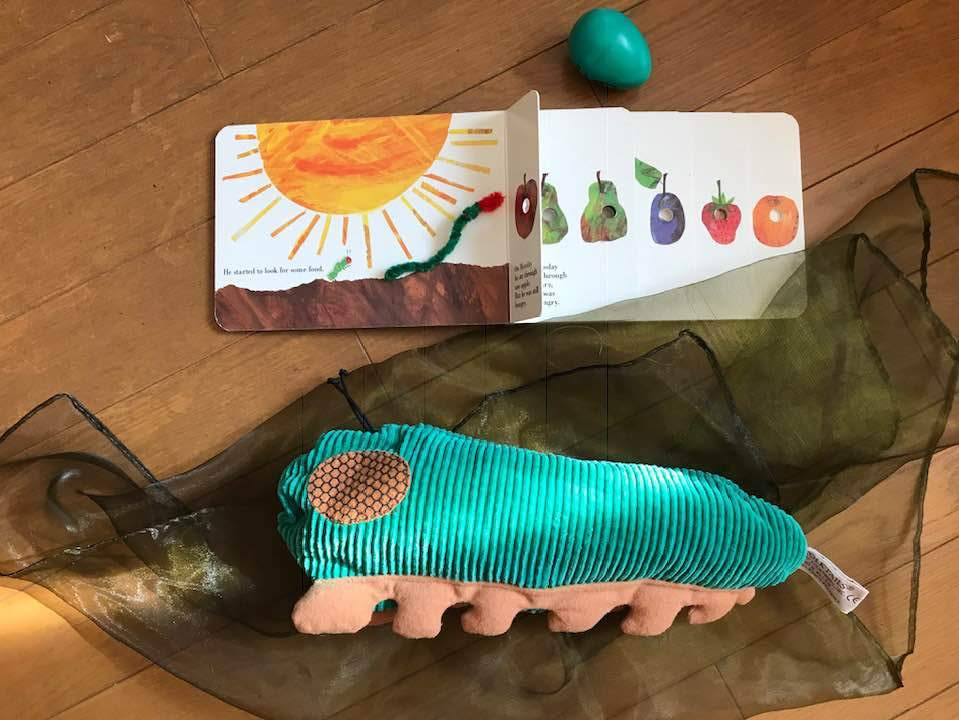
If you’re looking for activities for young learners, check out my Facebook LIVE workshop. I teach children from age 2 – 12 in Tokyo, and these activities have all been LOVED in my classrooms. The activities support English language development as well as developmental body movement. Today’s FB LIVE (February 21, 2019) included the following: It Is Raining (focus on body parts), Little Worms (vocal expression, yoga movement, building group unity), Come and Sit In Front of Me (transitional), Tiny Egg (Butterfly Life Cycle, creative movement, connection to Eric Carle’s The Very Hungry Caterpillar), Flitter Flutter Butterfly (pronunciation practice, rhyming sounds, movement), Here’s a Leaf (seed-leaf-bud-flower), Folding Scarves (transitional), Scarves Please (Transitional), We Love Hina Matsuri (song/canon for Japanese Girls’ Day), We Did It. You can find all of the lyrics inside the CDs.
These are the materials used for the Tiny Egg chant (available on iTunes) . . Children’s songs for special events for pre-school, kindergarten, and elementary studentsJump! Turn into butterflies. Plant magical flowers!
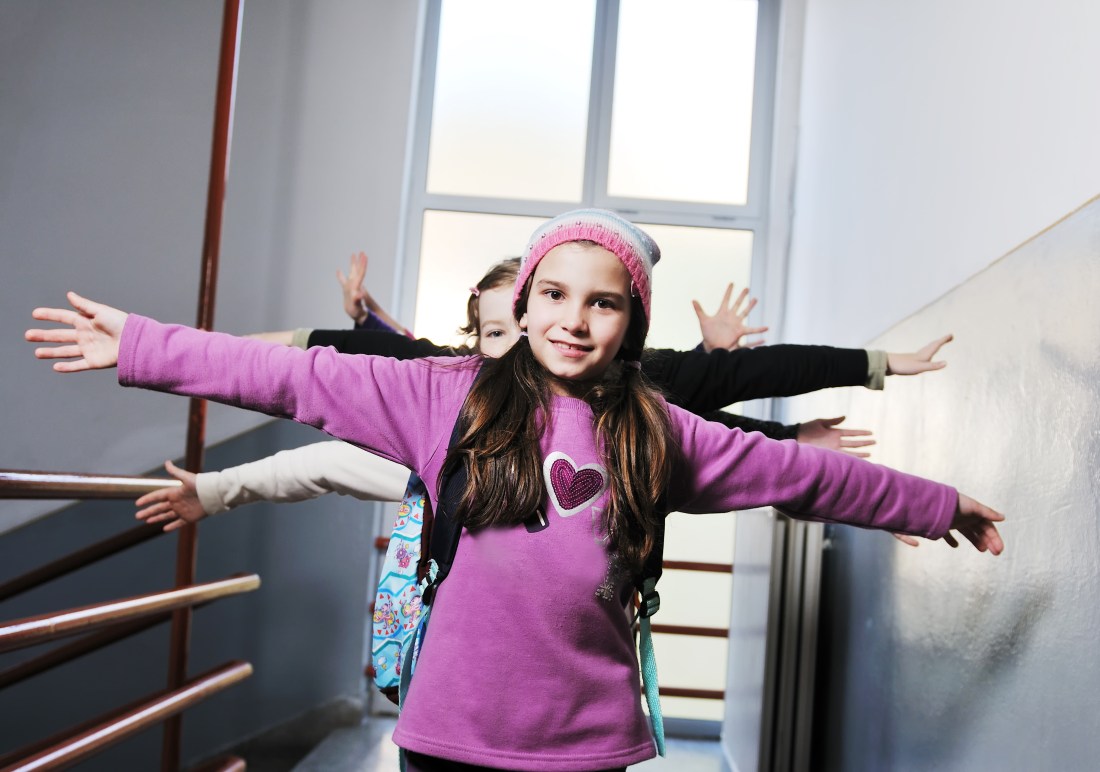
Students love to make letter shapes with their bodies.
Learning the names of the days of the week in English can be tricky. For many of us, we teach our English class on the same day each week. This song “What Day Is It?” is a fun way to practice the days of the week.
First of all, write a letter on the board or show a picture card. Model making that letter with your fingers, arms, or whole body. Make the letter so that students are able to read it. You might imagine how that letter would look when you write it on your whiteboard. Students will be able to “read” your letter. Invite students to make letters with you. They might even make letters with the entire class! Try making letters in many different ways.
We started at the beginning of the alphabet. Students made A, a, and B, b (see B below). In Magic Time (Oxford University Press) students have fun making letter shapes to learn the letter name and its sound.
Now write the names of the days of the week. Run your finger under the word as you say it (Sunday). Point out the first letter. Encourage students to make that letter with their bodies in several ways. Remind students that days of the week begin with capital letters. As you can see, sometimes the letters appear flipped around to us. The important idea is that students are making the letter shapes.
I love to catch my students making their amazing letters by taking photos. Remember CCBA (Catch Children Being Amazing!)
Pass out the “days of the week” cards, one to each student. Students line up in order around the circle starting with Sunday. Students make the initial letter shape as they sing each day of the week. When they sing “Tra la la la la” add a group movement, such as pat your knees, clap your own hands, clap your “neighbor’s” hands.
Happy New Year! All around the globe the new year is celebrated in different ways. Here in Japan people celebrate o-shogatsu, the new year, with many special traditions. One of the important traditions seen all over the country is the celebration of the new animal for the year. This year it is the year of the sheep. Perhaps you’re familiar with the Chinese calendar of twelve different animals.
At our first class this week, we’ll begin by wishing everyone a Happy New Year 2015, the year of the sheep. I wrote a simple song to teach the year and how to spell the word “sheep.” We had fun creating a recording for you at home with our son Christian.
It’s The Year
lyrics by Kathleen Kampa Vilina, melody (For He’s a Jolly Good Fellow/ BINGO)
sung by Christian Vilina
Intro:
Baa, baa, black sheep,
Have you any wool?
Yes, sir, yes, sir.
Three bags full.
It’s the year of the sheep.
It’s the year of the sheep.
It’s the year of the sheep.
It’s 2015!
s-h-e-e-p, s-h-e-e-p, s-h-e-e-p,
It’s the year of the sheep.
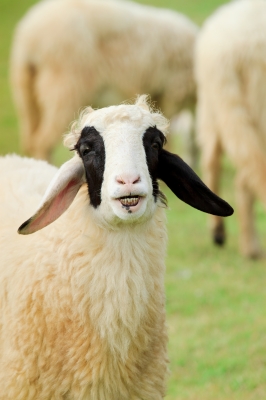
1. Show students the picture of a sheep.
Image courtesy of TCJ2020 at FreeDigitalPhotos.net
When they sing the word “sheep” they can make a pose like a sheep or point to the picture. If you have lively students, they might enjoy skipping or galloping during this part of the song instead.
2. On the words, “It’s 2015,” students stop moving and make the numbers 2015 with their fingers. Very young students can stop and wave their arms in the air as if saying “Hooray!”
3. Write the letters for the word “sheep” on the board. Clap the rhythm below to accompany the letters. (slow, slow, quick quick, slow)
To make it more challenging, students can pat, stamp, or snap the rhythm. My students like to clap the first time they spell “sheep,” then they pat their legs, and finally they stamp their feet. If you have instruments in your classroom, you can play this part.
4. The song ends with “It’s the year of the sheep!” Students make the sheep pose, or point to the picture.
———————————————————————————————————————-
You can also celebrate the New Year with our song, “Happy New Year!” I wrote it with our son Christian, and it is always a hit with our students. You can find it on Kathy Kampa’s Special Days and Holidays. The lyrics are easy for students to follow.
Students like to pat their legs, then clap their hands to the beat.
On the last Happy New Year, they turn around and wave their hands.
It’s October and we’re busy singing and dancing to Halloween songs. My students love getting up and moving to a song! At this time of year, we’re marching like monsters, skipping like skeletons, waltzing like witches, and jumping like jack-o-lanterns. If you want to find more Halloween songs, you can find teaching notes for songs like “Marching Monsters” on earlier blogs on this site.
On this blog, however, I want to share a handout and flash cards made by my good friend Setsuko Toyama. Setsuko is a well-known teacher trainer and author in Japan. On her worksheet, students match the same initial sound of the words, an important skill in developing phonemic awareness. They also have fun playing with alliteration, words that begin with the same sound. Many American nursery rhymes feature alliteration.
I like having my students do craft projects from time to time. While they’re busy creating their artwork, I play music to fit the holiday. Kathy Kampa’s Special Days and Holidays CD has several Halloween songs that children can easily sing along to for your Halloween parties.
Check out my Pinterest page for lots of Halloween craft activities.
Skeleton Dance is definitely one of my students’ favorite songs! It teaches various body parts and directional movements. You can start your school day with it, use it during break time, dance it on a rainy day, move during a health unit, or dance it on Halloween. I have taught Skeleton Dance to students in kindergarten through upper elementary, and everyone enjoys it. I’ve also shared this song with teachers in America, Japan, Korea, Mexico, Taiwan, Thailand, Vietnam, and Indonesia.
You can watch some of my students here in Japan doing the Skeleton Dance, and read the lyrics below:
Here’s how you do the Skeleton Dance:
In this song, students will move four different body parts: shoulders, elbows, knees, and feet.
First, students move their shoulders to the beat.
1. Move your shoulders . . .
A. Skeleton, skeleton, skeleton dance, Move your shoulders, do the skeleton dance. Skeleton, skeleton, skeleton dance, Move your shoulders, do the skeleton dance.
Next, students move their whole bodies to the front, to the back, and to the side. I usually start by moving only my arms, but my students love to jump in each direction.
B. To the front, to the back, to the side, side, side, To the front, to the back, to the side, side, side,
Next, students move their shoulders up, down, and around. Each time they repeat the song, they will move a different body part in these directions.
C. Put your shoulders up. Put your shoulders down. Move them up and down and all around. Put your shoulders up. Put your shoulders down. Move them up and down and all around.
Finally, students move their shoulders in their own way.
This dance is repeated with the following body parts.
Before I play the music, my students and I figure out how we’ll move up, down, and around using each of these body parts.
2. Move your elbows . . .
3. Move your knees . . .
4. Move your feet . . .
You can download this song from iTunes (Track #15) or CD Baby.
I hope that your students enjoy this as much as mine do.
Can you nurture creativity while building English language skills? Yes, you can!
An important part of creative thinking is to generate many possible solutions. This is easy to do with young learners. Here is a simple activity and chant that you can use to help develop creative and imaginative thinking with your young learners.
Introducing Vocabulary
1. Show students (or draw) a picture of a circle. Say, What is this? Can you make this shape with your fingers?
2. Point out the various ways that your students are making circles. For example:
Yuri is making a tiny circle using her thumb and pointer finger. Can you do that?
Daniel is using all of his fingers to make a circle. Let’s try that, too! We can make circles in many ways.
3. Say, Can you make your circle bigger? Can you make a circle with a friend?
4. Repeat the three steps above using other shapes. I usually show shapes in the following order because some are a little easier to make than others.
circle
triangle
heart
rectangle (two long sides, and two short sides)
square (four equal sides)
star (five points)
Remember, it’s important to take time making these shapes with your students before putting them into the chant.
My fingers, fingers, fingers, fingers, fingers dance!
My fingers, fingers, fingers, fingers, fingers dance!
Make a circle. Take a picture. Click!
Make a circle. Take a picture. Click!
Now, let me break it down so that you know the movement for each part.
1. My fingers, fingers, fingers, fingers, fingers dance!
My fingers, fingers, fingers, fingers, fingers dance!
(For this part, students have fun wiggling or “dancing” their fingers.)
2. Make a circle.
(Students make the shape with their fingers.)
3. Take a picture. Click!
(Students look through the shape at a classmate, and pretend to take a photo.)
(Repeat steps 2 and 3.)
(Students then substitute the other shapes in this chant.)
You can use any shape picture cards to teach the vocabulary. I used the picture cards from Magic Time 1, Unit Two, for my video. Feel free to add your own shape ideas, such as diamonds, ovals, etc.
Here’s a video I’ve prepared to show you how the chant is done. Just click here. You can also find a studio version of this chant on iTunes by clicking here.
This chant is also on my new album Jump Jump Everyone, available on iTunes. Physical CDs are also available.
Valentine’s Day is on February 14th, just a short time away! To celebrate the occasion, I wrote a song that my young learners love to sing and move to. It’s entitled “Be My Valentine.” This song helps children learn the shape and sound of the letter “V.” You might even call this song “V-V-Valentine.”
Children also explore how to make the shape of a heart with their hands, their arms, or with a partner.
The easiest way to demonstrate how to use this song is to view a video I created with my two nieces, Brooke and Shannon.
To hear and buy the studio version of the song, just click HERE on iTunes for the single, or HERE for the album (Track #4). You can also find the music on Spotify.
I hope that you and your children enjoying singing and moving to this song together, either at home or in the classroom!
“Happy New Year 2014 Card46” image courtesy of gubgib / FreeDigitalPhotos.net
It’s already January 3rd, yet here in Japan, New Year’s celebrations continue. O-shogatsu (New Year’s) begins on the night of Dec. 31st and continues for three days. Tonight we’ll be enjoying o-sechi ryori, traditional New Year’s foods, with our Japanese friends. Starting on Monday, I’ll be back in the classroom with my students. Here are two songs I’ve written to teach my students about New Year’s celebrations. The first song was written with my son Christian when he was in elementary school. He and Chuck are singing it for you!
Happy New Year
Words and music by Christian Vilina and Kathleen Kampa
My students love to keep a “steady beat” by patting their legs, then clapping their hands. Think “pat-clap-pat-clap.” Do this for the first three lines.
We like to do something special on the last line.
On Happy New Year! my students like to wave their hands above their heads. More advanced students like to turn around quickly!
On Hip hip hooray! students roll their hands and jump once in place.
To hear the studio version of this song, go to iTunes, and click on Track #3.
________________________________________________
And now for our second New Year’s song! . . .
In the Chinese or lunar calendar, this is the Year of the Horse. Here in Japan, we already began celebrating the Year of the Horse on January 1st.
In this song, students learn the name of the animal, how to spell the animal name, and how to say “2014.”
Medley of songs based on French song “Marlbrough s’en va-t-en guerre” (For He’s a Jolly Good Fellow) and BINGO
It’s the year of the horse,
It’s the year of the horse,
It’s the year of the horse,
It’s 2014.
H–o–r-s-e, h–o–r-s-e, h–o–r-s-e,
It’s the year of the horse!
1. Display the image of the horse. There are twelve animals in the lunar calendar. What do your students know about horses? Can they make a pose like a horse? Can they gallop like a horse? What other movements do horses do?
If you have a small space, have students create a pose when they sing the word “horse.” If you have a larger space, students may enjoy galloping in a circle while singing “It’s the year of the horse.”
2. Write the number 2014 on the board. My students like to make these numbers with their fingers. Try this:
Hold up two fingers for “two,” then move two fingers in a circle to say “thousand.” For fourteen, students hold up one finger on their left hand, and four fingers on their right.
When you sing the song, students stop in place and do the finger movements on “It’s 2014!” Students can even wave their hands in the air!
3. Now your students are ready to spell. Write the word horse on the board. Use lower case letters. Say the letters with your students.
Then clap the rhythm while saying the letters.
You can encourage your students to make different sounds for this rhythm by patting their legs, stamping their feet, or snapping their fingers. You can even add simple instruments.
4. Finish the song with a horse pose on “It’s the year of the horse!”
We hope you enjoy these New Year songs with your students!
(Image courtesy of digitalart / FreeDigitalPhotos.net)
Do your students like to pretend to be different Halloween characters? Then “Marching Monsters” is a great new addition to your Halloween song repertoire! It encourages creativity and imagination, plus gives students great language practice with “alliteration.”
“Alliteration” happens when two or more words begin with the same sound. The phrase “marching monsters” has two words that begin with the sound /m/. Other phrases in the song include “skipping skeletons,” “waltzing witches,” and “jumping jack-o-lanterns.” Children love to sing these fun phrases while doing the actions throughout the song. They also learn the song quickly because of the repeated phrases.
Here is a simple recording of the song. A FUN professional version is available on iTunes here (just click on Track #11).
Here are the lyrics, plus notes on how to teach it!
Marching Monsters
Words and music by Kathleen Kampa and Charles Vilina
Students can move around a circle or freely around the classroom.
1. On Marching Monsters, students march around, pretending to be monsters. On Turn around and stop, students turn around and make a pose. They hold until the music begins again.
2. On Skipping Skeletons, students skip around, moving their arms like a skeleton. For very young learners, children can gallop, or they can slide sideways.
3. On Waltzing Witches, students dance in one place. If you’re in a circle, face the center. Students sway from side to side moving their arms.
4. On Jumping Jack-o-lanterns, students jump in one place, making the shape of a jack-o-lantern.
Enjoy this wonderful song and dance activity with your students!
Once again, you can find the professional version of this song on
Left image courtesy of digitalart / FreeDigitalPhotos.net. Right image courtesy of nuchylee / FreeDigitalPhotos.net.
Are your students getting ready for Halloween? Mine are! This song was inspired by the book “Where’s the Halloween Treat?” by Harriet Ziefert and Richard Brown (Putnam Juvenile). As you read the book to students, you can see children dressed in different costumes going trick-or-treating.
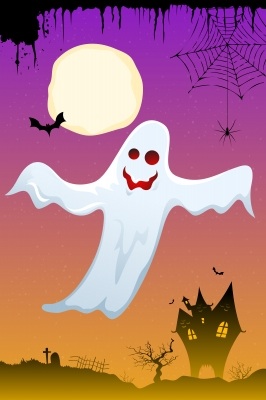
If you don’t have this wonderful book, you can hang pictures of Halloween friends around the classroom. In this song, we chose a ghost, a witch, a monster, a skeleton, and a black cat.
1) Have students sit in front of you. Ask students, What do you see? as they look around the classroom. They may be able to name some of the Halloween vocabulary words.
2) Point to one word, such as ghost. Say, I see a ghost.
Continue with the other Halloween friends in the same way.
3) Now teach the phrase Trick or Treat. You might explain the tradition of children going from house to house and getting treats from neighbors. When children ring the doorbell, they always say, Trick or Treat! We do this because It’s Halloween!
4) Students can sit as they sing the following song. Here’s a simple version of it. This is an original melody that’s easy to sing.
This song has also been recorded professionally and is available on iTunes on







 MagicTimeKids