It’s time to celebrate the Chinese New Year! We welcome the year of the tiger.
Let’s learn a song to celebrate! We’ll learn parts of the song first by making simple movements. Then we’ll put them together.
How can we move like a tiger standing in our space?
Make a movement while we say ti-ger. You could move your hands like paws. Change your expression
2. How can you show two thousand twenty-two or twenty twenty-two using your fingers? You could draw numbers in the air, or hold up your fingers (2-0-2-2).
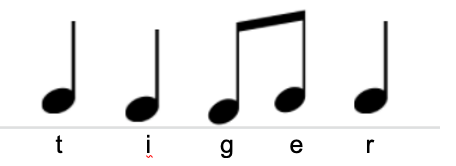
3. Last of all, let’s spell the word tiger. How can you make each letter using your fingers? Try making the letters with your arms or even your whole body. Which way do you like to make these letters the best? If you’re making letters, take time to make them.
Or you can clap, pat, stamp, or snap the rhythm when you spell tiger. This rhythm repeats three times, so you could choose a different type of sound each time.
It’s the Year of the Tigerby Kathy Kampa
Part 1: (melody: For He’s a Jolly Good Fellow) It’s the year of the tiger. It’s the year of the tiger. It’s the year of tiger. It’s 2022!
Part 2: (melody: BINGO) t-i-g-e-r, t-i-g-e-r, t-i-g-e-r, It’s the year of the tiger!
Here’s a video of my Zoom Magic Time English class. We always do music and movement during our class. Together, we created these movements. These students really enjoyed making the letter shapes. You can find videos from my classes and specially prepared videos on my YouTube Channel (Kathy Kampa).
My online Magic Time class singing It’s the Year of the Tiger
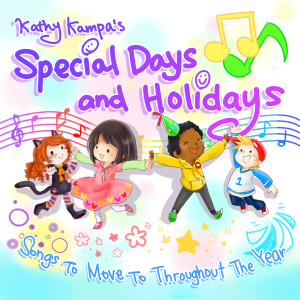
I change this song annually, so you won’t find it on my CDs. I create a new version for you each year! You can, however, find my lively song “Happy New Year” on Kathy Kampa’s Special Days and Holidays (available on iTunes).
Check out my music as a download on iTunes or order a CD complete with lyrics.
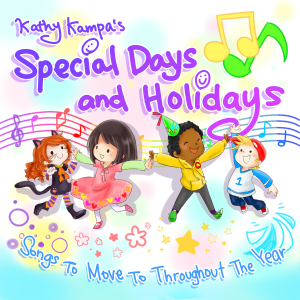
The songs on Kathy Kampa’s Special Days and Holidays celebrate various special moments throughout the year–the New Year, Valentine’s Day, Girls’ Day, Easter, Halloween, Thanksgiving, Christmas, plus birthdays and a loose tooth!
The festivities are beginning for Chinese New Year! This is the year of the ox! Why not celebrate with your students by using this simple chant/song!
During the pandemic, many students have not been allowed to sing. So enjoy these lyrics as a chant.
It’s The Yearby Kathy Kampa
Part A:
It’s the year of the ox,
It’s the year of the ox,
It’s the year of the ox,
It’s 2021!
Part B:
o-x ox!
o-x ox!
o-x ox!
It’s the year of the ox!
Try some of these movement suggestions. My students like making the animal shapes for each year of the Chinese calendar. I ask my students for their ideas. To make the shape of an ox, many of the students made horns with their fingers.
How can your students show the year 2021? My students liked to “draw” the numbers in the air. Some of them made numbers with their fingers. A few of them just decided to jump up into the air to celebrate!
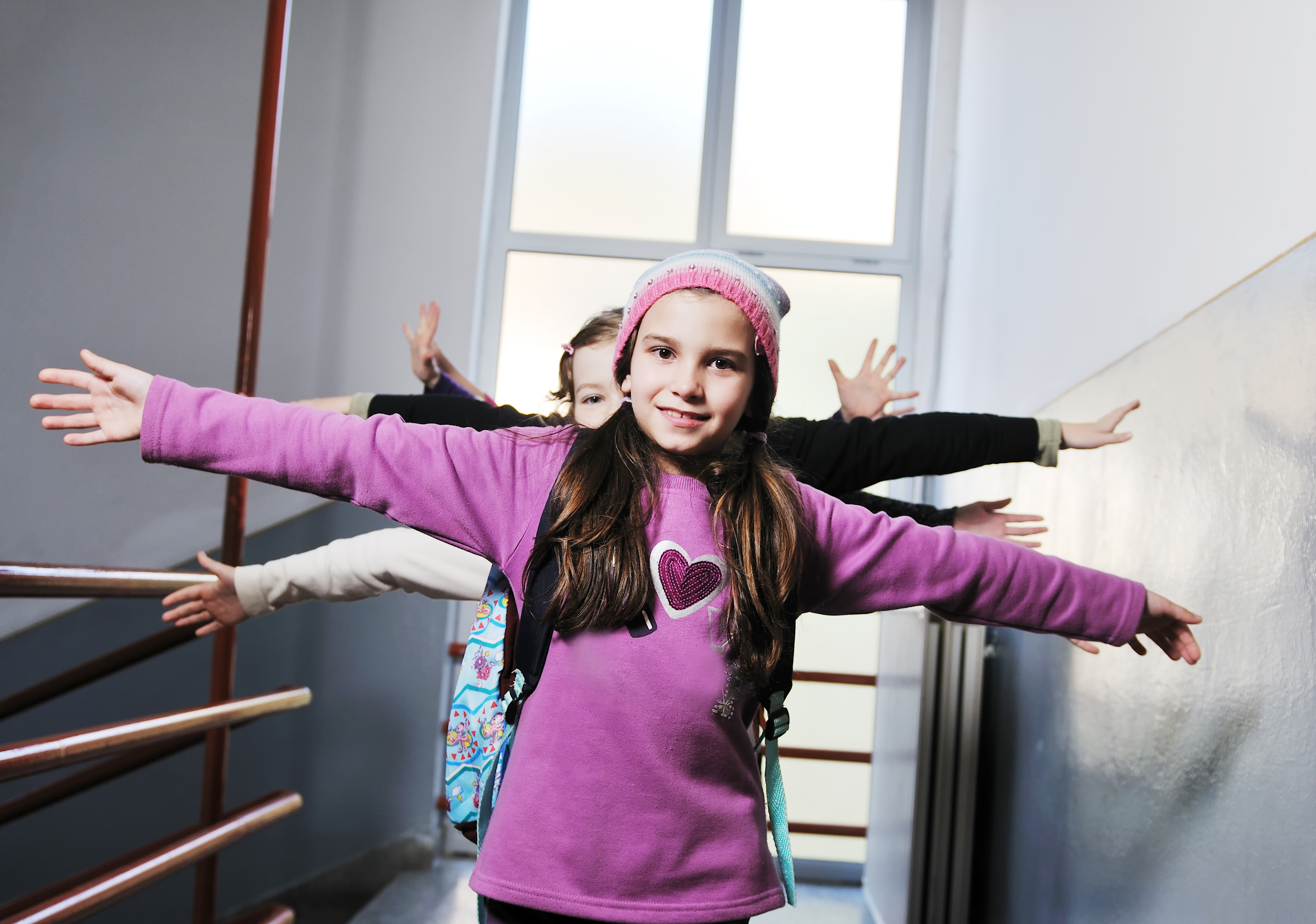
My students really love making these letter shapes! If your students aren’t used to making letter shapes, you can model this activity. Students make letters with their fingers, their arms, or even their whole bodies!
Let’s make the letter o with our fingers. Can you make it bigger? Try using your hands? Can you make the letter o even bigger? Wow! You can make it with your whole body! Now let’s try making the letter x in the same way.
Put these all together into a chant. Add instruments if you like to really make it festive!
If you’re interested in a melody to sing this, check out my simple video here. I’ve combined two familiar songs to create this new song.
Check out Kathy Kampa’s Special Days and Holidays for songs to celebrate your child’s special days–Valentine’s Day, Easter, a birthday, or even a loose tooth!
Children’s songs for special events for pre-school, kindergarten, and elementary students
I teach very young learners. I love the energy that these students bring to my class! The question is how to harness that energy productively. This chant from Magic Time One 2nd edition (OUP) is perfect for very young learners.
In the lessons prior to this, students learned about various pets, such as cat, dog, rabbit, bird, turtle, and frog. (Actually the artwork shows additional pets that the children find in the pictures). The four verbs in this lesson are jump, run, hop, fly.
First of all, students practice each of the four verbs–jump, run, hop, fly–standing in one place. It’s also important for young learners to learn “Stop!” It’s fun to make it a game by saying these verbs several times (Jump! Jump! Jump!), and then “Stop!” You can do this with music by starting and stopping the music. When my students, they love to make interesting poses, too.
Secondly, put these four words into the chant pattern. I like to do this as a fingerplay sitting with the students.
For jump, place two fingers in your palm, then pretend to “jump.”
For run, make your fingers move quickly in your palm.
For hop, place one finger in your palm, then pretend to “hop.”
For fly, move your fingers in the air.
You can place the four picture cards in the order of the song like this. Put the three verbs in one row, and run in another.
Jump Hop Fly
Run
You can see in the video that my students matched the animals to the picture cards.
Run, Run, Run! from Magic Time One 2e Unit 10
Jump! Jump! Run, run, run!
Jump! Jump! Run, run, run!
Jump! Jump! Run, run, run!
Jump! Jump! Stop!
Change jump to hop. Then change to fly.
Here’s a video of some of my very young learners performing this chant.
Students extend this language by putting it into the phrase, It can _______. Students are then able to talk about all of the pets they’ve learned about.
Yes, this is an unusual post for this blog! I have been asked by many teachers to write about the game I created to practice frequency adverbs.
The goal of this game is to practice frequency adverbs (never, sometimes, usually, always) with everyday chores. You need one dice and a set of “chore” flashcards. The chores in Everybody Up (published by Oxford University Press) include the following: wash the car, take out the garbage, water the plants, vacuum the carpet, sweep the floor, clean the bathroom. If you don’t have chore flashcards, you can certainly make up your own list.
This game works well in groups of three to four students.
My students decided that the numbers on the dice would represent the following words or choices.
1
never
2
sometimes
3
usually
4
always
5
my choice
6
my classmate’s or teacher’s choice
Place a set of flashcards for chores (from Everybody Up, Level 3, Unit 6) in the center of the group. The first student rolls the dice, then picks a “chore card.”
If the student rolls the number 2 (sometimes) and picks the chore card “wash the car,” the student says “I sometimes wash the car.”
If the student rolls the number 5, he/she can choose which frequency adverb to use.
If the student rolls the number 6, he/she can ask a classmate or teacher to choose which frequency adverb to use.
After each person’s turn, other students might ask if the statement is true or false. When a student says, I always make my bed, the others ask, Is it true?
To expand the practice, change the pronoun from “I” to “he“or “she.” Using these pronouns requires the use of the third person “s.” If a student rolls the number 4 (always) and picks the chore card “waters the plants,” he/she says, “She always waters the plants.”
Students love to make letter shapes with their bodies.
Learning the names of the days of the week in English can be tricky. For many of us, we teach our English class on the same day each week. This song “What Day Is It?” is a fun way to practice the days of the week.
First of all, write a letter on the board or show a picture card. Model making that letter with your fingers, arms, or whole body. Make the letter so that students are able to read it. You might imagine how that letter would look when you write it on your whiteboard. Students will be able to “read” your letter. Invite students to make letters with you. They might even make letters with the entire class! Try making letters in many different ways.
We started at the beginning of the alphabet. Students made A, a, and B, b (see B below). In Magic Time (Oxford University Press) students have fun making letter shapes to learn the letter name and its sound.
Now write the names of the days of the week. Run your finger under the word as you say it (Sunday). Point out the first letter. Encourage students to make that letter with their bodies in several ways. Remind students that days of the week begin with capital letters. As you can see, sometimes the letters appear flipped around to us. The important idea is that students are making the letter shapes.
I love to catch my students making their amazing letters by taking photos. Remember CCBA (Catch Children Being Amazing!)
Pass out the “days of the week” cards, one to each student. Students line up in order around the circle starting with Sunday. Students make the initial letter shape as they sing each day of the week. When they sing “Tra la la la la” add a group movement, such as pat your knees, clap your own hands, clap your “neighbor’s” hands.
Are you preparing for Halloween? I know that many of my teacher friends are. I love Halloween because it invites students to nurture their creativity through imaginative activities. Students move in more expressive ways and play with facial expressions. Let’s explore moving like various Halloween characters.
First of all, I like to gather students in front of me to teach the vocabulary. I sing the transitional song “Come and Sit In Front of Me.” (by K. Kampa) The professional version of this transitional song is here for you.
Come and sit in front of me, in front of me, in front of me.
Come and sit in front of me, in front of me,
You can print the I’m a Witch picture cards and teach students the following song.
I’m A Witch
Words by Kathleen Kampa and Charles Vilina,
melody: Skip to my Lou
Spoken: Let’s be witches and fly on our broomsticks.
Hee! Hee! Hee! I’m a witch
Hee! Hee! Hee! I’m a witch!
Hee! Hee! Hee! I’m a witch!
Happy Halloween!
2. Spoken: Let’s be ghosts and float gently through the air.
Boo! Boo! I’m a ghost! (3X) Happy Halloween!
3. Spoken: Let’s be bats and fly through the night sky.
Eeek! Eeek! I’m a bat! (3X) Happy Halloween!
4. Spoken: Let’s be owls and turn our heads from side to side.
Whoo! Whooo! I’m an owl! (3X) Happy Halloween!
5. Spoken: Let’s be black cats. Put on your whiskers and sneak around.
Meow! Meow! I’m a black cat! (3X) Happy Halloween!
Now it’s time to be creative and move. Decide on the space that your students can move in. I usually start with movement in a circle, and then allow students more freedom to move in an open space. You can use the spoken cues to help guide your students’ movements. Students start by posing like the characters, such as the witch, then move around in a circle. I often tap a drum to the rhythm of the movement. To make it more magical, add the words “Abracadabra! You’re a witch!” When you can see that students have moved enough, say “Stop!” Continue with the other characters. I like to recognize students who are really being imaginative and creative with their movement.
If you’re interested in the music, you can download the song from iTunes or get the CD with lyric sheets from CD Baby and Englishbooks.jp. Find more Halloween ideas here on the blog and on my Pinterest page.
Happy New Year! All around the globe the new year is celebrated in different ways. Here in Japan people celebrate o-shogatsu, the new year, with many special traditions. One of the important traditions seen all over the country is the celebration of the new animal for the year. This year it is the year of the sheep. Perhaps you’re familiar with the Chinese calendar of twelve different animals.
At our first class this week, we’ll begin by wishing everyone a Happy New Year 2015, the year of the sheep. I wrote a simple song to teach the year and how to spell the word “sheep.” We had fun creating a recording for you at home with our son Christian.
It’s The Year
lyrics by Kathleen Kampa Vilina, melody (For He’s a Jolly Good Fellow/ BINGO)
sung by Christian Vilina
Intro:
Baa, baa, black sheep,
Have you any wool?
Yes, sir, yes, sir.
Three bags full.
It’s the year of the sheep.
It’s the year of the sheep.
It’s the year of the sheep.
It’s 2015!
s-h-e-e-p, s-h-e-e-p, s-h-e-e-p,
It’s the year of the sheep.
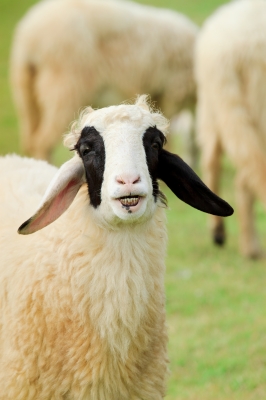
1. Show students the picture of a sheep.
Image courtesy of TCJ2020 at FreeDigitalPhotos.net
When they sing the word “sheep” they can make a pose like a sheep or point to the picture. If you have lively students, they might enjoy skipping or galloping during this part of the song instead.
2. On the words, “It’s 2015,” students stop moving and make the numbers 2015 with their fingers. Very young students can stop and wave their arms in the air as if saying “Hooray!”
3. Write the letters for the word “sheep” on the board. Clap the rhythm below to accompany the letters. (slow, slow, quick quick, slow)
To make it more challenging, students can pat, stamp, or snap the rhythm. My students like to clap the first time they spell “sheep,” then they pat their legs, and finally they stamp their feet. If you have instruments in your classroom, you can play this part.
4. The song ends with “It’s the year of the sheep!” Students make the sheep pose, or point to the picture.
———————————————————————————————————————-
You can also celebrate the New Year with our song, “Happy New Year!” I wrote it with our son Christian, and it is always a hit with our students. You can find it on Kathy Kampa’s Special Days and Holidays. The lyrics are easy for students to follow.
Students like to pat their legs, then clap their hands to the beat.
On the last Happy New Year, they turn around and wave their hands.
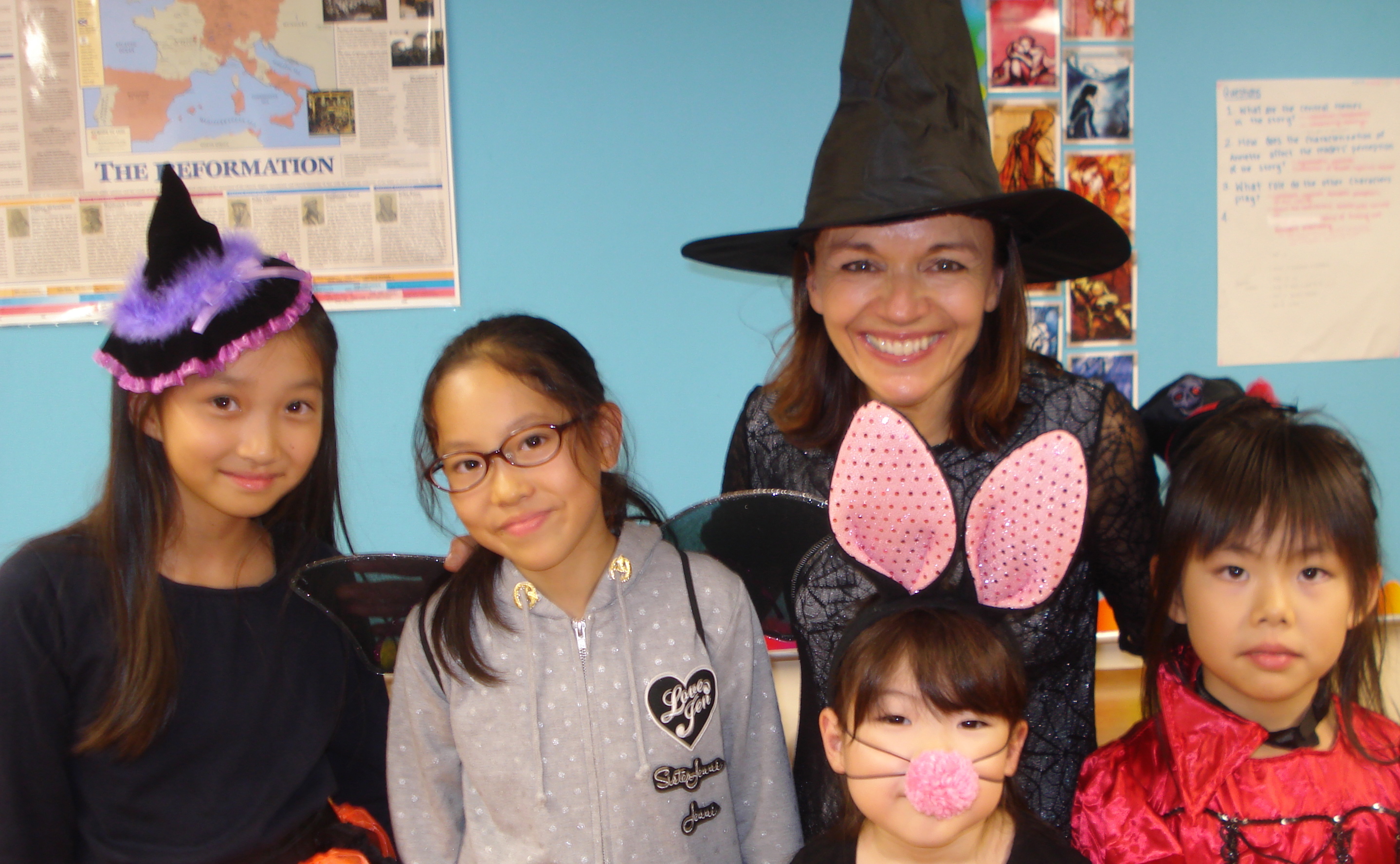
I love Halloween! It’s a time of year when students can use their imaginations and pretend to be many different characters. The photo above shows me with some of my students.
How can your students use their imaginations and expand their creativity?
1. USE VISUALS Build Halloween vocabulary by showing pictures, puppets, or other visuals.
These Halloween characters made from recycled toilet paper rolls are a simple way to get started. This first activity is by Artsy Momma. The second one is by Connect English School. Click on the first picture to find more Halloween activities on our Pinterest page.
Inspired by the outline of students’ hands
2. ADD MOVEMENT IN DIFFERENT WAYS Movement is an important way for children to learn. How do you feel about movement in your classroom? It’s important to teach students the commands “Move!” and “Stop!” Games like Simon Says help students learn this important skill, too.
Your students can create movements like Halloween characters. Hold up a picture card and have students make a “pose” in one place.
Now students can move around a circle. Say, for example, “Abracadabra! Move like a witch!” Students can move like a witch around the circle. This might look like galloping or flying on a broomstick. You might have students move for ten counts. Count to ten. “1-2-3-4-5-6-7-8-9-10” and say “Stop!” Praise students who have stopped moving. Then repeat with other characters.
Here are some suggestions for movement:
Witch: Students pretend to fly on broomsticks by holding their hands in front of their bodies and galloping.
Ghost: Students move their arms smoothly up and down, while walking in curvy pathways around the room.
Bat: Students pull their elbows in to create small wings. They move quickly around the room. My students also like to pretend they’re sleeping bats by folding their arms in and creating an upside-down pose.
Owl: Students stand in one place with their arms down. They turn their heads from side to side.
Black Cat: Students pretend to have whiskers, paws, and a tail. They sneak around with tiptoeing movements. I remind them to be “kind cats.”
3. ADD PROPS Students can also use their imaginations with costumes or props. With a scarf, a student can turn into a prince or princess, ride a witch’s broomstick, or become a spooky ghost. Pieces of fabric can be used over and over again and made into various costumes.
4. ADD MUSIC My Halloween song “I’m A Witch” prompts students to imagine becoming different Halloween characters.
Before we move to the song, we sit down together to listen to it. I sing my transitional song before we start, Come and Sit In Front of Me. I’m happy to provide this FREE professional version for you!
Here are the lyrics to Come and Sit in Front of Me:
Come and sit in front of me,
In front of me, in front of me,
Come and sit in front of me,
In front of me.
(Repeat)
Now you’re ready to listen to I’m a Witch.
Here’s a simple version of the song. (A more professional version is available below.)
Spoken: Let’s be witches and fly on our broomsticks.
Hee! Hee! Hee! I’m a witch!
Hee! Hee! Hee! I’m a witch!
Hee! Hee! Hee! I’m a witch!
Happy Halloween!
Spoken: Let’s be ghosts and float gently through the air.
Boo! Boo! I’m a ghost! (3X) Happy Halloween!
Spoken: Let’s be bats and fly through the night sky.
Eeek! Eeek! I’m a bat! (3X) Happy Halloween!
Spoken: Let’s be owls and turn our heads from side to side.
Whoo! Whooo! I’m an owl! (3X) Happy Halloween!
Spoken: Let’s be black cats. Put on your whiskers and sneak around.
Meow! Meow! I’m a black cat! (3X) Happy Halloween!
Show students images of each of the characters in the song as it plays. Using visuals is important — especially for students learning English. This is an important first step in learning the vocabulary in the song.
Whenever students are moving in your classroom, check to make sure that everything is safe. Push chair legs in, and move things out of the way.
Now students make a circle and move around it. Hold up pictures of each character if they need more practice. Now play the music! Remind students to stop after each character, and listen for the new cues.
If your classroom isn’t conducive to a lot of movement, have each student choose one character for movement. You can have students draw this picture, or pass out small picture cards.
I hope that your students have as much fun as mine do with this song!
Check out the professional version of “I’m a Witch” available on iTunes and CDBaby. Just click on the title below:









 If the student rolls the number 2 (sometimes) and picks the chore card “wash the car,” the student says “I sometimes wash the car.”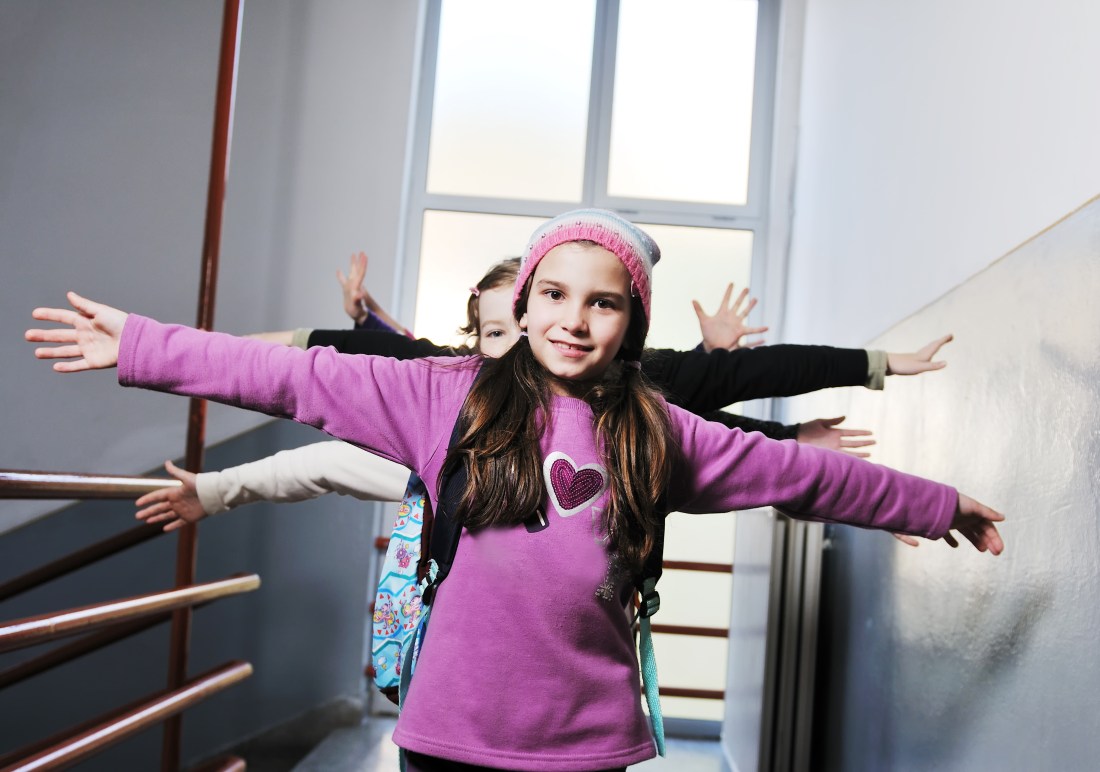







 MagicTimeKids