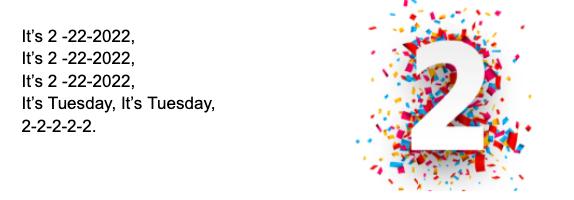
February 22, 2022 is a historic day–it’s 2/22/22! AND it’s on a Tuesday, yes, that’s TWO’S-DAY.
I wrote a little song called “Two-Two-Two-Two-Two” to celebrate this auspicious day.
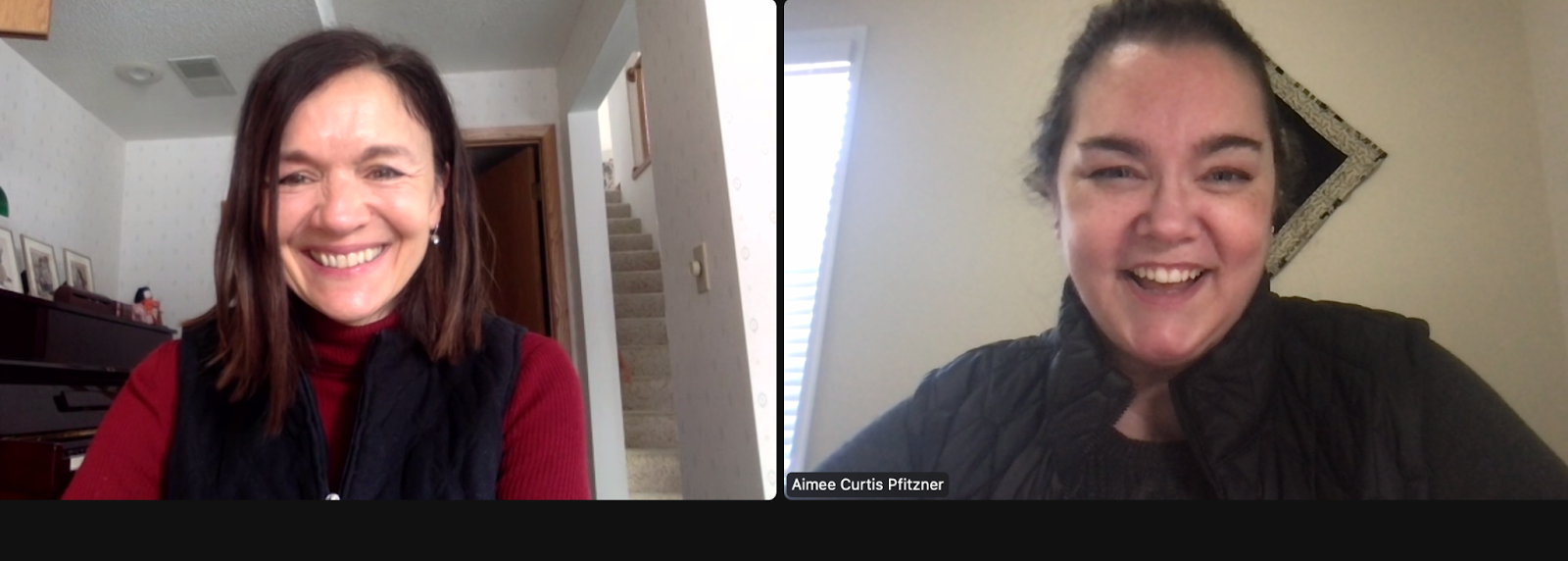
One of the wonderful outcomes of the pandemic was meeting amazing teachers online, like Aimee Curtis Pfitzer. Aimee is a passionate musician, songwriter, and teacher. She’s constantly creating. She has written numerous books with Beatin’ Path Publishing. Check her out at www singsmileplay.com. So I reached out to Aimee to collaborate with me on this little song. Here’s our Zoom photo!
In this blog post, you’ll find the song lyrics, the notation, accompaniment, and a video with movement suggestions. We hope that your Tuesday, February 22, 2022 will be amazing!
Here are the lyrics:
Two, Two, Two, Two, Two!
Here’s the musical score for the song with the words written out. Thanks to Aimee Curtis Pfitzner for creating this score.
Have fun by adding some movement! Hold up two fingers. Make the shape of the number 2! Add some 2 count patterns by clapping, patting, stamping, and snapping. Grab your “tutu” if you have one!
Here’s a slow version of the song “Two, Two, Two, Two, Two” using hand gestures.
Here’s the faster version using “body percussion.” I made a pattern–pat, clap, pat, clap-clap.
Here’s the “karaoke” accompaniment on Chrome music lab. It’s fun for your students to see how the melody is moving. We’ve made two versions, a slower tempo and a faster one. If you have Boomwackers, your students can play this.
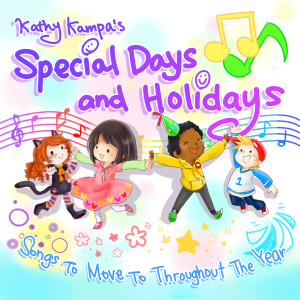
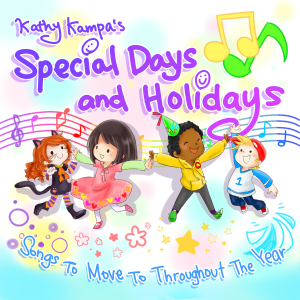
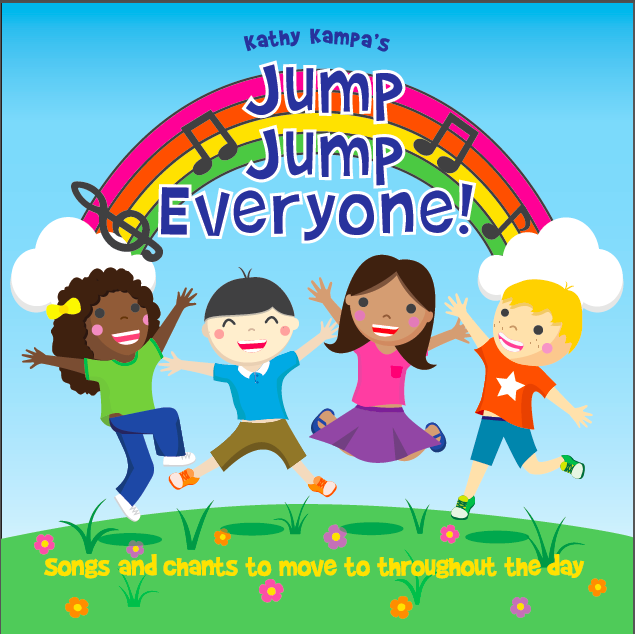
Kathleen’s two CDs for young learners, Kathy Kampa’sSpecial Days and HolidaysandJump Jump Everyone, build English language skills through music and movement while nurturing creativity and imagination.
Kathleen strives to help all students feel supported, balanced, and successful in the classroom. She supports the development of English language skills by creating songs, chants, and movement activities targeted to young learners’ overall needs.
Jump, hop, tiptoe . . . this CD invites children to move and use their imaginations. Grab a scarf and pretend to be a butterfly or a flower. Make the sounds of the rain on your legs. Children move in developmentally appropriate ways.
This album is filled with songs to celebrate the special days in your child’s life–a birthday, a loose tooth, plus lots of holidays. Songs prompt fun movement for kids.
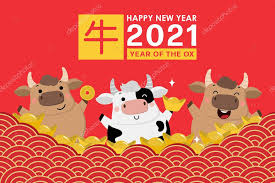
The festivities are beginning for Chinese New Year! This is the year of the ox! Why not celebrate with your students by using this simple chant/song!
During the pandemic, many students have not been allowed to sing. So enjoy these lyrics as a chant.
It’s The Yearby Kathy Kampa
Part A:
It’s the year of the ox,
It’s the year of the ox,
It’s the year of the ox,
It’s 2021!
Part B:
o-x ox!
o-x ox!
o-x ox!
It’s the year of the ox!
Try some of these movement suggestions. My students like making the animal shapes for each year of the Chinese calendar. I ask my students for their ideas. To make the shape of an ox, many of the students made horns with their fingers.
How can your students show the year 2021? My students liked to “draw” the numbers in the air. Some of them made numbers with their fingers. A few of them just decided to jump up into the air to celebrate!
My students really love making these letter shapes! If your students aren’t used to making letter shapes, you can model this activity. Students make letters with their fingers, their arms, or even their whole bodies!
Let’s make the letter o with our fingers. Can you make it bigger? Try using your hands? Can you make the letter o even bigger? Wow! You can make it with your whole body! Now let’s try making the letter x in the same way.
Put these all together into a chant. Add instruments if you like to really make it festive!
If you’re interested in a melody to sing this, check out my simple video here. I’ve combined two familiar songs to create this new song.
Check out Kathy Kampa’s Special Days and Holidays for songs to celebrate your child’s special days–Valentine’s Day, Easter, a birthday, or even a loose tooth!
Children’s songs for special events for pre-school, kindergarten, and elementary students
Happy New Year 2021! We have celebrated O-shogatsu (New Year’s) with toshikoshi soba and o-sechi ryori, traditional New Year’s foods. A couple of days ago my friend Kumi stopped by with her children. They had the song “Happy New Year” playing in their car. It fun to hear them singing along with with it. What a precious moment!! When our son Christian was in elementary school, he started playing this simple melody on our piano. Now he’s grown up and is acting in Hollywood! I love this recording with Christian and my husband Chuck singing it at home for you:.
How should we move with this song? When students first listen to the song, they might like to jump, march, or twirl around.
When I first teach the words to this song, students keep a “steady beat” by patting their legs or clapping their hands. Then, to make it a little more challenging, students can create a pattern by patting their legs once, then clapping their hands. Think “pat-clap-pat-clap” or “down-up-down-up.” Do this for the first three lines.
We like to do something special on the last line:
— On Happy New Year! my students like to shake their hands above their heads. Some students like to turn around quickly!
— On Hip hip hooray! students roll their hands, then jump once in place.
For an even bigger challenge, students can do the pat-clap pattern with a partner by patting their own legs, and then “air clapping” both hands with a partner.
Check out this pre-COVID video to see what my students did a couple of years ago! Students stand in a circle facing their partner. First they pat their own legs, then clap with their partner. Then they turn to the person on the other side (called a “corner” in folk dance), repeating the pat-clap. They repeat the pattern with their partner, then corner until the Hip hip hooray.
With COVID protocols in place, I’m going to revise this activity. Every student has a set of sticks, so I’m going to experiment using sticks like the Indian Dandiya dance. This will give students a chance to interact with a partner at a distance. Perhaps you have an idea for adapting this?
Happy New Year 2021! So perhaps you’re not singing with your students. Remember my chant.
We hope that you keep a song in your heart and a smile on your face. May this year be filled with lots of joy!
Kathy
Happy New Year is one of 15 great songs for kids on Kathy Kampa’s Special Days and Holidays. The CD includes a handy attached booklet with lyrics, and is available for teachers in Japan at ETJ Book Service.
For teachers residing outside of Japan, the songs are available for download through iTunes. To hear the studio version of this song, go to iTunes, and click on Track #3. CDs are also available for sale through the Mad Robin Music & Dance in Seattle, WA.
Kathy’s second CD Jump Jump Everyone is filled with songs to get students moving! Songs and chants build English language skills through simple movement activities. They nurture a child’s imagination and creativity. There are beautiful seasonal songs, lively gross motor movement songs, plus effective transitional songs. Grab a scarf and play along. Grown in the young learner classroom, you’ll find that your children will ask for these songs over and over again.
Students love to make letter shapes with their bodies.
Learning the names of the days of the week in English can be tricky. For many of us, we teach our English class on the same day each week. This song “What Day Is It?” is a fun way to practice the days of the week.
First of all, write a letter on the board or show a picture card. Model making that letter with your fingers, arms, or whole body. Make the letter so that students are able to read it. You might imagine how that letter would look when you write it on your whiteboard. Students will be able to “read” your letter. Invite students to make letters with you. They might even make letters with the entire class! Try making letters in many different ways.
We started at the beginning of the alphabet. Students made A, a, and B, b (see B below). In Magic Time (Oxford University Press) students have fun making letter shapes to learn the letter name and its sound.
Now write the names of the days of the week. Run your finger under the word as you say it (Sunday). Point out the first letter. Encourage students to make that letter with their bodies in several ways. Remind students that days of the week begin with capital letters. As you can see, sometimes the letters appear flipped around to us. The important idea is that students are making the letter shapes.
I love to catch my students making their amazing letters by taking photos. Remember CCBA (Catch Children Being Amazing!)
Pass out the “days of the week” cards, one to each student. Students line up in order around the circle starting with Sunday. Students make the initial letter shape as they sing each day of the week. When they sing “Tra la la la la” add a group movement, such as pat your knees, clap your own hands, clap your “neighbor’s” hands.
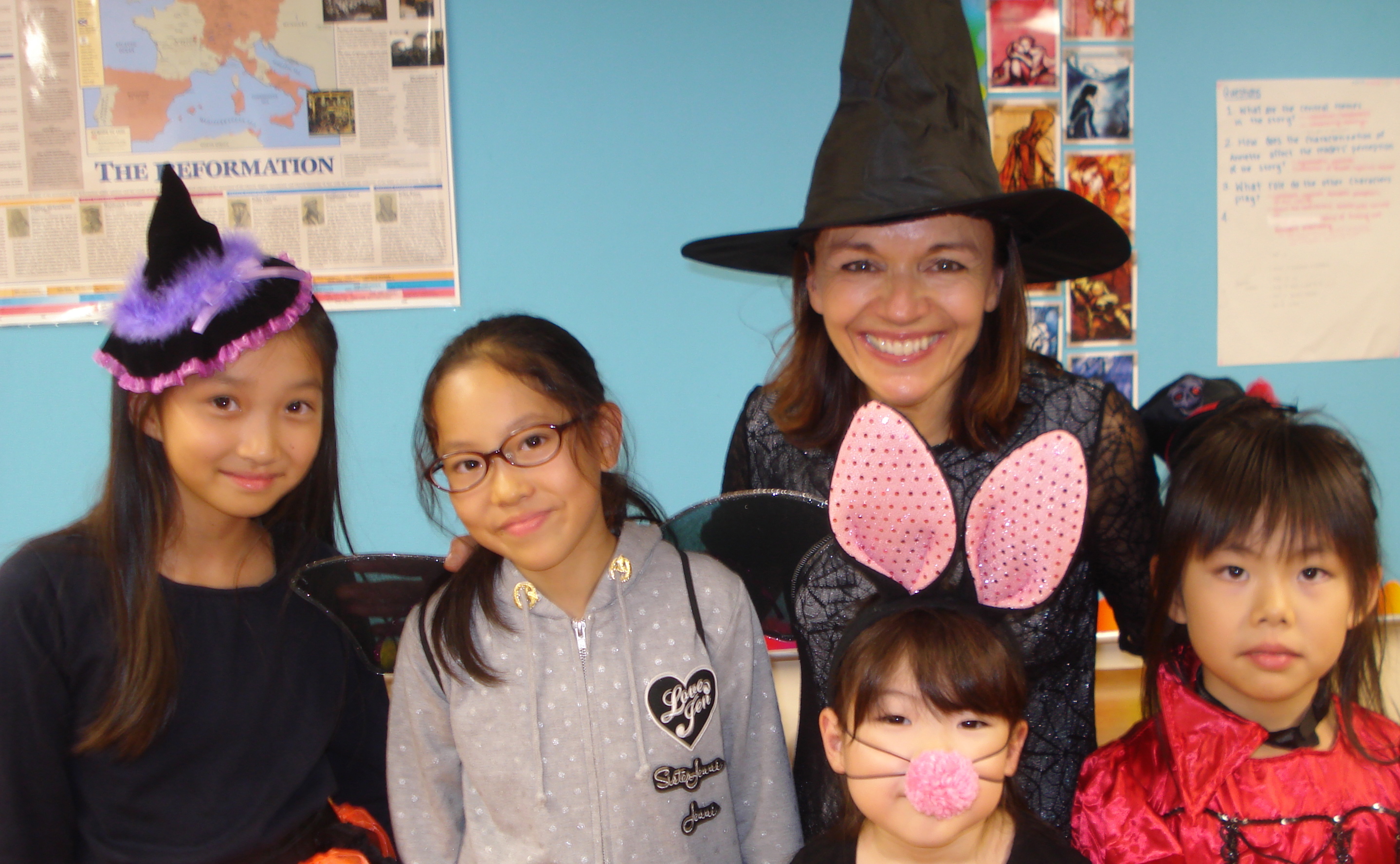
I love Halloween! It’s a time of year when students can use their imaginations and pretend to be many different characters. The photo above shows me with some of my students.
How can your students use their imaginations and expand their creativity?
1. USE VISUALS Build Halloween vocabulary by showing pictures, puppets, or other visuals.
These Halloween characters made from recycled toilet paper rolls are a simple way to get started. This first activity is by Artsy Momma. The second one is by Connect English School. Click on the first picture to find more Halloween activities on our Pinterest page.
Inspired by the outline of students’ hands
2. ADD MOVEMENT IN DIFFERENT WAYS Movement is an important way for children to learn. How do you feel about movement in your classroom? It’s important to teach students the commands “Move!” and “Stop!” Games like Simon Says help students learn this important skill, too.
Your students can create movements like Halloween characters. Hold up a picture card and have students make a “pose” in one place.
Now students can move around a circle. Say, for example, “Abracadabra! Move like a witch!” Students can move like a witch around the circle. This might look like galloping or flying on a broomstick. You might have students move for ten counts. Count to ten. “1-2-3-4-5-6-7-8-9-10” and say “Stop!” Praise students who have stopped moving. Then repeat with other characters.
Here are some suggestions for movement:
Witch: Students pretend to fly on broomsticks by holding their hands in front of their bodies and galloping.
Ghost: Students move their arms smoothly up and down, while walking in curvy pathways around the room.
Bat: Students pull their elbows in to create small wings. They move quickly around the room. My students also like to pretend they’re sleeping bats by folding their arms in and creating an upside-down pose.
Owl: Students stand in one place with their arms down. They turn their heads from side to side.
Black Cat: Students pretend to have whiskers, paws, and a tail. They sneak around with tiptoeing movements. I remind them to be “kind cats.”
3. ADD PROPS Students can also use their imaginations with costumes or props. With a scarf, a student can turn into a prince or princess, ride a witch’s broomstick, or become a spooky ghost. Pieces of fabric can be used over and over again and made into various costumes.
4. ADD MUSIC My Halloween song “I’m A Witch” prompts students to imagine becoming different Halloween characters.
Before we move to the song, we sit down together to listen to it. I sing my transitional song before we start, Come and Sit In Front of Me. I’m happy to provide this FREE professional version for you!
Here are the lyrics to Come and Sit in Front of Me:
Come and sit in front of me,
In front of me, in front of me,
Come and sit in front of me,
In front of me.
(Repeat)
Now you’re ready to listen to I’m a Witch.
Here’s a simple version of the song. (A more professional version is available below.)
Spoken: Let’s be witches and fly on our broomsticks.
Hee! Hee! Hee! I’m a witch!
Hee! Hee! Hee! I’m a witch!
Hee! Hee! Hee! I’m a witch!
Happy Halloween!
Spoken: Let’s be ghosts and float gently through the air.
Boo! Boo! I’m a ghost! (3X) Happy Halloween!
Spoken: Let’s be bats and fly through the night sky.
Eeek! Eeek! I’m a bat! (3X) Happy Halloween!
Spoken: Let’s be owls and turn our heads from side to side.
Whoo! Whooo! I’m an owl! (3X) Happy Halloween!
Spoken: Let’s be black cats. Put on your whiskers and sneak around.
Meow! Meow! I’m a black cat! (3X) Happy Halloween!
Show students images of each of the characters in the song as it plays. Using visuals is important — especially for students learning English. This is an important first step in learning the vocabulary in the song.
Whenever students are moving in your classroom, check to make sure that everything is safe. Push chair legs in, and move things out of the way.
Now students make a circle and move around it. Hold up pictures of each character if they need more practice. Now play the music! Remind students to stop after each character, and listen for the new cues.
If your classroom isn’t conducive to a lot of movement, have each student choose one character for movement. You can have students draw this picture, or pass out small picture cards.
I hope that your students have as much fun as mine do with this song!
Check out the professional version of “I’m a Witch” available on iTunes and CDBaby. Just click on the title below:
Featuredimage courtesy of hin255/ FreeDigitalPhotos.net.
One of the “big ideas” we teach young learners is the concept of change. Babies grow up. Children can mark their height and see how they are changing. Little seeds planted in the ground in our little paper cups grow into plants. Small pumpkins grow into big pumpkins. Caterpillars turn into butterflies.
Halloween is filled with magical changes. Children put on costumes, and “change into” a princess, Spiderman, a witch, a ghost, or a character from their favorite Disney movie.
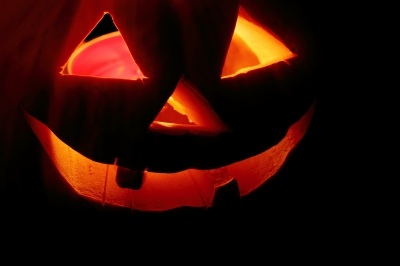
When we think of Halloween, we see the magical change of pumpkins into jack-o-lanterns. When possible, I love to purchase a pumpkin for Halloween and teach children how to carve it into a jack-o-lantern.
In the classroom, it’s easy for students to use craft projects to show both a pumpkin and a jack-o-lantern. For a very simple art project, trace the outline of a pumpkin on orange construction paper. Students cut out the shape. With colored pencils or crayons, they draw the ridges of the pumpkin on one side, and a face of a jack-o-lantern on the other.
For more pumpkin craft ideas, check out my Pinterest page with simple cooking and craft ideas.
Here’s a simple chant to teach the words “pumpkin” and “jack-o-lantern.”
Show the students the plain side and say “pumpkin.” Then turn it around and say “jack-o-lantern.” Once students know these two words, put it into this simple chant:
Pumpkin, Pumpkin (words adapted by Kathleen Kampa, music: traditional)
(Sit with students in a small circle. Sing quietly.)
Pumpkin, pumpkin, small and fat, (With fingers, make the shape of a small pumpkin.)
Turn into a jack-o-lantern, (Roll hands. Spread fingers out wide.)
Just like that! (Tap two fingers on the palm of your hand as you say each word.)
(Sing the verse again!)
Spoken: Grow and grow and grow and grow
and grow and grow and grow and GROW! (Slowly stand up while making a big pumpkin shape. If you’re standing in a circle with the students, make it bigger. Get louder! Crescendo!)
(Sing loudly.)
Pumpkin, pumpkin, big and fat, (While standing, make the shape of a big pumpkin with your whole body.)
Turn into a jack-o-lantern, (Turn around. Jump into a big shape.)
JUST LIKE THAT! (Clap and stamp on each word.)
(Sing the verse again!)
Here is a simple recording of the song to let you hear the melody and rhythm.
For a professional version of this song and other Halloween songs I’ve written, click here.
I’d love to see your children singing and dancing to this song. I’d love to see their cute jack-o-lanterns. Share this idea with your friends. Tell me how you’ve used this with your students.
Skeleton Dance is definitely one of my students’ favorite songs! It teaches various body parts and directional movements. You can start your school day with it, use it during break time, dance it on a rainy day, move during a health unit, or dance it on Halloween. I have taught Skeleton Dance to students in kindergarten through upper elementary, and everyone enjoys it. I’ve also shared this song with teachers in America, Japan, Korea, Mexico, Taiwan, Thailand, Vietnam, and Indonesia.
You can watch some of my students here in Japan doing the Skeleton Dance, and read the lyrics below:
Here’s how you do the Skeleton Dance:
In this song, students will move four different body parts: shoulders, elbows, knees, and feet.
First, students move their shoulders to the beat.
1. Move your shoulders . . .
A. Skeleton, skeleton, skeleton dance, Move your shoulders, do the skeleton dance. Skeleton, skeleton, skeleton dance, Move your shoulders, do the skeleton dance.
Next, students move their whole bodies to the front, to the back, and to the side. I usually start by moving only my arms, but my students love to jump in each direction.
B. To the front, to the back, to the side, side, side, To the front, to the back, to the side, side, side,
Next, students move their shoulders up, down, and around. Each time they repeat the song, they will move a different body part in these directions.
C. Put your shoulders up. Put your shoulders down. Move them up and down and all around. Put your shoulders up. Put your shoulders down. Move them up and down and all around.
Finally, students move their shoulders in their own way.
This dance is repeated with the following body parts.
Before I play the music, my students and I figure out how we’ll move up, down, and around using each of these body parts.
2. Move your elbows . . .
3. Move your knees . . .
4. Move your feet . . .
You can download this song from iTunes (Track #15) or CD Baby.
I hope that your students enjoy this as much as mine do.
While our summer was filled with many opportunities to enjoy the nature of Minnesota, it was also a busy time of successfully completing my MA degree. Now we have time to share many more ideas with you!
On our second day back at school, my Grade One students found a giant grasshopper outside of our classroom. It was as big as a praying mantis. We took it into our classroom. What an exciting way to begin our new school year!
Giant grasshopper
Children are fascinated with living creatures–especially insects and other mini-beasts. While some children may be a bit timid about holding certain insects, most seem to enjoy them.
Here are a couple of activities that you can easily do in your classroom.
1.Simple, Invented Songs
It’s easy to nurture creativity in young learners through music. Try “playing” with words.
Here’s a simple pattern to create a song or chant.
Students choose three insects for their song, usually one shorter word, and two longer words.
When young children sing, they often use so and mi in their invented songs. You can use so and mi for this song, too.
My students think it’s funny to sing the negative form of this. I don’t like ______. I hate bugs!
Another activity to help students play with words is to repeat the first consonant of a word, such as /b/ /b/ /b/ /b/ Bees! Bees!
2. Stories
I love using stories with my students–especially predictable ones. A predictable story uses repetition, similar to the way a song might have a chorus. It might have repeated words, phrases, sentences, and other patterns. New characters, new events, and other surprises keep the children guessing about what’s going to happen next.
Story: The Very Busy Spider by Eric Carle
This story shows how a spider gradually spins a web. In my edition of this book, students can also feel the change in the web as it gets bigger. You can read the book to your students in a traditional manner, but you can use the pictures in the book like flash cards to help you tell the story.
A. Pre-read by looking at the pictures of the animals in the book. You can chant this pattern, or sing it to the melody of “The Farmer in the Dell.”
The horse says “Neigh!” The horse says “Neigh!” Let’s play together. “Neigh! Neigh! Neigh!”
Many animals visit the spider, but the spider continues to spin the web.
Repeat with the other animals from the story (cow, sheep, goat, pig, dog, duck, rooster).
The cow says “Moo!” The cow says “Moo!” Let’s play together. “Moo! Moo! Moo!”
The phrase for the rooster is longer than the rest.
“Cock-a-doodle-doo!” “Cock-a-doodle-doo!” Let’s play together. “Cock-a-doodle-doo!”
B. Now add the following chant pattern.
(But the spider said . . . ) Sorry. I’m busy. I’m spinning a web. Busy, busy, busy. I’m spinning a web.
Add gestures to help children remember the language. Change your voice to express the sounds of the animals.
C. Now I “read” the story by showing the children the pictures of the animals and singing the animal songs. I show students the web in the book. With a small class, students can feel the texture of the web on the page. On subsequent readings, you can draw the web on a whiteboard as the story progresses by drawing a couple of lines at a time. If your students can sit in a circle, you can even create a yarn web by passing a ball of yarn from one student to one across on the other side.
D. At the very end, an owl comes and the spider is sleeping.
Whisper . . . .
The spider was busy, but she’s sleeping now. Sh! Sh! Be quiet! She’s sleeping now.
*Another fun predictable story with insects and animals is Lily and the Moon by Mari Nakamura and Patricia Daly Oe.
3. Find It!
You can look for insects outside with your students. You can also find them in books! In Magic Time One, Unit One, Annie and Ted are outside playing. In addition to finding the target vocabulary, students can look for animals and insects on these pages too. They can find a dragonfly, grasshopper, rabbit, turtle, frog, squirrel, bird, butterfly, and caterpillar. We love to add little surprises for the students to discover.
Enjoy this season of insects and mini-beasts! Happy teaching!
In my last post, I explained two ways to teach this song. Here’s a video of my students sharing this dance with you. You can find the lyrics in my blog post “Hop Along Easter Bunny.” If you like this music, check out my CD Kathy Kampa’s Special Days and Holidays, available on iTunes and CD Baby.
(Note: This is our second blog post on transitional songs. Our first blog post, entitled “Transitional Songs Part One,” was posted on September 23, 2013. Please scroll down this page to our earlier blog posts to find it, or simply click here. Thanks!)
In any children’s class, many activities are needed to keep students happy and motivated throughout the lesson. Transitional songs are a perfect way to signal to children that one activity is ending and another is beginning. A good transitional song also has other benefits:
It supports the natural rhythm and intonation of the phrase or sentence you are using.
The melody is quickly learned and recognized by students, so they move into action as soon as they hear it.
In most cases, children can be encouraged to sing along, building group cohesion as well as productive language skills.
Transitional songs soon become part of a classroom routine, giving students a sense of structure and making them feel secure during the lesson.
Today, for Part Two, we present a variety of transitional songs that help to make activities smooth and enjoyable for students.
1. Open Your Books
This song is a great way to motivate students to open their student books to the correct page.
Open your books. Please open your books. (gesture)
(Spoken) Turn to page _________.
(Write this page number on the board, or show the number with your fingers. Hold the book open to show the page to students, then check to be sure all students are ready.)
Open your books.
2. Let’s Make a Line
This transitional song quickly motivates children to form a line in the classroom, either for an activity or when they are preparing to leave the classroom.
This is a great chant to use when students need to find a partner. Demonstrate this chant with one student first. Decide how students will show that they are partners. They can stand back-to-back, touch palms, sit facing each other knee-to-knee, etc.
Practice finding partners before you actually do your activity.
(Note: The following transitional songs can be found on our blog post entitled “Transitional Songs, Part One.” Please scroll down to our earlier blog posts to find these songs and the recordings for them, or simply click here.)








 Happy New Year is one of 15 great songs for kids on Kathy Kampa’s Special Days and Holidays. The CD includes a handy attached booklet with lyrics, and is available for teachers in Japan at
  English language skills through simple movement activities. They nurture a child’s imagination and creativity. There are beautiful seasonal songs, lively gross motor movement songs, plus effective transitional songs. Grab a scarf and play along. Grown in the young learner classroom, you’ll find that your children will ask for these songs over and over again.







 MagicTimeKids