Let’s Celebrate the New Year!

%22Happy New Year 2014 Card46%22 by gubgib

“Happy New Year 2014 Card46” image courtesy of gubgib / FreeDigitalPhotos.net

It’s already January 3rd, yet here in Japan, New Year’s celebrations continue. O-shogatsu (New Year’s) begins on the night of Dec. 31st and continues for three days. Tonight we’ll be enjoying o-sechi ryori, traditional New Year’s foods, with our Japanese friends. Starting on Monday, I’ll be back in the classroom with my students. Here are two songs I’ve written to teach my students about New Year’s celebrations. The first song was written with my son Christian when he was in elementary school. He and Chuck are singing it for you!

Happy New Year

Words and music by Christian Vilina and Kathleen Kampa

copyright © 2013 by Kathleen Kampa

Happy New Year!  Happy New Year!

Happy New Year!  Happy New Year!

Happy New Year!  Happy New Year!

Happy New Year!  Hip hip hooray!

My students love to keep a “steady beat” by patting their legs, then clapping their hands.  Think “pat-clap-pat-clap.” Do this for the first three lines.

We like to do something special on the last line.

On Happy New Year!  my students like to wave their hands above their heads. More advanced students like to turn around quickly!

On Hip hip hooray! students roll their hands and jump once in place.

To hear the studio version of this song, go to iTunes, and click on Track #3.

________________________________________________

And now for our second New Year’s song! . . .

In the Chinese or lunar calendar, this is the Year of the Horse. Here in Japan, we already began celebrating the Year of the Horse on January 1st.

In this song, students learn the name of the animal, how to spell the animal name, and how to say “2014.”

It’s The Year

Words by Kathleen Kampa

copyright © 2013 by Kathleen Kampa

Medley of songs based on French song “Marlbrough s’en va-t-en guerre” (For He’s a Jolly Good Fellow) and BINGO

It’s the year of the horse,

It’s the year of the horse,

It’s the year of the horse,

It’s 2014.

H–o–r-s-e, h–o–r-s-e, h–o–r-s-e,

It’s the year of the horse!

1. Display the image of the horse. There are twelve animals in the lunar calendar. What do your students know about horses? Can they make a pose like a horse? Can they gallop like a horse? What other movements do horses do?

If you have a small space, have students create a pose when they sing the word “horse.” If you have a larger space, students may enjoy galloping in a circle while singing “It’s the year of the horse.”

2. Write the number 2014 on the board. My students like to make these numbers with their fingers. Try this:

Hold up two fingers for “two,” then move two fingers in a circle to say “thousand.” For fourteen, students hold up one finger on their left hand, and four fingers on their right.

When you sing the song, students stop in place and do the finger movements on “It’s 2014!” Students can even wave their hands in the air!

3. Now your students are ready to spell. Write the word horse on the board. Use lower case letters. Say the letters with your students.

Then clap the rhythm while saying the letters.

You can encourage your students to make different sounds for this rhythm by patting their legs, stamping their feet, or snapping their fingers. You can even add simple instruments.

4. Finish the song with a horse pose on “It’s the year of the horse!”

We hope you enjoy these New Year songs with your students!

Happy Teaching!

Kathy and Chuck

The Flower Poem

%22The Rose%22 by Gualberto107

“The Rose” courtesy of Gualberto107 / FreeDigitalPhotos.net

If you sing the Autumn Leaves song with scarves (see the blog post below this one), you might like to finish up with this poem about a flower. I first show my students a picture of a flower with leaves. I then use 27-inch hemmed scarves from West Music.com (item #540053). These scarves expand beautifully for this poem. However, you can use other scarves as well.

To begin, scrunch up the scarf in your hands, so that it can’t be seen.

Flower Poem (with scarves)

adapted by K. Kampa

Here’s a leaf, and here’s a leaf.

(Pretend that your thumbs are leaves. Wiggle one thumb, then the other.)

Count them. 1-2.

(When you count 1-2, move your thumbs up and to the side.)

Here’s a bud.

(Open your hands slightly to reveal the scrunched up scarf.)

Here’s a flower,

(Open your hands a little more.)

blooming just for you.

(Open your hands and let the scarf ‘bloom’ like a flower.)

 Here’s a video to show you how you might do it (click on the arrows in the lower right corner of the screen to see the full picture):

Autumn Leaves Are Here!

%22Autumn Maple Leaves%22 by oana roxana birtea

“Autumn Maples Leaves” courtesy of oano roxana birtea / FreeDigitalPhotos.net

Here in Tokyo, Japan, the autumn leaves have turned colors. Now beautiful reds, oranges, and yellows fill the sky. Little by little, the leaves tumble to the ground.

My Kindergarten students delight in gathering the fallen leaves. We have a very simple song about the autumn leaves that I’d like to share with you. If you have a xylophone or glockenspiel, you can play it by starting at the shortest bar (C) (do), and going step by step to the longest bar (C).

Autumn Leaves Song One (traditional melody)

Down, down, down, down, the leaves are falling to the ground. 

    do       ti        la       sol             fa              mi        re        do

Whoosh!

My students will sing this song over and over again until you finally bring the song to a close by saying “Last time” and eliminating the “Whoosh!”

If you have colored leaves, let students dance with the leaves in their hands. If you don’t have colored leaves, you can have students make them out of construction paper. They can paint or color them. My students also love to dance with lightweight scarves (available at West Music.com — item # 540053). As students sing, they move their bodies lower and lower, just like the music. When they sing “Whoosh!” they pretend to scoop up the leaves / scarves and start again.

You can make this song a little more complicated by adding the colors of autumn leaves.

Autumn Leaves Song Two

Adapted by K. Kampa

Red, yellow, orange, and brown, the leaves are falling to the ground. 

Whoosh!

Here’s a video to give you some ideas (click on the arrows in the lower right corner of the screen to get a full video image):

Celebrate Halloween as Marching Monsters . . . Boo!

Happy Halloween by digitalart

(Image courtesy of digitalart / FreeDigitalPhotos.net)

Do your students like to pretend to be different Halloween characters? Then “Marching Monsters” is a great new addition to your Halloween song repertoire! It encourages creativity and imagination, plus gives students great language practice with “alliteration.”

“Alliteration” happens when two or more words begin with the same sound. The phrase “marching monsters” has two words that begin with the sound /m/. Other phrases in the song include “skipping skeletons,” “waltzing witches,” and “jumping jack-o-lanterns.” Children love to sing these fun phrases while doing the actions throughout the song. They also learn the song quickly because of the repeated phrases.

Here is a simple recording of the song. A FUN professional version is available on iTunes here (just click on Track #11).

Here are the lyrics, plus notes on how to teach it!

Marching Monsters

Words and music by Kathleen Kampa and Charles Vilina

copyright © 2013 by Kathleen Kampa

1. Marching monsters!  Happy Halloween!  Boo!

Marching monsters!  Happy Halloween!  Boo!

Marching monsters,

Turn around and stop! (hold)

Marching monsters!  Happy Halloween!  Boo!

2. Skipping skeletons!  Happy Halloween!  Boo! . . .

3. Waltzing witches!  Happy Halloween!  Boo! . . . .

4. Jumping jack-o-lanterns!  Happy Halloween!  Boo! . . . .

Students can move around a circle or freely around the classroom.

1. On Marching Monsters, students march around, pretending to be monsters. On Turn around and stop, students turn around and make a pose. They hold until the music begins again.

2. On Skipping Skeletons, students skip around, moving their arms like a skeleton. For very young learners, children can gallop, or they can slide sideways.

3. On Waltzing Witches, students dance in one place. If you’re in a circle, face the center. Students sway from side to side moving their arms.

4. On Jumping Jack-o-lanterns, students jump in one place, making the shape of a jack-o-lantern.

Enjoy this wonderful song and dance activity with your students!

Once again, you can find the professional version of this song on

Kathy Kampa’s Special Days and Holidays, available on iTunes.

Happy Teaching!

Kathy and Chuck

“The Apple in the Tree” : Storytelling that builds phonics and listening skills!

%22Elefante%22 by Idea go

“Elefante” courtesy of Idea go / FreeDigitalPhotos.net

As teachers of young learners, we know that phonics is an important part of our curriculum.  How can we teach phonics in a way that gets children excited to learn?

 The following activity is one of our favorites!  Here’s how it’s done:

1.  Begin by showing your students the following words illustrated with colorful pictures. These six vocabulary words are part of our Magic Time series (Magic Time One, Spring ABC’s).  If you teach Magic Time, use the picture cards for that lesson. If not, make your own picture cards, placing the upper and lower case letters above the picture that begins with that sound. Attach them to your whiteboard or blackboard. You can also use items such as stuffed animals, puppets, plastic fruit, etc.  The Internet also has pictures available.

Aa   apple

Bb   bear

Cc   cat

Dd   dog

Ee   elephant

Ff    fish

2.  For each picture card, teach the letter name (optional), the letter sound, and the word that begins with it.  For example:  “A / a / apple,” and so on.  Continue until students are familiar with the six words and the sounds they begin with.  Students can also make apple shapes, or explore the movements these animals make.

3.  Draw a simple apple tree on the board, with one big apple high up on a branch of the tree.

4.  Next, read the following story to your students.  As the six words above are introduced in the story, point to their pictures on the board.  You may want to tell the story more than once as you say the words slowly and clearly.

The Apple in the Tree

by Kathy Kampa and Chuck Vilina

copyright © 2013 by Kathleen Kampa and Charles Vilina

Once upon a time, there was a very hungry elephant.  She was looking for something to eat.  Suddenly, she saw an apple tree with a big red apple on it.  She reached for the apple with her trunk.  Oh, no!  It was too high up in the tree.

Along came a bear.  “Climb up on my back,” said the elephant, “and you can get the apple.”  So the bear climbed up on the elephant’s back, and reached for the apple.  Oh, no!  It was too high up in the tree.

Along came a dog.  “Climb up on my back,” said the bear, “and you can get the apple.”  So the dog climbed up on the bear’s back, and reached for the apple.  Oh, no!  It was too high up in the tree.

Along came a cat.  “Climb up on my back,” said the dog, “and you can get the apple.”  So the cat climbed up on the dog’s back, and reached for the apple.  Oh, no!  It was too high up in the tree.

The elephant, the bear, the dog, and the cat looked at the apple.  It was such a big, red apple!  Oh, how they wanted to eat that apple!

Suddenly, a little fish jumped out of the water — up, up, up!  It grabbed the apple in its mouth, and went back under the water. “Thank you,” said the fish.  “I just LOVE apples!”

__________________________________________

Children love this story.  And NOW they’ll have an opportunity to MOVE to it.  Do you notice the underlined words in the story?  They are the six target words, used this many times:

apple:              14 times

bear:                  5 times

cat:                    3 times

dog:                   5 times

elephant:           4 times

fish:                   2 times

This brings us to the next step in the activity:

5.  Prepare one small picture card for each child, using the six target words above.  You can even let children draw their favorite picture (from the above group) on a piece of paper and use that.  However, the cards should be evenly mixed if possible.  For example, if you have six students, each one should get a different letter picture card.  If you have more than six students, add more cards, so that more than one student will have the same word card.

6.  Have your students place their chairs in a circle, facing out.  If space is a problem, the chairs can be put in two rows with their backs to each other.  Students sit quietly in their chairs.  At this time, give each student a picture card (unless they drew their own, in which case they should be holding them).

7.  Explain to students that you are going to tell the story again.  When a student hears the word on their picture card, they GET UP QUICKLY and run around the circle of chairs, then sit back down in their own chair.  They must do this EVERY TIME they hear their word.

8.  NOW – tell the story SLOWLY.  Watch as your children jump up out of their seats and run around the circle.  As you can see from the words above, the “apple” holders have to run around the circle 14 times!  The “fish” holders only run around 2 times.

Of course, to make it more fair, mix up the cards after the story, hand them out again, and tell the story again!  This gives each child more chances to run around the circle.

This activity has many Multiple Intelligence strategies rolled into one:  It’s Word Smart (using written and spoken words), Picture Smart (using pictures), Body Smart (moving quickly in a circle), People Smart (listening and responding together), Self Smart (drawing their own picture cards), and Nature Smart (showing the relationship between the animals according to size).

Most importantly, it builds strong listening skills as it reinforces letter sounds.

You can follow up this activity with an art project:  students can draw a funny picture with all the animals standing on top of each other, with the fish jumping up to grab the apple!

You can also write similar stories using other letters from the alphabet.  Be creative!  In fact, your students may help you write the story!

Let us know how your students enjoy this activity!  Happy Teaching!

Kathy and Chuck

Using Multiple Intelligences in the Young Learners’ Classroom

ID-10053661                       (Image courtesy of FreeDigitalPhotos.net)

Today we’d like to talk about the “many ways to learn” that are available to us through the theory of Multiple Intelligences (what we will refer to as MI).

This theory was proposed by Dr. Howard Gardner of Harvard University in 1983.  Dr. Gardner proposed that there was not just ONE intelligence that we could measure in people, but MANY.

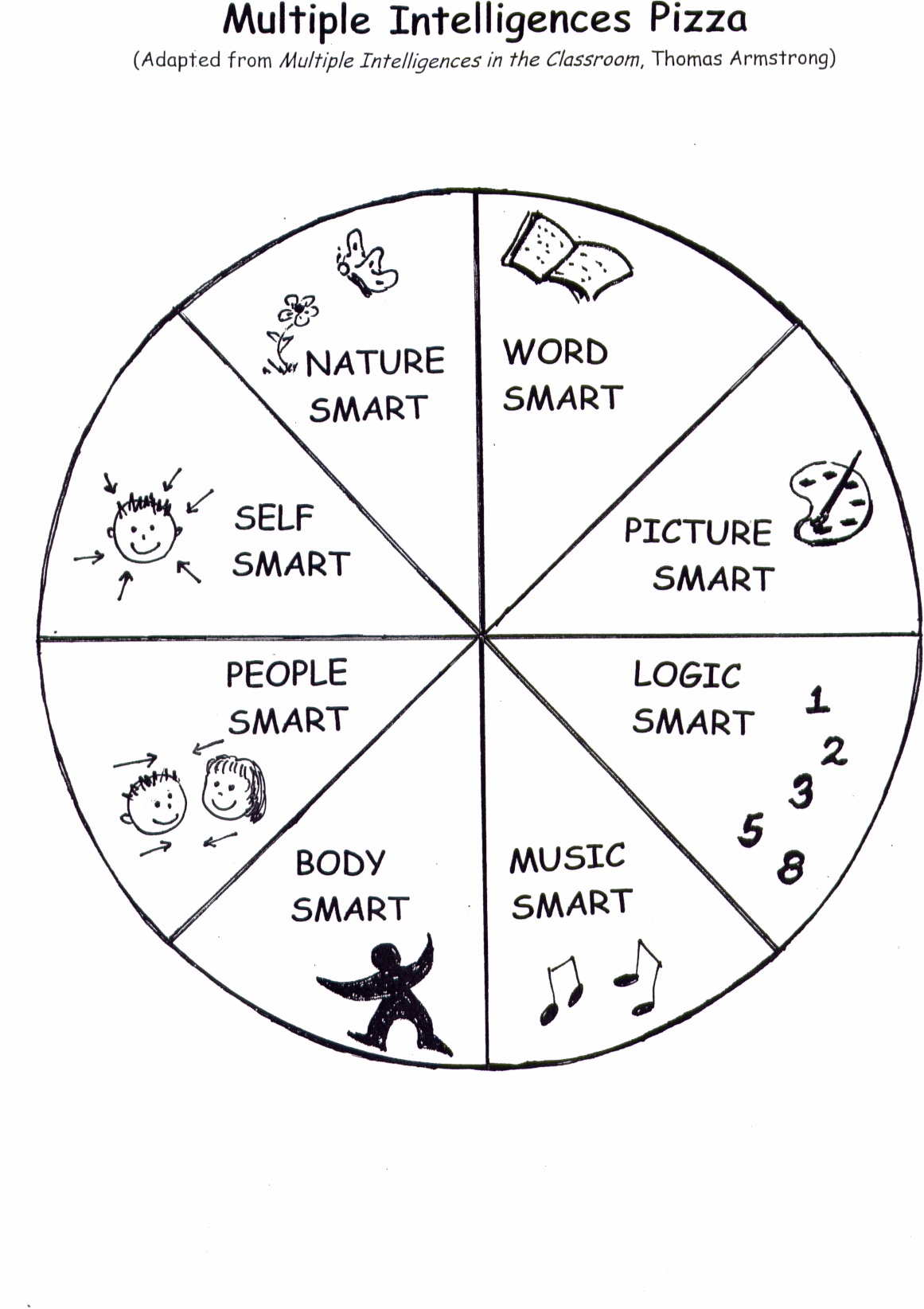
Later, Dr. Thomas Armstrong took this theory and made it even more practical for teachers of children by creating the following MI Pizza! (We’ve adapted it from the original.)  He referred to each intelligence as a way of being “smart.”

MIPizzaEach student learns in different ways.  Some learn best through words, as in the Word Smart category above.  Other students learn best through visual support such as pictures and photos.  Some learn well through music, while others learn best by moving.

Of course, it is difficult for us to know how each of our students learn best.  Therefore, the best way to approach MI in the classroom is to provide as many ways to learn as possible in each of our lessons.  Here are some guidelines to consider as you plan tomorrow’s lesson, based on the MI Pizza shown above:

1.  Word Smart:  Are you providing strong Word support?  Write words on the board, even if students are pre-readers.  When you speak the words, say them slowly, quickly, or with different voices and emotions.  Play with words!  Use poems, tongue twisters, onomatopoeia (words formed from actual sounds, such as “bark,” “clap,” “giggle,” “splash,” “whisper,” and many others), and alliteration  (such as “skipping skeletons,” “blue bouncing balls,” or “Walter is washing windows.”)

2.  Picture Smart:  Are you providing a lot of visual support for the language you are teaching?  Most children are strong visual learners, so illustrations and photos are important for comprehension and retention of language.  In addition, when you write letters or words, draw close borders around them so that students become aware of their shapes.  Picture books and art activities are also an important part of every lesson.

3.  Logic Smart:  Patterns are important for learning.  Find ways to present language in patterns to tap into a child’s sense of logic.  Many chants and songs use patterns.  So do “pattern predictable” books that repeat words, phrases, and language in fun ways.  Give students opportunities to solve word problems or puzzles that use logic.

4.  Nature Smart:  This type of intelligence is also logical, finding similarities and differences in the world around us.  Look for opportunities to “classify” and “categorize” vocabulary.  For example, have students put food words into groups such as fruits and vegetables. You can also put some words in chronological, or “time” order, such as a butterfly’s life cycle:  egg, caterpillar, chrysalis, and butterfly.  Thinking logically helps students learn better.

5.  Music Smart:  There is more and more research being done about the power of music to help learning.  Young learners are natural singers, so bring music into every lesson.  Songs and chants help students to learn and remember target vocabulary and phrases.  The steady beat in music helps students develop fluency and proper intonation.  Use musical sounds such as “snap,” “clap,” “pat,” and “stamp,” as you chant with children.  In addition, use transitional songs to help children move quickly from one activity to another (see our blog post below about transitional songs).

6.  Body Smart:  Closely tied in with music is “movement.”  Children love to move, and in fact they learn better by moving.  For example, making letter shapes with their fingers, their arms, their whole body, and together with friends can help students remember those letters better.  Moving to commands (Total Physical Response) helps students learn a variety of action verbs.  Add movement to the songs and chants you use in the classroom.  Any opportunity to move will bring greater learning and motivation into your classroom.

7.  People Smart:  Children are social beings.  A language classroom should be a place where children interact using English in a variety of ways.  Songs, chants, and activities can be done first with the entire class, then with small groups, then with partners.  Non-competitive games, folk dances, and role plays all help students to learn and achieve goals together.

8.  Self Smart:  Finally, give your students a chance to personalize their learning through creative activities such as individual art projects that use the target language.  Give individual students opportunities to think of their own ways to make letter shapes or move to action verbs.  By personalizing what they have learned, students make English a lasting part of their lives.

These eight “ways of learning” can and should be combined as often as possible in your lessons.  Very often, the best and most successful activities bring all of these “ways of learning” together in one event.  In future blog posts, we’ll give you some examples of these activities and how you can use them effectively.  Until then, keep a copy of the MI Pizza in your lesson planner, reminding you to bring many ways to learn into each and every lesson.

Happy Teaching!   Chuck and Kathy

Magic Time Webinar: How to give every kindergarten child the chance to learn English successfully

Chuck and I are going to be leading a webinar this week for teachers of very young learners. It’s really exciting for us to do this and share ideas with teachers. If you’d like to join us, just follow the link to sign up. 

Dates: 25th and 28th September 2013

Times: 12:00 – 13:00 and 07:00 – 08:00 (BST)

Speakers: Kathleen Kampa and Charles Vilina

 This webinar draws on content from the Magic Time course.
  • What are Multiple Intelligences?
  • How can I use Multiple Intelligence strategies with my young learners?
  • How can I bring my lessons to life with big pictures, picture cards, songs, chants, and movement?
  • How does a good kindergarten course differentiate learning so that all my students are successful?

Join Magic Time authors, Kathleen Kampa and Charles Vilina to learn practical answers to these questions and find out more about giving every child in your class the chance to learn English – and enjoy it!

Here’s the link!

http://elt.oup.com/events/global/How_to_give_every_kindergarten_child_the_chance_to_learn_English_successfully?cc=gb&selLanguage=en&mode=hub

How Can You Build English Throughout a Lesson? Use Transitional Songs, Part One

DotIn any children’s class, many activities are needed to keep students happy and motivated throughout the lesson.  Transitional songs are a perfect way to signal to children that one activity is ending and another is beginning.  A good transitional song also has other benefits:

  1. It supports the natural rhythm and intonation of the phrase or sentence you are using.
  2. The melody is quickly learned and recognized by students, so they move into action as soon as they hear it.
  3. In most cases, children can be encouraged to sing along, building group cohesion as well as productive language skills.
  4. Transitional songs soon become part of a classroom routine, giving students a sense of structure and making them feel secure during the lesson.

Today, for Part One, we present three transitional songs that help to make activities smooth and enjoyable for students. The lyrics for each of the transitional songs are included below with a simple recording.  A professional recording is now available on “Jump Jump Everyone.”

1.  Let’s Make a Circle

Many language activities work well with students seated (or standing) in a circle.  This transitional song quickly motivates children into forming a circle in the classroom.

Let’s Make a Circle  (copyright © 2012 by Kathleen Kampa and Charles Vilina)

(melody:  Skip to My Lou)

Let’s make a circle big and round.

Let’s make a circle big and round.

Let’s make a circle big and round.

Everybody please sit down. (or Let’s make a circle big and round to remain standing)

2.  Come and Sit in Front of Me

This transitional song works well when you want students to sit as a group in front of you, perhaps for a storytelling session.

Come and Sit in Front of Me  (copyright © 2012 by Kathleen Kampa and Charles Vilina)

(melody:  Muffin Man)

Come and sit in front of me,

In front of me, in front of me,

Come and sit in front of me,

In front of me.

3.  Cards, Please!

Many activities involve the use of picture cards for language support. After the activity is over, this transitional song gets the picture cards back to you quickly and efficiently.

The song is sung as a dialogue between the teacher and students.  The word cards can also be changed to any other item that needs to be collected (papers, crayons, etc.)

Cards, Please!  (copyright © 2012 by Kathleen Kampa and Charles Vilina)

(melody:  Skip to My Lou)

T: Cards please.   Ss: Here you are.

T: Cards please.   Ss: Here you are.

T: Cards please.   Ss: Here you are.

All: Thank you very much!

You can sing these transitional songs in your classroom.  The songs are also professionally recorded here on “Jump Jump Everyone.”  Check out the link on iTunes .

Mimi CD cover 2015-10-12 at 1.04.43 AM

This album has lots of movement songs which are important for young learners growth and development.  Contact Englishbooks.jp or me (magictimekids@gmail.com) to order CDs.


Celebrate success! CCBA . . . Catch Children Being Amazing!

DotTeachers have regular opportunities to observe classroom behavior.  Bad behavior can be disruptive, of course.  However, when we focus on our students’ successes and describe the great things they are doing, we can create a positive classroom culture that minimizes bad behavior.  Chuck and I call this strategy CCBA — Catch Children Being Amazing!

Here’s what to do when you catch a child being amazing:

1.  Refer to the student by name.  

2.  Name the task that the student is doing.

3.  Describe the behavior that you want other students to notice and imitate.

For example: 

I see that Natalia and Carlos have opened their books and are already writing their stories.

I see Mariko making a big ‘M’ using her whole body.  At first she made a small ‘m’ with her fingers, but now she thought of another idea.  

I can hear Jiwoo singing all of the words to our song.  She is pointing to the picture cards, too.

Students work harder when they know that their hard work doesn’t go unnoticed.  Celebrate your class successes with this chant.  Songs and chants help build a positive classroom atmosphere.  This celebration chant really builds team spirit!
We Did It!

(from Magic Time, by Kathleen Kampa and Charles Vilina, © Oxford University Press 2012)

We did it!  We did it!  We did it today!

We did it!  We did it!  Hip, hip hooray!

Melody Roll Call!

Dot

When we begin a new English class with a group of young learners, we want to guide them toward the following goals from the very beginning:


1.  We want students to get to know everyone’s names.

2.  We want students to develop the confidence to respond independently.

3.  We want students to respond as a group.

4.  We want students to become comfortable with singing in class.

Fortunately, we can achieve all of these goals by beginning each class with a melody roll call.  It’s so catchy, students will learn it by the second week and expect it by the third.  It requires the simplest of melodies:  Sol – Mi – Sol – Mi  and Sol – Mi – Do

Teacher:    Where         is          Mariko?       (Sol – Mi – Sol – Mi)

Mariko:       Here           I             am!             (Sol – Mi – Sol – Mi)

If a student is absent, then the entire class chimes in!

Teacher:    Where         is          Kenta?        (Sol – Mi – Sol – Mi)

Class:         I               don’t        know!         (Sol – Mi – Do)

Our students love beginning each class with this activity.  It also demonstrates the power of music in supporting pronunciation — within one month every student is articulating the words (including the contraction don’t) with native precision.  Try it tomorrow, even if your class has been together for a while!