Skeleton Dance is definitely one of my students’ favorite songs! It teaches various body parts and directional movements. You can start your school day with it, use it during break time, dance it on a rainy day, move during a health unit, or dance it on Halloween. I have taught Skeleton Dance to students in kindergarten through upper elementary, and everyone enjoys it. I’ve also shared this song with teachers in America, Japan, Korea, Mexico, Taiwan, Thailand, Vietnam, and Indonesia.
You can watch some of my students here in Japan doing the Skeleton Dance, and read the lyrics below:
Here’s how you do the Skeleton Dance:
In this song, students will move four different body parts: shoulders, elbows, knees, and feet.
First, students move their shoulders to the beat.
1. Move your shoulders . . .
A. Skeleton, skeleton, skeleton dance, Move your shoulders, do the skeleton dance. Skeleton, skeleton, skeleton dance, Move your shoulders, do the skeleton dance.
Next, students move their whole bodies to the front, to the back, and to the side. I usually start by moving only my arms, but my students love to jump in each direction.
B. To the front, to the back, to the side, side, side, To the front, to the back, to the side, side, side,
Next, students move their shoulders up, down, and around. Each time they repeat the song, they will move a different body part in these directions.
C. Put your shoulders up. Put your shoulders down. Move them up and down and all around. Put your shoulders up. Put your shoulders down. Move them up and down and all around.
Finally, students move their shoulders in their own way.
This dance is repeated with the following body parts.
Before I play the music, my students and I figure out how we’ll move up, down, and around using each of these body parts.
2. Move your elbows . . .
3. Move your knees . . .
4. Move your feet . . .
You can download this song from iTunes (Track #15) or CD Baby.
I hope that your students enjoy this as much as mine do.
While our summer was filled with many opportunities to enjoy the nature of Minnesota, it was also a busy time of successfully completing my MA degree. Now we have time to share many more ideas with you!
On our second day back at school, my Grade One students found a giant grasshopper outside of our classroom. It was as big as a praying mantis. We took it into our classroom. What an exciting way to begin our new school year!
Giant grasshopper
Children are fascinated with living creatures–especially insects and other mini-beasts. While some children may be a bit timid about holding certain insects, most seem to enjoy them.
Here are a couple of activities that you can easily do in your classroom.
1.Simple, Invented Songs
It’s easy to nurture creativity in young learners through music. Try “playing” with words.
Here’s a simple pattern to create a song or chant.
Students choose three insects for their song, usually one shorter word, and two longer words.
When young children sing, they often use so and mi in their invented songs. You can use so and mi for this song, too.
My students think it’s funny to sing the negative form of this. I don’t like ______. I hate bugs!
Another activity to help students play with words is to repeat the first consonant of a word, such as /b/ /b/ /b/ /b/ Bees! Bees!
2. Stories
I love using stories with my students–especially predictable ones. A predictable story uses repetition, similar to the way a song might have a chorus. It might have repeated words, phrases, sentences, and other patterns. New characters, new events, and other surprises keep the children guessing about what’s going to happen next.
Story: The Very Busy Spider by Eric Carle
This story shows how a spider gradually spins a web. In my edition of this book, students can also feel the change in the web as it gets bigger. You can read the book to your students in a traditional manner, but you can use the pictures in the book like flash cards to help you tell the story.
A. Pre-read by looking at the pictures of the animals in the book. You can chant this pattern, or sing it to the melody of “The Farmer in the Dell.”
The horse says “Neigh!” The horse says “Neigh!” Let’s play together. “Neigh! Neigh! Neigh!”
Many animals visit the spider, but the spider continues to spin the web.
Repeat with the other animals from the story (cow, sheep, goat, pig, dog, duck, rooster).
The cow says “Moo!” The cow says “Moo!” Let’s play together. “Moo! Moo! Moo!”
The phrase for the rooster is longer than the rest.
“Cock-a-doodle-doo!” “Cock-a-doodle-doo!” Let’s play together. “Cock-a-doodle-doo!”
B. Now add the following chant pattern.
(But the spider said . . . ) Sorry. I’m busy. I’m spinning a web. Busy, busy, busy. I’m spinning a web.
Add gestures to help children remember the language. Change your voice to express the sounds of the animals.
C. Now I “read” the story by showing the children the pictures of the animals and singing the animal songs. I show students the web in the book. With a small class, students can feel the texture of the web on the page. On subsequent readings, you can draw the web on a whiteboard as the story progresses by drawing a couple of lines at a time. If your students can sit in a circle, you can even create a yarn web by passing a ball of yarn from one student to one across on the other side.
D. At the very end, an owl comes and the spider is sleeping.
Whisper . . . .
The spider was busy, but she’s sleeping now. Sh! Sh! Be quiet! She’s sleeping now.
*Another fun predictable story with insects and animals is Lily and the Moon by Mari Nakamura and Patricia Daly Oe.
3. Find It!
You can look for insects outside with your students. You can also find them in books! In Magic Time One, Unit One, Annie and Ted are outside playing. In addition to finding the target vocabulary, students can look for animals and insects on these pages too. They can find a dragonfly, grasshopper, rabbit, turtle, frog, squirrel, bird, butterfly, and caterpillar. We love to add little surprises for the students to discover.
Enjoy this season of insects and mini-beasts! Happy teaching!
Image courtesy of stockimages / FreeDigitalPhotos.net
Do your students enjoy learning vocabulary? It is certainly one of the first steps in learning a new language. A few simple strategies can help our students learn vocabulary meaningfully and productively.
Presenting the new words
Picture cards can be a very effective way of introducing vocabulary. One method is to point to a picture, say the word, and ask students to repeat it. However, this is a passive approach that doesn’t motivate children to learn — and it doesn’t build their deeper thinking skills.
One approach that provides active learning and deeper thinking is as follows. Let’s assume you are introducing words from Magic Time One Unit 10, which introduces the following pets:
rabbit dog turtle bird frog cat
Before class, attach the picture cards for this vocabulary to the board face down (with the back of the card facing the students). Explain to students that you have six pets that you want to introduce to them.
Peel back the first card to secretly look at the first pet. Turn to the students as you imitate the shape or movement of the animal (such as a hopping rabbit, the wagging tail of a dog, or a slow-moving turtle).
Some of your students may know the English word for the animal, and will call out its name. If they do so correctly, nod yes and reveal the card. If not, say the word as you do the action (for example, say frog as you jump like a frog). Then reveal the picture card. When you show the picture card, say the word twice, first pointing to the picture, then to the written word beneath it. Continue in the same way with all six cards.
Another way to do this would be to bring in stuffed animals, pulling them slowly out of a bag until students are able to identify them. You may also do a “slow reveal” of the picture card, sliding it up from behind a book until students are able to guess what it is.
The above activities allow students to tap into their prior knowledge – this will tell us what they already know. It also gets them to think about the subject of pets – as they guess the animals, their brains are thinking about which animals could possibly be pets. This simple activity then becomes a critical thinking activity that engages students far beyond memorization.
Producing the new words
In the next activity, we want to move to more productive skills – with our students actually using the language. Remember that this can take time – students need to move through the receptive stage first. However, this activity motivates them to use the language more quickly.
Let’s assume you are using the set of words from Magic Time One Unit 11, which introduces family members:
grandmother mother sister grandfather father brother
Let’s also assume that we have taught these words using one of the activities described above. Our next goal is to get our students to produce these words while using their critical thinking skills.
Attach the family picture cards in random order across the board so that students can see the family members. Then draw a simple picture of a girl on one side of the board, and a picture of a boy on the other side. Ask students to tell you which picture cards belong on which side. This requires students to say the words (grandmother, father, etc.) as they point to them. Then attach the picture cards under the boy or girl, but not in any particular order.
Next, invite students to pair up the family members. To do so, point to the mother card as students say mother. Move the card to the top of the board as you say “mother and . . .” Students point to the father card as they say the word father. Then place the two picture cards together on the board. Continue in the same way with sister – brother and grandmother – grandfather.
Students can each have their own set of six picture cards, which they can make themselves, or which can be copied from the Magic Time Picture and Word Card Book. You can ask students to classify the cards at their desks, in the two ways described above. You can also ask students to classify and arrange the cards in other ways — from oldest pairs to youngest pairs, for example, or in ABC order. With other picture card sets (such as classroom items), students can arrange the items in other ways, such as from biggest to smallest.
Songs and chants
In Magic Time, we also practice vocabulary by putting the words into chants and songs. This gives students an opportunity to produce the language as they chant and sing along. It also helps students build comprehension of the words. Chants and songs make learning fun and memorable.
Predicting and producing vocabulary
Finally, for Magic Time users, the following activity is very engaging for students, allowing them to predict, think about what they know, and use the language productively. This is normally done after the chant is taught to the students:
On the first and third pages of each unit in Magic Time, students are asked to “Listen and write the number.” Normally, students listen as the narrator on the CD says, “Number One,” followed by a word. Students then write the number “1” in the white circle next to the correct picture in the large scene. This serves as an assessment to see what students know. Click on the link below to see sample pages from Magic Time One Unit 7.
To make this activity more productive, first put the six picture cards on the board facing the students. Draw a white circle next to each picture card. Pause the CD, and ask students to guess what they think “Number One” will be. Each student needs to point to a picture card and say the word. Write each student’s name beside the picture cards they choose. Then listen to what the narrator says on the CD for “Number One.” Of course, students are listening very closely to see if their guess is correct. If so, they cheer! All students then write the number “1” in the correct white circle in their student books. With the CD paused, students then try to guess the second word, and so on. You can keep track of each student’s correct guesses if you wish. With a large class, this activity can be done with partners or with teams.
These are just three ways to get your students to think more deeply as they use the vocabulary words meaningfully and productively. These activities go beyond simple memorization and comprehension – they allow students to tap into their prior knowledge, to understand relationships, and to predict. They require active participation and active learning, which means happier and more engaged students.
Can you nurture creativity while building English language skills? Yes, you can!
An important part of creative thinking is to generate many possible solutions. This is easy to do with young learners. Here is a simple activity and chant that you can use to help develop creative and imaginative thinking with your young learners.
Introducing Vocabulary
1. Show students (or draw) a picture of a circle. Say, What is this? Can you make this shape with your fingers?
2. Point out the various ways that your students are making circles. For example:
Yuri is making a tiny circle using her thumb and pointer finger. Can you do that?
Daniel is using all of his fingers to make a circle. Let’s try that, too! We can make circles in many ways.
3. Say, Can you make your circle bigger? Can you make a circle with a friend?
4. Repeat the three steps above using other shapes. I usually show shapes in the following order because some are a little easier to make than others.
circle
triangle
heart
rectangle (two long sides, and two short sides)
square (four equal sides)
star (five points)
Remember, it’s important to take time making these shapes with your students before putting them into the chant.
My fingers, fingers, fingers, fingers, fingers dance!
My fingers, fingers, fingers, fingers, fingers dance!
Make a circle. Take a picture. Click!
Make a circle. Take a picture. Click!
Now, let me break it down so that you know the movement for each part.
1. My fingers, fingers, fingers, fingers, fingers dance!
My fingers, fingers, fingers, fingers, fingers dance!
(For this part, students have fun wiggling or “dancing” their fingers.)
2. Make a circle.
(Students make the shape with their fingers.)
3. Take a picture. Click!
(Students look through the shape at a classmate, and pretend to take a photo.)
(Repeat steps 2 and 3.)
(Students then substitute the other shapes in this chant.)
You can use any shape picture cards to teach the vocabulary. I used the picture cards from Magic Time 1, Unit Two, for my video. Feel free to add your own shape ideas, such as diamonds, ovals, etc.
Here’s a video I’ve prepared to show you how the chant is done. Just click here. You can also find a studio version of this chant on iTunes by clicking here.
This chant is also on my new album Jump Jump Everyone, available on iTunes. Physical CDs are also available.
In my last post, I explained two ways to teach this song. Here’s a video of my students sharing this dance with you. You can find the lyrics in my blog post “Hop Along Easter Bunny.” If you like this music, check out my CD Kathy Kampa’s Special Days and Holidays, available on iTunes and CD Baby.
(Note: This is our second blog post on transitional songs. Our first blog post, entitled “Transitional Songs Part One,” was posted on September 23, 2013. Please scroll down this page to our earlier blog posts to find it, or simply click here. Thanks!)
In any children’s class, many activities are needed to keep students happy and motivated throughout the lesson. Transitional songs are a perfect way to signal to children that one activity is ending and another is beginning. A good transitional song also has other benefits:
It supports the natural rhythm and intonation of the phrase or sentence you are using.
The melody is quickly learned and recognized by students, so they move into action as soon as they hear it.
In most cases, children can be encouraged to sing along, building group cohesion as well as productive language skills.
Transitional songs soon become part of a classroom routine, giving students a sense of structure and making them feel secure during the lesson.
Today, for Part Two, we present a variety of transitional songs that help to make activities smooth and enjoyable for students.
1. Open Your Books
This song is a great way to motivate students to open their student books to the correct page.
Open your books. Please open your books. (gesture)
(Spoken) Turn to page _________.
(Write this page number on the board, or show the number with your fingers. Hold the book open to show the page to students, then check to be sure all students are ready.)
Open your books.
2. Let’s Make a Line
This transitional song quickly motivates children to form a line in the classroom, either for an activity or when they are preparing to leave the classroom.
This is a great chant to use when students need to find a partner. Demonstrate this chant with one student first. Decide how students will show that they are partners. They can stand back-to-back, touch palms, sit facing each other knee-to-knee, etc.
Practice finding partners before you actually do your activity.
(Note: The following transitional songs can be found on our blog post entitled “Transitional Songs, Part One.” Please scroll down to our earlier blog posts to find these songs and the recordings for them, or simply click here.)
When I was a little girl, we made “Fortune Tellers” to play with our friends. We used our homemade fortune tellers to write messages about things that might happen when we grew up.
Your students will love this game. It’s easy for students to put into their pockets and play wherever they go. You can practice any vocabulary or grammar by adapting the game in this way.
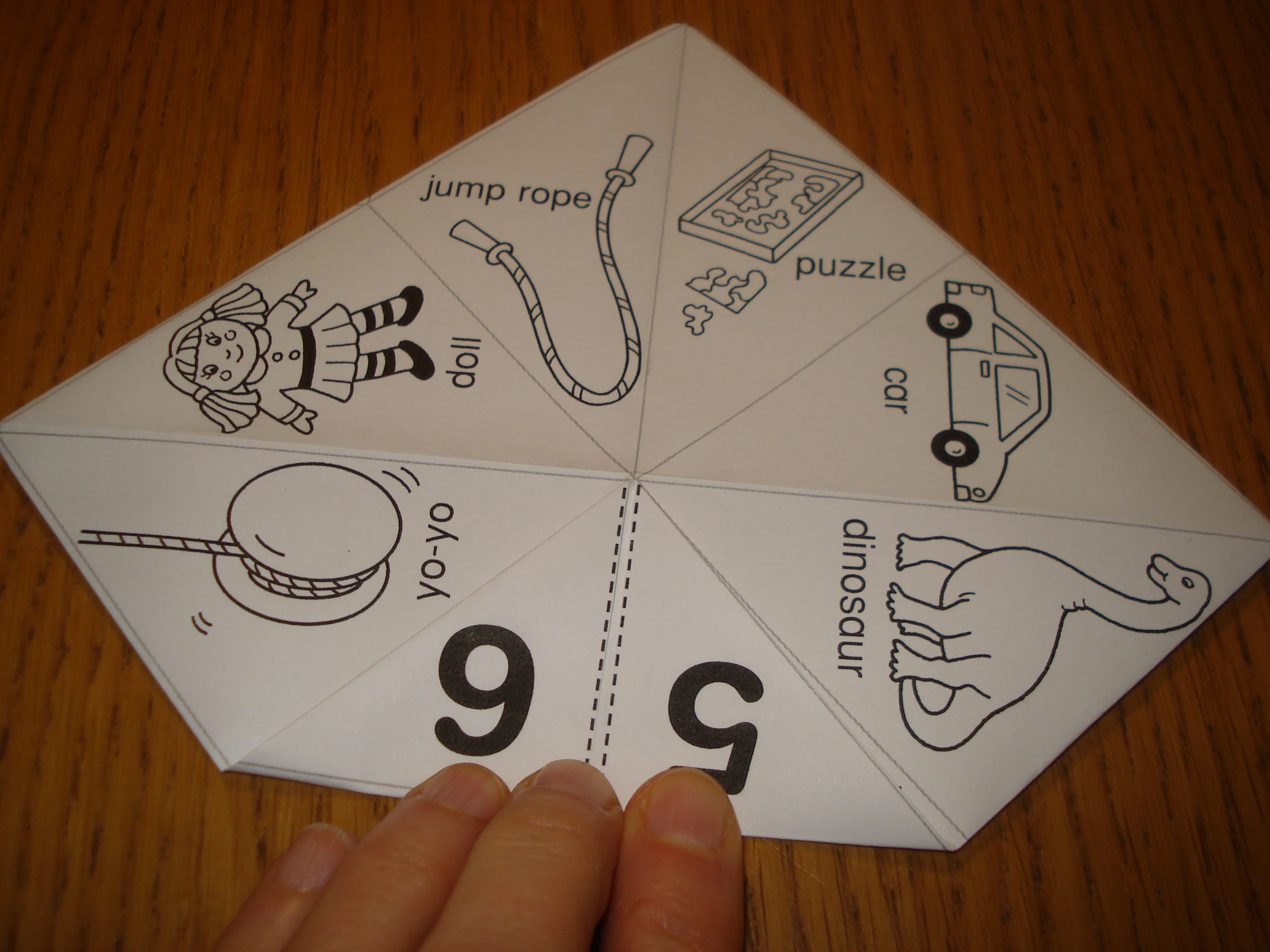
Here’s an example of a fortune teller from Magic Time 2, Unit 5, Teacher’s Book reproducible by Oxford University Press. Once you understand how this fortune teller works, your students can create their own. This unit focuses on toys with the phrase “I have a _________.” They can expand it to “You have a ________.”
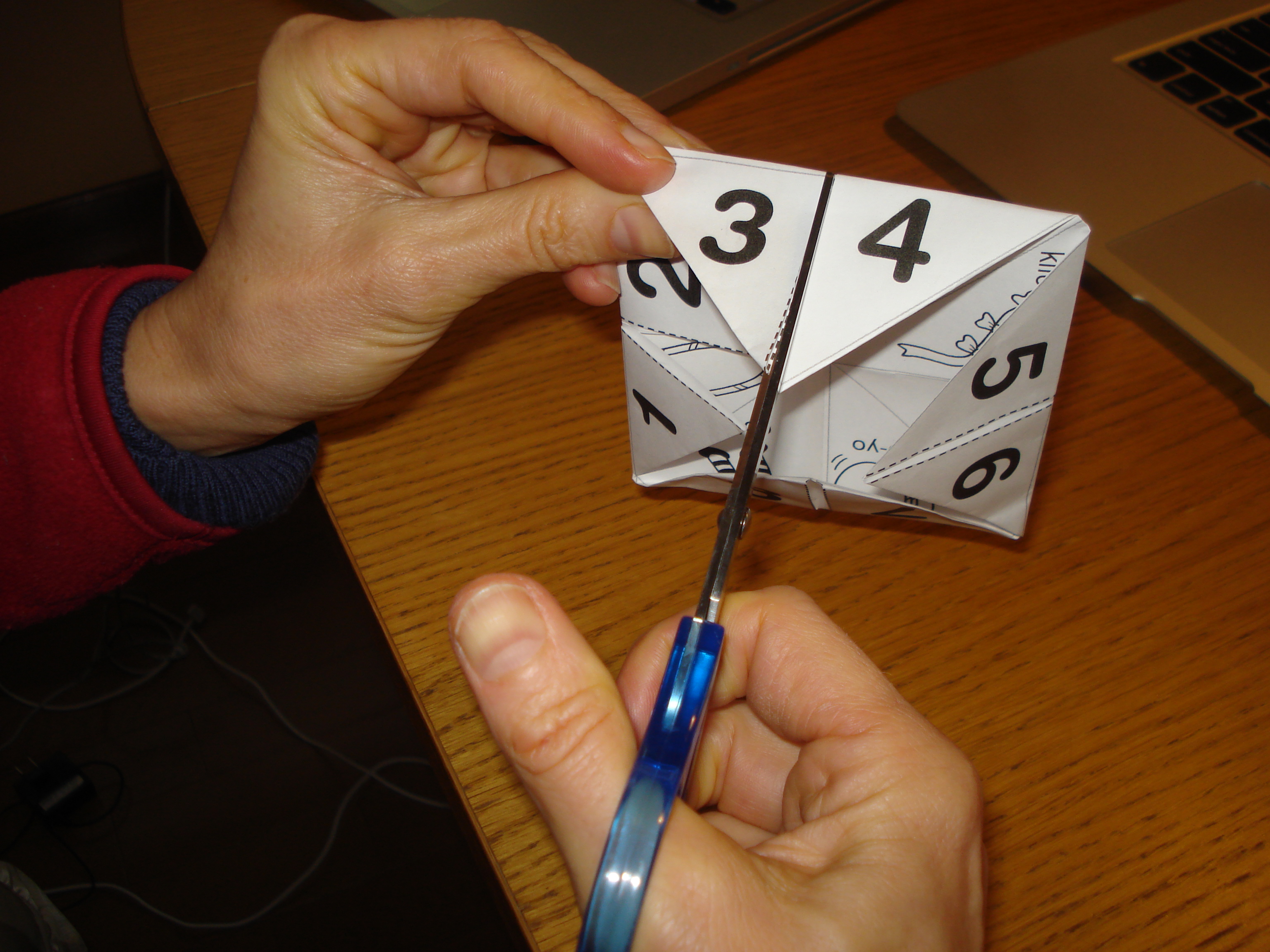
3. Copy one sheet per student. Students cut out on the dotted lines to create a square.
a. To begin, have students fold the paper in half.
Open and fold in half the other way. This makes folding easier. (See below.)
b. Turn paper over. Find the middle point. Fold the corners to this middle point. Crease well.
c. Turn the paper over again. Fold the new corners to the middle.
d. Find the numbers. Cut up from the point up to the fold between each of the numbers (1 and 2, 3 and 4, 5 and 6, 7 and 8).
e. Now fold it in half so that you can put your thumbs and pointer fingers into the four openings at the bottom.
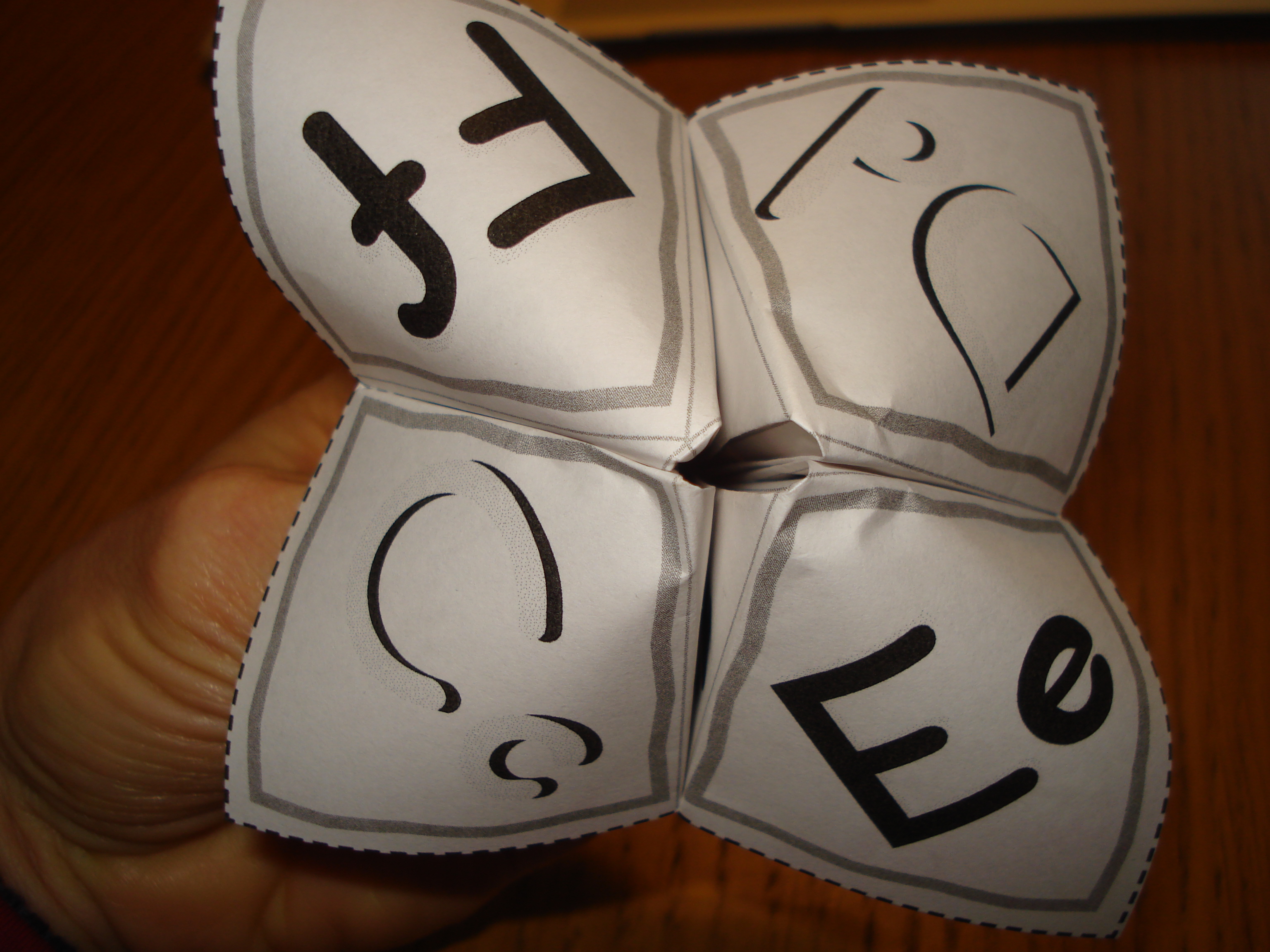
f. Bring the points together. Then open and close the fortune teller.
To play the game:
A: Asks, “Which letter?”
B: Says (for example), “C.”
A: Moves the fortune teller three times, and says, “A-B-C.”
A: Shows the inside of the fortune teller, and asks, “Which number?”
B: Says (for example), “4.”
A: Moves the fortune teller four times, counting to 4.
A: Shows the inside of the fortune teller again, and asks, “Which number?”
B: Says (for example), “7.”
A: Says, “You have a yo-yo!”
With a little creativity, you can add more language to these dialogues. With this fortune teller, students can imagine that they’re celebrating a birthday.
A: “Happy Birthday. This toy is for you! It’s a yo-yo!”
B: “Thanks a lot!”
Or they can pretend to be Santa, saying “Ho, ho, ho! Merry Christmas. Here’s a yo-yo for you!”
To make your own fortune teller, do your folding first. Then open it up and add numbers, pictures, words, etc. Instead of counting or saying the ABC’s, more advanced students can spell out words.
Keep me posted . . . I’d love to see how your creativity builds upon this idea in your classroom.
My nieces like to dress up as black cats for Halloween.
I love Halloween! It’s a time of year when students can enjoy expressing their ideas. They’re encouraged to use their imaginations and can pretend to be many different characters.
How can your students use their imaginations?
First, you can encourage students to create movements like Halloween characters. For example, students can make a pose while sitting. Then, they can do movements around a circle. Finally, you can let them move freely around an open space. For shy students, demonstrate some simple ideas. Soon they’ll be creating their own ideas.
Students can also use their imaginations with costumes or props. With a scarf, a student can turn into a prince or princess, ride a witch’s broomstick, or become a spooky ghost. Pieces of fabric can be used over and over again and made into various costumes. Show students photos of children dressed up to go trick-or-treating. Although many companies sell fancy costumes, I have fond memories of creating costumes from things we had around the house.
Here’s a Halloween song I wrote entitled “I’m A Witch.” It prompts students to imagine that they’re different Halloween characters. To teach this song, sit with students in front of you.
(Use the transitional song: Come and sit in front of me . . .)
Show students images of each of the characters in the song — a witch on a broomstick, a ghost floating in the air, a bat flying in the air, an owl sitting in a tree, and a black cat creeping. Using visuals is important — especially for students learning English. This is an important first step in learning the vocabulary in the song.
Here’s a simple version of the song. (A more professional version is available below.) You can listen to the song while showing students these pictures.
Spoken: Let’s be witches and fly on our broomsticks.
Hee! Hee! Hee! I’m a witch!
Hee! Hee! Hee! I’m a witch!
Hee! Hee! Hee! I’m a witch!
Happy Halloween!
Spoken: Let’s be ghosts and float gently through the air.
Boo! Boo! I’m a ghost! (3X) Happy Halloween!
Spoken: Let’s be bats and fly through the night sky.
Eeek! Eeek! I’m a bat! (3X) Happy Halloween!
Spoken: Let’s be owls and turn our heads from side to side.
Whoo! Whooo! I’m an owl! (3X) Happy Halloween!
Spoken: Let’s be black cats. Put on your whiskers and sneak around.
Meow! Meow! I’m a black cat! (3X) Happy Halloween!
Now students can stand in a circle, move around the circle, or move freely around the classroom. Hold up pictures of each character. Before playing the music, I like to practice movements for each of the characters. You may want to share your own ideas. Just remember that if you demonstrate the movement first, your students are more likely to copy your ideas.
Here are some suggestions:
Witch: Students pretend to fly on broomsticks by holding their hands in front of their bodies and galloping.
Ghost: Students move their arms smoothly up and down, while walking in curvy pathways around the room.
Bat: Students pull their elbows in to create small wings. They move quickly around the room. My students also like to pretend they’re sleeping bats by folding their arms in and creating an upside-down pose.
Owl: Students stand in one place with their arms down. They turn their heads from side to side.
Black Cat: Students pretend to have whiskers, paws, and a tail. They sneak around with tiptoeing movements. I remind them to be “kind cats.”
Whenever students are moving in your classroom, check to make sure that everything is safe. Push chair legs in, and move things out of the way.
Now play the music! My students love moving freely about the room while they hear the cues. I remind them to stop after each character, and listen for the new cues. I hope that your students have as much fun as mine do with this song!
The professional version of “I’m a Witch” is available on iTunes and CDBaby. Just click on the title below:
In any children’s class, many activities are needed to keep students happy and motivated throughout the lesson. Transitional songs are a perfect way to signal to children that one activity is ending and another is beginning. A good transitional song also has other benefits:
It supports the natural rhythm and intonation of the phrase or sentence you are using.
The melody is quickly learned and recognized by students, so they move into action as soon as they hear it.
In most cases, children can be encouraged to sing along, building group cohesion as well as productive language skills.
Transitional songs soon become part of a classroom routine, giving students a sense of structure and making them feel secure during the lesson.
Today, for Part One, we present three transitional songs that help to make activities smooth and enjoyable for students. The lyrics for each of the transitional songs are included below with a simple recording. A professional recording is now available on “Jump Jump Everyone.”
1. Let’s Make a Circle
Many language activities work well with students seated (or standing) in a circle. This transitional song quickly motivates children into forming a circle in the classroom.
Many activities involve the use of picture cards for language support. After the activity is over, this transitional song gets the picture cards back to you quickly and efficiently.
The song is sung as a dialogue between the teacher and students. The word cards can also be changed to any other item that needs to be collected (papers, crayons, etc.)
You can sing these transitional songs in your classroom. The songs are also professionally recorded here on “Jump Jump Everyone.” Check out the link on iTunes .
This album has lots of movement songs which are important for young learners growth and development. Contact Englishbooks.jp or me (magictimekids@gmail.com) to order CDs.





 MagicTimeKids