Discover the parts of a flower with this magical fingerplay

When I was living in Japan, springtime was filled with one beautiful flower after another. We could find flowering trees (especially plum and cherry blossoms), purple and blue hydrangeas, wisteria, tulips, rapeseed, azaleas, and lots of roses.

Now we’re living in Minnesota. It’s been too cold for anything to start blooming yet. Once it warms up, however, we can find gardens filled with colorful flowers–zinnias, daylilies, purple coneflowers, hollyhocks, daisies, bee balms, and more. This year we’re going to plant a pollinator garden to help the bee and butterfly population.

The kindergarten children at my former school learned about living things. They planted seeds and watched them grow. Look at a real plant with your students. Look at the stem, the leaves, the buds, and the flowers. Do all plants have the same types of leaves? Buds? Flowers? What do they look like? If you don’t have a real plant, you can often find a silk one at a bargain store. I like to show students a watering can, too. This graphic showing how to plant from a Garden of Goodies (Pinterest) may be helpful.
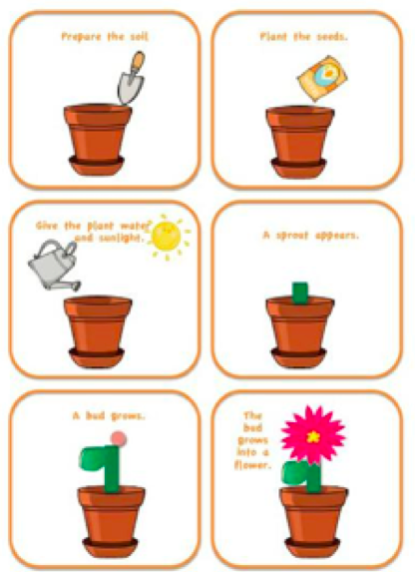
Looking at how seeds changed into a flower

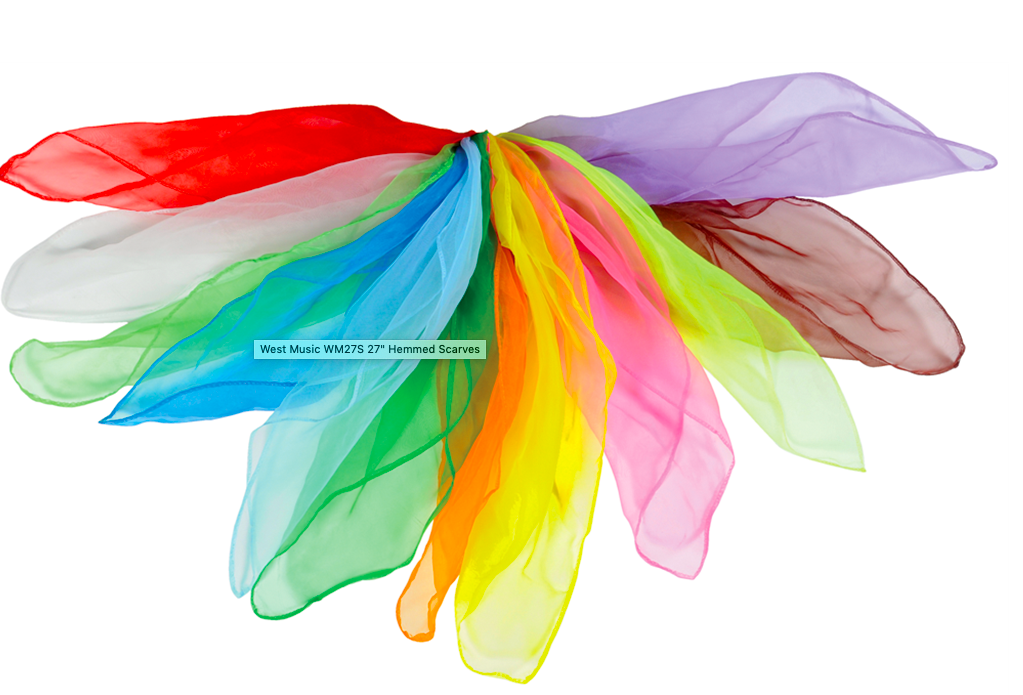
My students loved this poem called Here’s a Leaf! They would ask to do it over and over again. Yours will, too! You’ll see the magic when you try it. I use small, lightweight hemmed scarves like these. Search for “hemmed scarves” or “juggling scarves.” Check the reviews. I like mine! These scarves expand beautifully for this poem. Young children can practice naming the color, too.
Screen Shot 2020-03-19 at 16.55.57

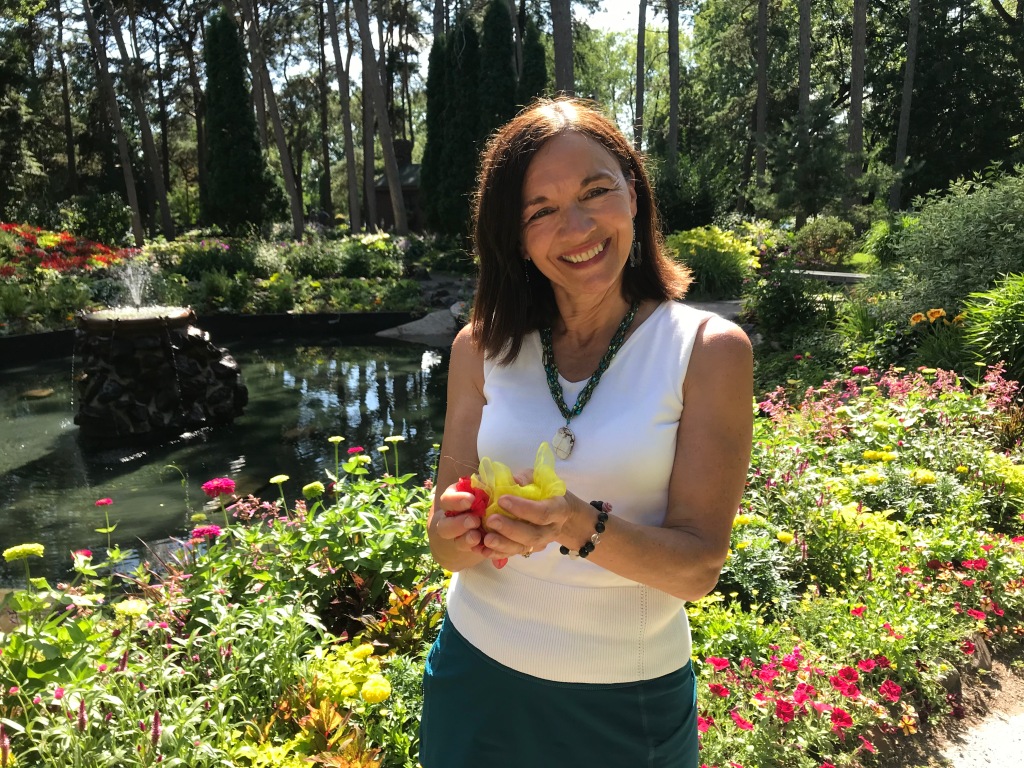
In my video, we take you to Munsinger-Clemens Gardens, one of my favorite places in St. Cloud, Minnesota. Special thanks to my son, Christian Vilina for his awesome video work.

To begin, scrunch up the scarf in your hands, so that it can’t be seen. Here’s the video to show you how you might do it.

Here’s a Leaf (also known as The Flower Poemadapted by Kathy Kampa

Available on iTunes (Jump Jump Everyone)

Children listen and answer.

Here’s a Leaf video

Do you have a scarf? (Yes!) 

Let’s scrunch up our scarves. (tsch, tsch, tsch, tsch . . . . .)

(Scrunch up the scarf in your hands so that it’s not visible.)

Is your scarf very tiny? (Yes, it is!)

Are you ready? (I’m ready!)

Let’s pretend.

Let’s plant a seed in the dirt.

(Bend down and tap the ground, pretending to plant a seed in the dirt.)

Water it!

(Pretend to water the seeds by tipping your hands.)

Watch it grow and grow and grow.

(Stand up slowly.)

Now show me your thumbs. Here we go.

Here’s a leaf, and here’s a leaf.

(Pretend that your thumbs are leaves. Wiggle one thumb, then the other.)

Count them. 1-2.

(When you count 1-2, move your thumbs up and to the side.)

Here’s a bud.

(Open your hands slightly to reveal the scrunched-up scarf.)

Here’s a flower,

(Open your hands a little more.)

blooming just for you.

(Open your hands and let the scarf ‘bloom’ like a flower.)

Hooray!

(Toss the scarf into the air!)

Let’s grab our scarves and do it again!

For more kid-tested music and movement activities, check out my music on iTunes.
Jump Jump Everyone
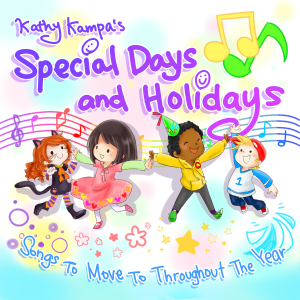
Kathy has produced two music CDs for very young learners, Kathy Kampa’s Special Days and Holidays and Jump Jump Everyone, which build English language skills through movement while nurturing creativity and imagination! Grown and loved by real kids!

Kathy Kampa is a teacher, author, and teacher-trainer specializing in working with young learners. As a PYP (Primary Years Program) teacher, she uses a globally-minded and inquiry-based approach to teaching through which students develop 21st-century skills. She also supports the development of English language skills by creating songs, chants, and TPR/movement activities targeted to young learners’ needs.

Kathy and her husband Charles Vilina are also co-authors of Magic Time, Everybody Up, Oxford Discover (ELTon winner), Beehive/Buzz (2022), Blue Dot (2024), all published by Oxford University Press.

Thanks again to my son Christian Vilina for his vision in creating this video.

Images: “Easter Lily” by Recherché Furnishings is licensed under CC BY 2.0

Two-Two-Two-Two-Two

February 22, 2022 is a historic day–it’s 2/22/22! AND it’s on a Tuesday, yes, that’s TWO’S-DAY.

I wrote a little song called “Two-Two-Two-Two-Two” to celebrate this auspicious day.

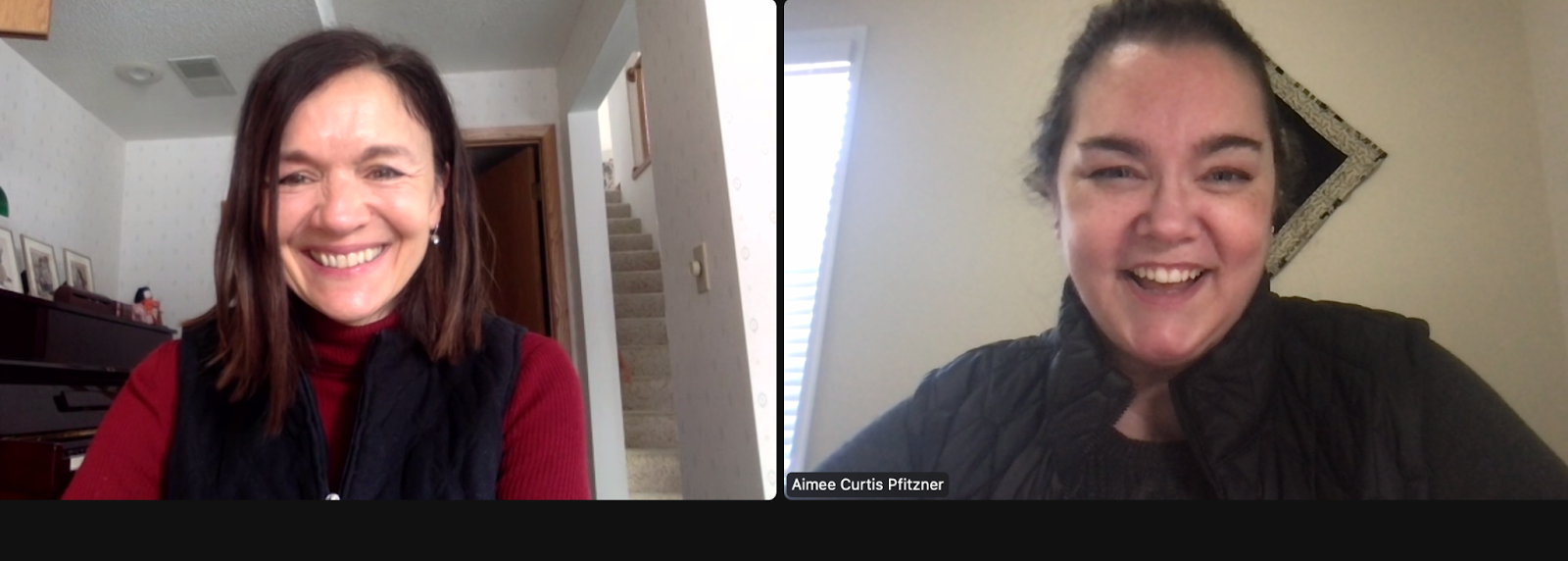
One of the wonderful outcomes of the pandemic was meeting amazing teachers online, like Aimee Curtis Pfitzer. Aimee is a passionate musician, songwriter, and teacher. She’s constantly creating. She has written numerous books with Beatin’ Path Publishing. Check her out at www singsmileplay.com. So I reached out to Aimee to collaborate with me on this little song. Here’s our Zoom photo!

In this blog post, you’ll find the song lyrics, the notation, accompaniment, and a video with movement suggestions. We hope that your Tuesday, February 22, 2022 will be amazing!

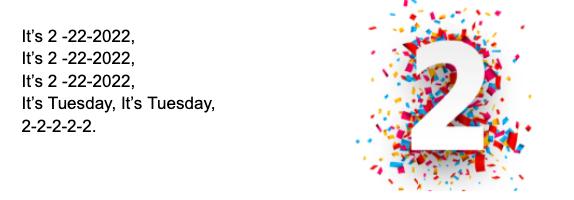
Here are the lyrics:

Two, Two, Two, Two, Two!

Here’s the musical score for the song with the words written out. Thanks to Aimee Curtis Pfitzner for creating this score.

Have fun by adding some movement! Hold up two fingers. Make the shape of the number 2! Add some 2 count patterns by clapping, patting, stamping, and snapping. Grab your “tutu” if you have one!

Here’s a slow version of the song “Two, Two, Two, Two, Two” using hand gestures.
Here’s the faster version using “body percussion.” I made a pattern–pat, clap, pat, clap-clap.

Here’s the “karaoke” accompaniment on Chrome music lab. It’s fun for your students to see how the melody is moving. We’ve made two versions, a slower tempo and a faster one. If you have Boomwackers, your students can play this.

Slow version: 80

https://musiclab.chromeexperiments.com/Song-Maker/song/5761674782441472

 Fast version: 105

https://musiclab.chromeexperiments.com/Song-Maker/song/4818068420689920

Chrome Music Lab – Song made Feb 12, 2022

Join the fun and have a very happy 22222!

Kathleen’s two CDs for young learners, Kathy Kampa’s Special Days and Holidays and Jump Jump Everyone, build English language skills through music and movement while nurturing creativity and imagination.
 
Kathleen strives to help all students feel supported, balanced, and successful in the classroom. She supports the development of English language skills by creating songs, chants, and movement activities targeted to young learners’ overall needs.

Jump, hop, tiptoe . . . this CD invites children to move and use their imaginations. Grab a scarf and pretend to be a butterfly or a flower. Make the sounds of the rain on your legs. Children move in developmentally appropriate ways.
This album is filled with songs to celebrate the special days in your child’s life–a birthday, a loose tooth, plus lots of holidays. Songs prompt fun movement for kids.

It’s the Year of the Ox

The festivities are beginning for Chinese New Year! This is the year of the ox! Why not celebrate with your students by using this simple chant/song!

During the pandemic, many students have not been allowed to sing. So enjoy these lyrics as a chant.

It’s The Year by Kathy Kampa

Part A:

It’s the year of the ox,

It’s the year of the ox,

It’s the year of the ox,

It’s 2021!

Part B:

o-x  ox!

o-x  ox!

o-x  ox!

It’s the year of the ox!

Try some of these movement suggestions. My students like making the animal shapes for each year of the Chinese calendar. I ask my students for their ideas. To make the shape of an ox, many of the students made horns with their fingers.

How can your students show the year 2021? My students liked to “draw” the numbers in the air. Some of them made numbers with their fingers. A few of them just decided to jump up into the air to celebrate!

My students really love making these letter shapes! If your students aren’t used to making letter shapes, you can model this activity. Students make letters with their fingers, their arms, or even their whole bodies!

Let’s make the letter o with our fingers. Can you make it bigger? Try using your hands? Can you make the letter o even bigger? Wow! You can make it with your whole body! Now let’s try making the letter x in the same way.

Put these all together into a chant. Add instruments if you like to really make it festive!

If you’re interested in a melody to sing this, check out my simple video here. I’ve combined two familiar songs to create this new song.

Check out Kathy Kampa’s Special Days and Holidays for songs to celebrate your child’s special days–Valentine’s Day, Easter, a birthday, or even a loose tooth!

Children’s songs for special events for pre-school, kindergarten, and elementary students

Let’s Celebrate the New Year 2021!

images-1 Happy New Year 2021! We have celebrated O-shogatsu (New Year’s) with toshikoshi soba and o-sechi ryori, traditional New Year’s foods.  A couple of days ago my friend Kumi stopped by with her children. They had the song “Happy New Year” playing in their car. It fun to hear them singing along with with it. What a precious moment!! When our son Christian was in elementary school, he started playing this simple melody on our piano.  Now he’s grown up and is acting in Hollywood! I love this recording with Christian and my husband Chuck singing it at home for you:.


Happy New Year

Words and Music by Christian Vilina and Kathleen Kampa  © 2013

Happy New Year!  Happy New Year!

Happy New Year!  Happy New Year!

Happy New Year!  Happy New Year!

Happy New Year!  Hip hip hooray!

How should we move with this song? When students first listen to the song, they might like to jump, march, or twirl around.

When I first teach the words to this song, students keep a “steady beat” by patting their legs or clapping their hands. Then, to make it a little more challenging, students can create a pattern by patting their legs once, then clapping their hands. Think “pat-clap-pat-clap” or “down-up-down-up.” Do this for the first three lines.

We like to do something special on the last line:

—  On Happy New Year!  my students like to shake their hands above their heads. Some students like to turn around quickly!

—  On Hip hip hooray! students roll their hands, then jump once in place.

For an even bigger challenge, students can do the pat-clap pattern with a partner by patting their own legs, and then “air clapping” both hands with a partner.

Check out this pre-COVID video to see what my students did a couple of years ago! Students stand in a circle facing their partner. First they pat their own legs, then clap with their partner. Then they turn to the person on the other side (called a “corner” in folk dance), repeating the pat-clap. They repeat the pattern with their partner, then corner until the Hip hip hooray

With COVID protocols in place, I’m going to revise this activity. Every student has a set of sticks, so I’m going to experiment using sticks like the Indian Dandiya dance. This will give students a chance to interact with a partner at a distance. Perhaps you have an idea for adapting this? 

Happy New Year 2021!  So perhaps you’re not singing with your students. Remember my chant.Screen Shot 2021-01-05 at 17.13.38

We hope that you keep a song in your heart and a smile on your face. May this year be filled with lots of joy!

Kathy

Special Days and HolidaysHappy New Year is one of 15 great songs for kids on Kathy Kampa’s Special Days and Holidays. The CD includes a handy attached booklet with lyrics, and is available for teachers in Japan at ETJ Book Service.
For teachers residing outside of Japan, the songs are available for download through iTunes. To hear the studio version of this song, go to iTunes, and click on Track #3. CDs are also available for sale through the Mad Robin Music & Dance in Seattle, WA.


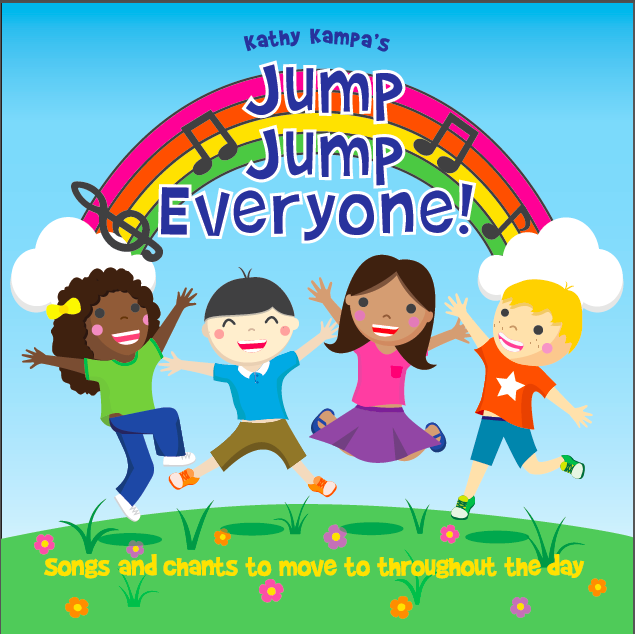
Kathy’s second CD Jump Jump Everyone is filled with songs to get students moving! Songs and chants build Cover screen shotEnglish language skills through simple movement activities. They nurture a child’s imagination and creativity.  There are beautiful seasonal songs, lively gross motor movement songs, plus effective transitional songs. Grab a scarf and play along. Grown in the young learner classroom, you’ll find that your children will ask for these songs over and over again.

 

Run, Run, Run!

happy kids , jumping
I teach very young learners. I love the energy that these students bring to my class!  The question is how to harness that energy productively.  This chant from Magic Time One 2nd edition (OUP) is perfect for very young learners.

In the lessons prior to this, students learned about various pets, such as cat, dog, rabbit, bird, turtle, and frog.  (Actually the artwork shows additional pets that the children find in the pictures). The four verbs in this lesson are jump, run, hop, fly.

First of all, students practice each of the four verbs–jump, run, hop, fly–standing in one place.  It’s also important for young learners to learn “Stop!”  It’s fun to make it a game by saying these verbs several times (Jump! Jump! Jump!), and then “Stop!”  You can do this with music by starting and stopping the music.  When my students, they love to make interesting poses, too.

Secondly, put these four words into the chant pattern.  I like to do this as a fingerplay sitting with the students.

For jump, place two fingers in your palm, then pretend to “jump.”

For run, make your fingers move quickly in your palm.

For hop, place one finger in your palm, then pretend to “hop.”

For fly, move your fingers in the air.

You can place the four picture cards in the order of the song like this.  Put the three verbs in one row, and run in another.

Jump           Hop                Fly

              Run

You can see in the video that my students matched the animals to the picture cards.

Run, Run, Run! from Magic Time One 2e Unit 10

Jump! Jump! Run, run, run!

Jump! Jump! Run, run, run!

Jump! Jump! Run, run, run!

Jump! Jump! Stop!

Change jump to hop.  Then change to fly.

Here’s a video of some of my very young learners performing this chant.

Students extend this language by putting it into the phrase, It can _______.  Students are then able to talk about all of the pets they’ve learned about.

Have fun!!!

Frequency Adverbs

Yes, this is an unusual post for this blog! I have been asked by many teachers to write about the game I created to practice frequency adverbs.JM-03292016-Healthy-pranje_auta_4.jpg

The goal of this game is to practice frequency adverbs (never, sometimes, usually, always) with everyday chores. You need one dice and a set of “chore”  flashcards. The chores in Everybody Up (published by Oxford University Press) include the following: wash the car, take out the garbage, water the plants, vacuum the carpet, sweep the floor, clean the bathroom. If you don’t have chore flashcards, you can certainly make up your own list.
This game works well in groups of three to four students.

My students decided that the numbers on the dice would represent the following words or choices.

1 never
2 sometimes
3 usually
4 always
5 my choice
6 my classmate’s or teacher’s choice

Place a set of flashcards for chores (from Everybody Up, Level 3, Unit 6) in the center of the group. The first student rolls the dice, then picks a “chore card.”

dice-style-cube-with-heart-pattern_fkc9iiooIf the student rolls the number 2 (sometimes) and picks the chore card “wash the car,” the student says “I sometimes wash the car.”
If the student rolls the number 5, he/she can choose which frequency adverb to use.

If the student rolls the number 6, he/she can ask a classmate or teacher to choose which frequency adverb to use.

After each person’s turn, other students might ask if the statement is true or false. When a student says, I always make my bed, the others ask, Is it true?

To expand the practice, change the pronoun from “I” to “he“or “she.” Using these pronouns requires the use of the third person “s.” If a student rolls the number 4 (always) and picks the chore card “waters the plants,” he/she says, “She always waters the plants.”

Here’s a link to a short video of my students playing this game. I hope that you enjoy it!

What Day Is It?

happy children group in school
Students love to make letter shapes with their bodies.

Learning the names of the days of the week in English can be tricky.  For many of us, we teach our English class on the same day each week.  This song “What Day Is It?” is a fun way to practice the days of the week.

First of all, write a letter on the board or show a picture card.  Model making that letter with your fingers, arms, or whole body.  Make the letter so that students are able to read it. You might imagine how that letter would look when you write it on your whiteboard. Students will be able to “read” your letter. Invite students to make letters with you.  They might even make letters with the entire class! Try making letters in many different ways.

We started at the beginning of the alphabet.  Students made  A, a, and B, b (see B below).  In Magic Time (Oxford University Press) students have fun making letter shapes to learn the letter name and its sound.

Now write the names of the days of the week.  Run your finger under the word as you say it (Sunday). Point out the first letter. Encourage students to make that letter with their bodies in several ways.  Remind students that days of the week begin with capital letters. As you can see, sometimes the letters appear flipped around to us.  The important idea is that students are making the letter shapes.

I love to catch my students making their amazing letters by taking photos. Remember CCBA (Catch Children Being Amazing!)

Pass out the “days of the week” cards, one to each student. Students line up in order around the circle starting with Sunday.  Students make the initial letter shape as they sing  each day of the week.  When they sing “Tra la la la la” add a group movement, such as pat your knees, clap your own hands, clap your “neighbor’s” hands.

What Day Is It? 

from Magic Time Two, Unit 8, Use the Words

What day is it?

Today is Sunday.

Today is Sunday.

Today is Sunday.

Tra la la la la.

*repeat with the remaining days of the week

Here are some of my students demonstrating this song.  Come and join them!


Happy New Year!

Japanese Sheep
Japanese Sheep

Happy New Year! All around the globe the new year is celebrated in different ways. Here in Japan people celebrate o-shogatsu, the new year, with many special traditions. One of the important traditions seen all over the country is the celebration of the new animal for the year. This year it is the year of the sheep. Perhaps you’re familiar with the Chinese calendar of twelve different animals.

At our first class this week, we’ll begin by wishing everyone a Happy New Year 2015, the year of the sheep. I wrote a simple song to teach the year and how to spell the word “sheep.” We had fun creating a recording for you at home with our son Christian.

It’s The Year 

lyrics by Kathleen Kampa Vilina, melody (For He’s a Jolly Good Fellow/ BINGO)

sung by Christian Vilina

Intro:

Baa, baa, black sheep,

Have you any wool?

Yes, sir, yes, sir.

Three bags full.

It’s the year of the sheep.

It’s the year of the sheep.

It’s the year of the sheep.

It’s 2015!

s-h-e-e-p, s-h-e-e-p, s-h-e-e-p,

It’s the year of the sheep.

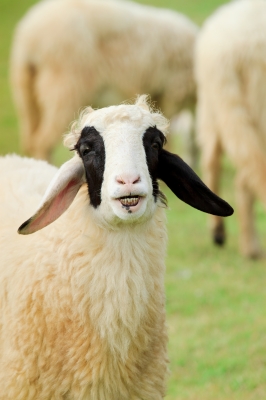
1. Show students the picture of a sheep.

 Image courtesy of TCJ2020 at FreeDigitalPhotos.net
Image courtesy of TCJ2020 at FreeDigitalPhotos.net

When they sing the word “sheep” they can make a pose like a sheep or point to the picture. If you have lively students, they might enjoy skipping or galloping during this part of the song instead.

2. On the words, “It’s 2015,” students stop moving and make the numbers 2015 with their fingers. Very young students can stop and wave their arms in the air as if saying “Hooray!”

3. Write the letters for the word “sheep” on the board. Clap the rhythm below to accompany the letters. (slow, slow, quick quick, slow)

UnknownUnknown images-1Unknown

To make it more challenging, students can pat, stamp, or snap the rhythm. My students like to clap the first time they spell “sheep,” then they pat their legs, and finally they stamp their feet. If you have instruments in your classroom, you can play this part.

4. The song ends with “It’s the year of the sheep!” Students make the sheep pose, or point to the picture.

———————————————————————————————————————-

You can also celebrate the New Year with our song, “Happy New Year!” I wrote it with our son Christian, and it is always a hit with our students. You can find it on Kathy Kampa’s Special Days and Holidays. The lyrics are easy for students to follow.

Students like to pat their legs, then clap their hands to the beat.

On the last Happy New Year, they turn around and wave their hands.

Happy New Year!

Happy New Year!  Happy New Year!

Happy New Year!  Happy New Year!

Happy New Year!  Happy New Year!

Happy New Year!  Hip hip hooray!

ms kampa 12-8

Making the Most of Student Performances

varandah freedigitalphotos

Image courtesy of varandah / FreeDigitalPhotos.net

For many teachers around the world, this is the time of year when students perform holiday songs at school. For me, I’m busily preparing my students for a performance, too. What are some things you do to prepare for this event?

  1. Choose a song that students are able to perform. Look at the vocabulary. Check out the grammar structures. Is there enough repetition for young learners? Does the melody stay within a comfortable singing range?
  1. Now let your students listen to a few different songs that fit these requirements. Which one do they like best?
  1. To teach a song, I make sure that my students understand the background and the vocabulary first. I use visual images when possible. Creating a rebus reading with pictures and sight words is an easy way to begin learning a song.
  1. Next, I add simple movements to help students remember the words. Young learners are especially successful with this approach. If you are new to using movement with your students, you may need to show them some movements first.

*To build creativity, ask students for their ideas for movement. For example, in the song “It’s Christmas Time,” students have words for senses, such as hear, see, smell. I show them a picture, and ask all of my students to share an idea of how they might show these words. Then we look at the nouns, such as jingle bells, Christmas tree, and gingerbread. Can we make a pose or movement? I might say, “A few people, like Kenji and Yuta, are moving like this. Let’s try it.” Students are so proud when we choose their movement.

  1. I often have a “slow” practice by saying the words and doing the movements. Students stand on “double dots”– a place where they will stand and sing. I use two of the same colored dots or colored tape. I write down where each child will stand.
  2. DSC00021Then we speed things up with the music and the movements. I stand in front of my students and lead them in singing and moving. Model enthusiasm!
  1. Finally, we take turns. Half of the students perform while the other half becomes the audience — their mommies and daddies. The audience practices clapping. The singers practice bowing at the end. (Bend over: I see my shoes. Stand up: I see my mom and dad.)
  1. Throughout this time, you must be thinking about simple costumes that will make your song come alive. Asking students to come dressed in one solid color makes it easy to add things like a small picture hung on a ribbon around their necks, or a string of sparkly garland on their heads. If your students are getting dressed in costumes at school, make sure that everything is labeled with each child’s name.
  2. DSC_0314DSC_0312Now have a dress rehearsal. Here’s where I bring out a bunch of stuffed animals and put them on chairs. Practice introductions. Take a video and show the students. Make sure that the costumes work.
  1. Prepare a simple program. Our students often prepare their own art for the cover.
  2. Check to make sure everything is ready — music, chairs, instruments, programs, microphone, etc.
  3. Now it’s show time! Make sure that each child goes to the restroom beforehand. Give parents time to take photos and keep students calm.  Enjoy the moment!

Happy Holidays, everyone!

How Can You Build English Throughout a Lesson? Use Transitional Songs, Part One

DotIn any children’s class, many activities are needed to keep students happy and motivated throughout the lesson.  Transitional songs are a perfect way to signal to children that one activity is ending and another is beginning.  A good transitional song also has other benefits:

  1. It supports the natural rhythm and intonation of the phrase or sentence you are using.
  2. The melody is quickly learned and recognized by students, so they move into action as soon as they hear it.
  3. In most cases, children can be encouraged to sing along, building group cohesion as well as productive language skills.
  4. Transitional songs soon become part of a classroom routine, giving students a sense of structure and making them feel secure during the lesson.

Today, for Part One, we present three transitional songs that help to make activities smooth and enjoyable for students. The lyrics for each of the transitional songs are included below with a simple recording.  A professional recording is now available on “Jump Jump Everyone.”

1.  Let’s Make a Circle

Many language activities work well with students seated (or standing) in a circle.  This transitional song quickly motivates children into forming a circle in the classroom.

Let’s Make a Circle  (copyright © 2012 by Kathleen Kampa and Charles Vilina)

(melody:  Skip to My Lou)

Let’s make a circle big and round.

Let’s make a circle big and round.

Let’s make a circle big and round.

Everybody please sit down. (or Let’s make a circle big and round to remain standing)

2.  Come and Sit in Front of Me

This transitional song works well when you want students to sit as a group in front of you, perhaps for a storytelling session.

Come and Sit in Front of Me  (copyright © 2012 by Kathleen Kampa and Charles Vilina)

(melody:  Muffin Man)

Come and sit in front of me,

In front of me, in front of me,

Come and sit in front of me,

In front of me.

3.  Cards, Please!

Many activities involve the use of picture cards for language support. After the activity is over, this transitional song gets the picture cards back to you quickly and efficiently.

The song is sung as a dialogue between the teacher and students.  The word cards can also be changed to any other item that needs to be collected (papers, crayons, etc.)

Cards, Please!  (copyright © 2012 by Kathleen Kampa and Charles Vilina)

(melody:  Skip to My Lou)

T: Cards please.   Ss: Here you are.

T: Cards please.   Ss: Here you are.

T: Cards please.   Ss: Here you are.

All: Thank you very much!

You can sing these transitional songs in your classroom.  The songs are also professionally recorded here on “Jump Jump Everyone.”  Check out the link on iTunes .

Mimi CD cover 2015-10-12 at 1.04.43 AM

This album has lots of movement songs which are important for young learners growth and development.  Contact Englishbooks.jp or me (magictimekids@gmail.com) to order CDs.